
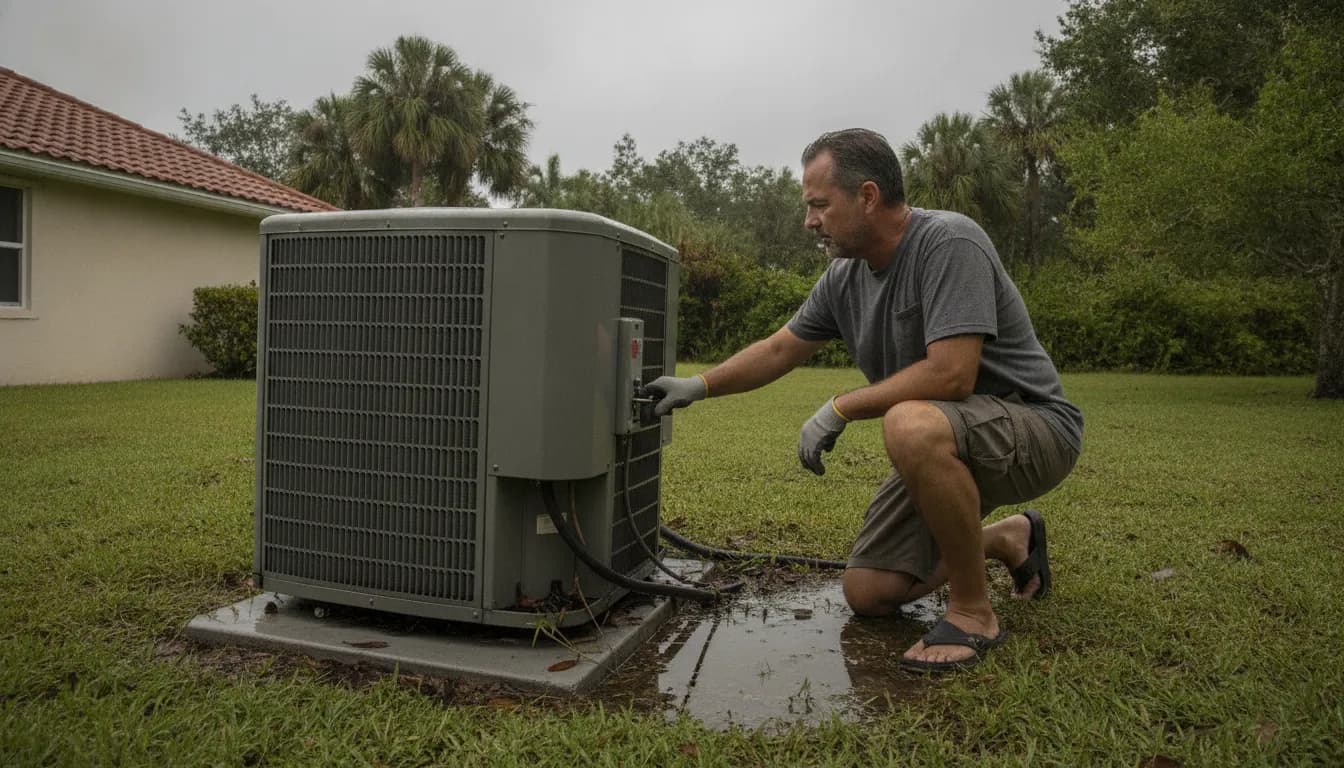
Severe summer storms can knock out electricity and leave Brevard County homes hot and humid in minutes. If your ac not turning on after power outage has left you stranded in the heat, we can help. You can read our AC and HVAC Symptom Diagnostics and Repair Guides for Florida Homeowners for quick troubleshooting tips.
Ready to get your cooling back? Contact Space Coast Cooling & Plumbing online or call (321) 631-5755 today.
An ac not turning on after power outage is a very common Florida problem that is usually caused by a tripped circuit breaker, safety delay, or surge damage.
During our hot and humid storm season, sudden voltage fluctuations can trip the main electrical breaker or trigger a built-in safety delay to protect the compressor component. A study in the National Institutes of Health shows that losing electricity and climate control during severe heatwaves can double the risk of heat-related health issues for homeowners.
You can try resetting the main circuit switch and checking your thermostat batteries, but if the unit still fails to start, it likely suffered electrical surge damage.
If your air conditioner will not run after a storm, you must find the exact cause before trying to fix it. We will guide you through the process of checking your system step by step. Let us look at Why Your AC Is Not Turning On After a Power Outage so you can find the root cause, and the path begins with:
Why Your AC Is Not Turning On After a Power Outage
A Florida storm can knock out power in seconds. When the lights at last come back on, you expect your AC system to start running. But sometimes, you find your ac not turning on after power outage. This issue is common after bad weather. It can leave your home hot and damp in the heavy Florida air. Learning why your system remains off is the first step to getting cool air back.
Tripped Circuit Breakers and Safety Locks
Your AC system uses a lot of power. When the power grid goes down, it can cause a large spike in current. This power surge can trip your main breaker to guard your home. A tripped breaker is the most common reason an AC will not start up.
You should first check your main breaker panel. You can find a complete AC troubleshooting guide for Florida systems to help you locate and reset this switch. If the breaker tripped, your unit will not get any power until you flip it back on. This simple step often solves the issue without any tools.
Thermostat Reset Needs and Built-In Delays
Your thermostat controls the system. A sudden power loss can reset your unit settings or drain its batteries. If the screen is blank, the system cannot turn on. Many modern units also use a built-in safety delay. This delay protects the compressor from rapid cycling when power flickers on and off. You may need to wait three to five minutes before you feel cool air. To test this, you can follow these AC troubleshooting tips to reset your control settings and batteries. Give your system a few minutes to clear this safety timer.
Electrical Surge Damage to Sensitive Components
When power returns after a storm, a sudden rush of current can flood your system. This big spike in voltage can burn the fine control boards or ruin the capacitor. Modern AC units are highly prone to this type of damage.
Based on a study on heat-related health issues, losing your cooling system during severe heat creates a serious health risk. If a surge fried a part like your capacitor, your outdoor unit may just hum. It will not start. In these cases, you will need a trained HVAC pro to test the electric parts and safely swap out any damaged pieces.
| Symptom You Notice | Likely Cause | Next Step to Try |
|---|---|---|
| AC does nothing at all when the power returns | Tripped circuit breaker or dead thermostat battery | Reset the AC breaker, then check thermostat power |
| Thermostat screen is blank | Lost power feed or dead backup batteries | Verify the breaker, then replace the batteries |
| Outdoor unit hums but the fan does not spin | Weak or failed capacitor | Call a pro to test and replace the capacitor |
| No sound at all plus a burnt odor | Surge damage to the control board | Turn the system off and call a pro right away |
Check the Circuit Breaker First: AC-Specific Reset Steps
When a storm knocks out your power in Brevard County, the rising heat can quickly turn risky. A study in PubMed Central shows that losing power during storms can double the risk of heat health issues. That is why getting your cooling running is so urgent. Before you call for help, check your breaker box first. Often, the cause of your ac not turning on after power outage is simply a tripped breaker.
Storm safety and flood risks
Before you touch any wires, safety comes first. Florida storms often bring heavy rain and local floods. If you see water near your breaker box, stay away. Standing in water near an electrical panel can cause a severe shock. Do not try a DIY reset if you see bare wires or flood damage. In these cases, stay safe and call a pro.
HVAC breaker reset steps
If the area around your panel is dry and safe, you can try to reset the system. You can also follow these AC troubleshooting tips if you suspect other issues. To reset your breaker, use this simple sequence:
- Find your main breaker panel. Look for the grey metal box on your wall. It is often in your garage, laundry room, or on an outside wall.
- Locate the AC circuit breaker. Scan the labels to find the switch marked AC, HVAC, or Air Conditioner. Most homes also have an outdoor switch box near the outdoor unit.
- Flip the breaker fully off. A tripped breaker often sits in the middle. Push the switch firmly to the OFF side until you hear a click.
- Wait for thirty seconds. This allows any stored power in the AC control boards to drain fully.
- Flip the breaker back on. Firmly push the switch back to the ON side. You should feel it click and stay there.
- Listen for the unit to start. Walk near the system and listen for a hum or click. A built-in time delay may keep it from starting for a few minutes.
- Verify your thermostat. Check the display to ensure it has power. Set the cooling mode to on and lower the setting.
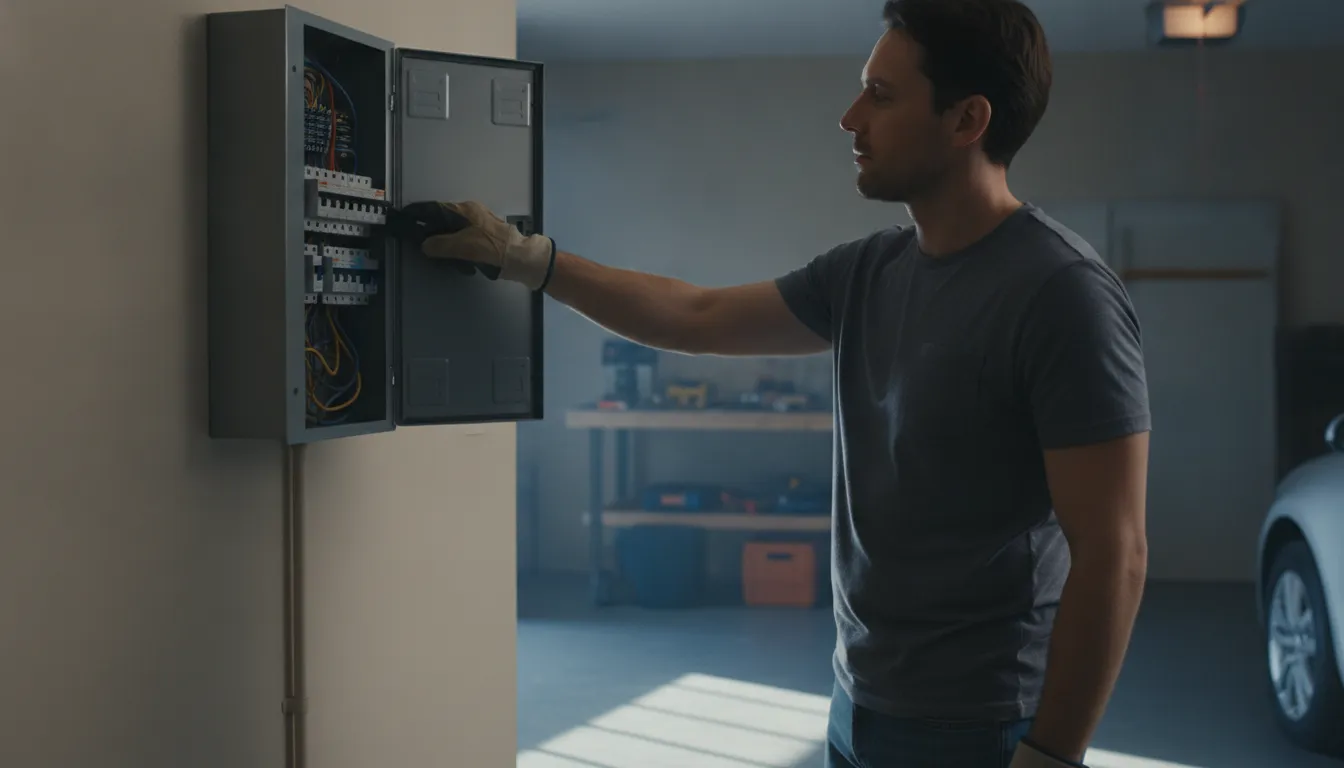
If your system starts, watch it to make sure it keeps running. If the breaker trips again right away, do not reset it again. This is a sign of a short circuit or a bigger electrical issue. In this case, call a pro to check your system safely.
Reset Your Thermostat After a Power Loss
When your cooling system does not start after a storm, a lost link in your control system is often the cause. Having your ac not turning on after power outage is stressful during hot Florida days. A loss of power during a storm can lead to a two-fold greater risk of heat-related illness. This risk makes a quick system reset vital for your home.
Blank thermostat screen
If your control screen is dark, the system cannot run. This issue often happens when the unit loses its main power feed. First, check your main circuit breaker panel to see if the switch for the air handler has tripped. If the breaker is on, you should check the thermostat batteries. Many units use standard double-A or triple-A batteries as a backup.
When the main power goes out, dead backup batteries will cause the screen to go blank. This prevents the thermostat from sending signals to your AC once power returns. You can swap the old cells for fresh ones to see if the screen lights up. If it is still blank, the wiring at the air handler might have a loose link.
Thermostat battery replacement
Replacing the batteries is a simple task that you can do in a few minutes. Most thermostat models let you slide the faceplate up and off the wall. Some have a small door on the side or bottom for the battery compartment. Be sure to use the right battery type and put them in the correct way. Once the new batteries are in place, snap the faceplate back onto its wall plate firmly.
System setpoint and connection reset
After you reset the power and batteries, you must restore your settings. The power loss may have cleared the memory on your device. Check that your thermostat is set to cool mode instead of heat or off. Next, set the target temperature at least five degrees below the current room temperature. This setting forces the thermostat to call for cold air.
If the system does not start right away, do not panic. Most modern AC units have a built-in time delay of three to five minutes to protect the compressor. If you still have no cold air after ten minutes, you may need a deeper look. A Space Coast maintenance plan can keep your system running its best. You can also contact our team for expert help.
Time-Delay Protection: Why Your AC Waits 3-5 Minutes to Restart
If you find your AC not turning on after power outage, do not panic right away. Your cooling system has built-in safety features to prevent major damage. After a storm or a grid failure, the outdoor unit usually waits for three to five minutes before it turns back on. This normal delay is a standard design, not a sign of a broken system.
The purpose of a short-cycle timer
This protective pause is controlled by a part called a short-cycle timer. When the power grid goes down or drops out, the system shuts down to keep its parts safe. When power comes back, the timer starts. It keeps the system off for a short window to prevent rapid power cycling. If the AC tries to start too quickly, the compressor can suffer severe stress or burn out completely.
Why your compressor needs protection
The compressor is the heart of your cooling system. It pumps refrigerant to cool your home, which needs a large amount of power. Power grid recovery after a storm is vital for restoring home comfort, as noted in studies of disaster response and grid function. But when power first returns, it often comes with voltage spikes. If the compressor starts up during a spike, high current can ruin the motor. The three-to-five-minute delay allows the voltage to settle before the system takes on this heavy load.
What to do during the restart delay
If your home power comes back on, do not fiddle with the thermostat buttons right away. Turn the AC to its "cool" setting and set the temperature to a standard level. Then, simply wait. If you try to force a restart, you might restart the timer, which only extends the delay. If the outdoor unit does not start after ten minutes, you should read our AC troubleshooting guide to find the next steps. A tripped breaker, a dead thermostat battery, or a blown fuse could also block the system from running.
Spotting Surge Damage to Your AC
If your AC system is still silent after a storm, the issue may go deeper than a simple trip of the circuit breaker. In Brevard County, Florida storms bring strong lightning and voltage spikes that can hurt home cooling units. High heat combined with a power outage can double your risk of heat illness, as noted by the National Institutes of Health. This threat makes it vital to find the root cause of your system issues quickly. If your efforts to reset the system did not work, you may have surge damage.
Signs of a failed capacitor
A power surge often hits the AC capacitor first. This small part works like a battery to start the compressor and fan motors. When a storm surge damages the capacitor, it may bulge or leak oil. If you have an ac not turning on after power outage, listen to the outer unit. A low humming sound with no fan movement points to a bad capacitor. It wants to start but lacks the needed power. If you notice these signs of a failing AC capacitor, the part needs a quick swap.
Burnt control boards
The control board is the brain of your cooling system. High voltage from a storm can burn the tiny circuits on this board. When this happens, there is no signal between your thermostat and the AC unit. Unlike a failed capacitor, a burnt board often results in total silence. You will not hear a hum or click when you call for cooling.
You might also notice a sharp, burnt odor near the indoor air handler or the outdoor unit. This smell is a clear sign that a short circuit happened. Modern systems have complex control boards that cannot take even small power spikes.
The dangers of DIY electrical work
It can be tempting to try to fix these issues yourself, but AC parts carry high voltage even when the power is off. Capacitors store power and can cause severe shocks if touched. For your safety, do not open the outer unit panels or touch the wiring. Always rely on a licensed pro to test and swap these parts. Safe and proper care keeps your system running and protects your home. Calling a trained pro is the best way to handle tricky HVAC repairs.
When to Call an HVAC Pro After a Storm Power Loss
Sometimes, simple steps like flipping a breaker do not solve the issue. If basic checks fail and your ac not turning on after power outage persists in our hot Florida climate, you need expert help. Studies show that losing power in hot weather leads to a two-fold greater risk of heat-related illness. Knowing when to stop trying to fix it yourself keeps your household safe.
Signs of system damage
Severe storms bring strong power surges that can fry inner parts. You may notice a burning smell near your outdoor compressor or indoor unit. A loud humming sound often means a capacitor is dead or the fan motor is stuck. If you see or smell these signs, turn off the system and call a pro right away.
Do not keep trying to run the system if it makes odd noises. Trying to force a damaged unit to start can turn a small repair into a big replacement. You can read our AC Repair Guide Florida to learn about common failures. Let an expert inspect the system.
Electrical and physical safety risks
Storms can cause severe electrical hazards around your home. If your breaker panel is wet, do not touch it or stand near it. Exposed wires or standing water around the outdoor unit are also major dangers. Wet electrical parts can cause shocks or fires if you try to work on them yourself.
If your circuit breaker trips again right after you reset it, stop and do not try to reset it a second time. A breaker that trips again and again is telling you there is a short circuit or overload. Forcing it to stay on can melt wires and start a house fire. Leave the breaker off and let an expert handle the issue.
Professional help for local homeowners
When storm damage leaves you without cooling, you need a local team you can trust. Space Coast Cooling & Plumbing has served Brevard County, FL, since 1994. We know how vital a working AC is during hot Florida summers. Our team offers 24/7 emergency service at (321) 631-5755, where a real person always answers.
Do not risk your safety or your system with DIY electrical repairs. Our licensed techs can find the root cause of your power issue fast. We will check your control board, compressor, and wiring to find the exact problem.
Need help after a storm? Contact Space Coast Cooling & Plumbing today to schedule a professional AC service visit.
Frequently Asked Questions
Why won't my AC turn on after a power outage?
Your system may fail to start due to tripped safety features, a blown fuse, or a tripped circuit breaker from an electrical surge. Sometimes the unit simply needs a manual reset to clear internal faults. A study on PubMed Central shows that losing cooling doubles your risk of heat-related illness. You must restore your home climate control quickly to stay safe.
How do I reset my AC unit after a power outage?
Start by turning off your system at the thermostat. Next, find your main electrical panel and flip the AC circuit breaker to the off position. Wait for about thirty seconds before flipping the breaker back to on. Finally, turn your thermostat back on and set it to cool. This manual reset clears simple system errors.
What should I do if my thermostat is blank after a power outage?
First, check if your system breaker has tripped and reset it. If the breaker is fine, check if your thermostat uses batteries and change them. A blank screen can also mean that your indoor AC unit drain pan is full. When water triggers the safety float switch, it cuts all power to the thermostat to prevent a flood.
How long should I wait for my AC to turn on after power is restored?
You should wait at least ten minutes after power comes back. Most modern AC units have a built-in time delay of three to five minutes. This delay protects the compressor from damage caused by rapid power cycling. If your cooling system does not start after ten minutes, you may need a manual reset.
Schedule a Professional AC Checkup and Restore Your Cool Air
Leaving your AC offline after a storm can quickly turn your Florida home into a hot box. Damp, hot air will settle in fast. This sticky air can cause mold growth and damage your walls. You do not want to wait and let the heat ruin your house. Do not let high heat put your family at risk. Getting a professional checkup now ensures your system runs safely. It also prevents costly repairs down the road. Our local team is ready to help you get cold air back today.
Ready to get your home cool and safe again? Contact our team today to schedule a professional AC checkup or emergency service call. We are here twenty-four hours a day to answer your call and help you stay cool.