
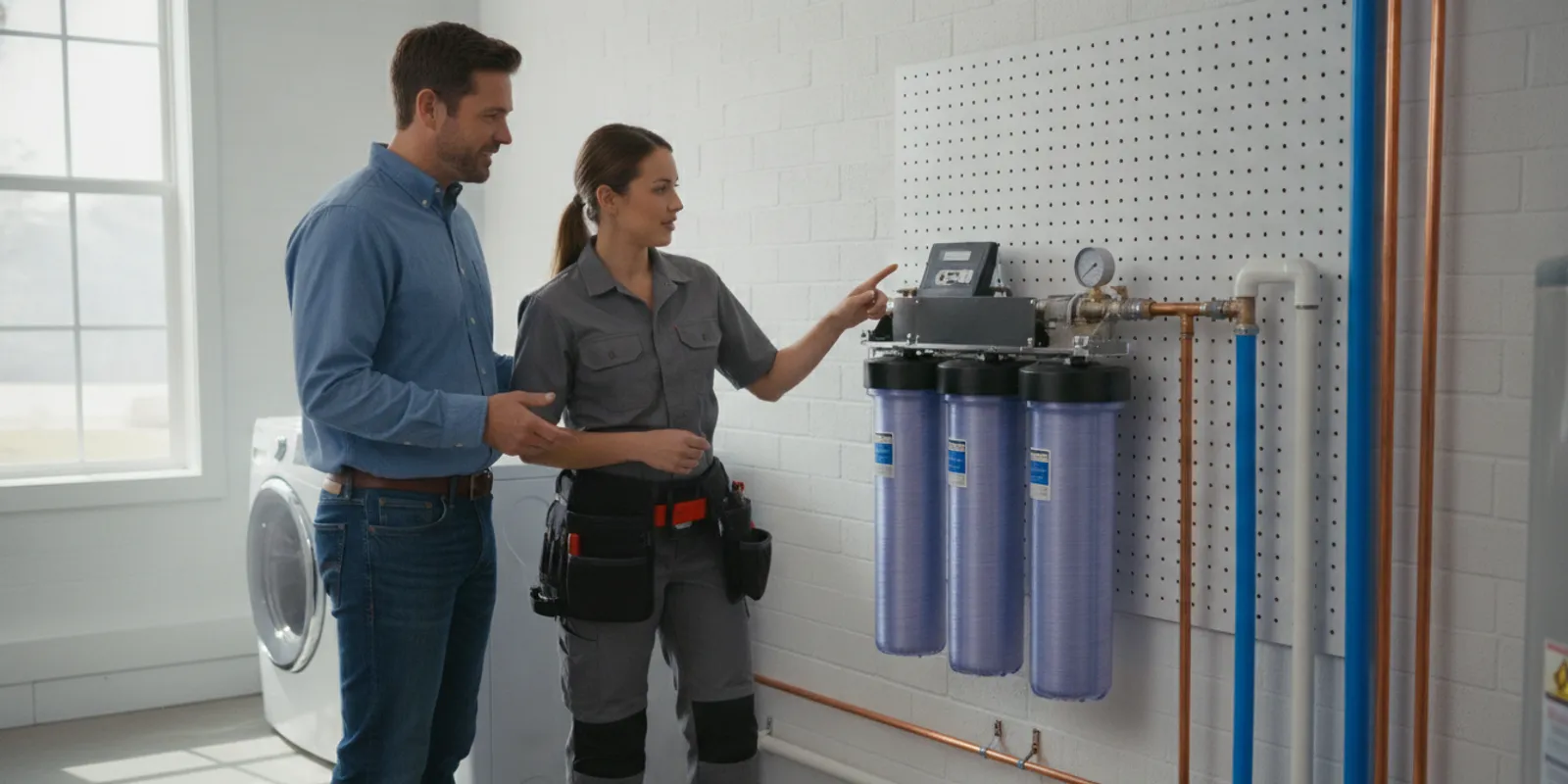
Choosing the best whole house water filter for well water starts with knowing what is in your water, not with picking a filter by its label. Well supplies can differ from one property to another, so a system that helps one household may not address another household’s concern. Use water testing and your actual goals to narrow the options before comparing equipment.
Talk with our team about water filtration
Why should well water be tested before you choose a filter?
A private well does not come with a single, predictable water profile. The source, plumbing, nearby land uses, and conditions at the property can all affect what a test detects. A filter chosen without test information may target the wrong issue, leave a concern unaddressed, or add equipment that the home does not need.
Start by arranging water testing through a qualified laboratory. If you are unsure where to begin, your local health department can explain what testing resources or recommendations are available in your area. Ask the lab or a qualified water professional which tests make sense for your well and circumstances. A basic panel may not answer every question, so mention any change in taste, color, odor, or appearance and any known issue in the area.
Keep the report, including the date and the lab’s explanation of results. The results provide a baseline for discussing treatment. If results indicate a potential health concern, use the appropriate public-health or laboratory guidance to understand what to do; do not assume that a general-purpose filter resolves it. Treatment decisions should be based on the specific finding and equipment performance information.
What do you want the system to improve?
“Better water” can mean different things. One household may want to reduce visible particles, another may be concerned about an odor, and another may want to address a test result. Write down the problem you want to solve and where you notice it. That helps separate a whole-house treatment need from a concern limited to drinking water at one tap.
- Visible sediment: Note whether particles appear in water from several fixtures or only one. The pattern can help distinguish a supply concern from a fixture or plumbing issue.
- Color or staining: Record where and when it appears, and share photos if helpful. Appearance alone does not reliably identify the cause.
- Taste or odor: Describe the character and whether it occurs at every cold-water tap, only hot water, or at a single fixture. These differences are useful clues, not a substitute for testing.
- A laboratory result: Bring the full report, not just a summary or a single number. Treatment depends on what was tested and what the results mean.
- Drinking-water preference: If the concern is limited to water used for drinking and cooking, ask whether point-of-use treatment is more appropriate than treating water throughout the home.
A filter is not a general-purpose fix for every water-quality or plumbing problem. For instance, a change at one faucet could involve the fixture or the local pipe rather than the well. If you suspect a leak or plumbing fault, a water leak inspection may be a separate issue from choosing filtration. Keep water treatment and plumbing diagnosis as related but distinct questions. If a concern appears only at hot-water taps, it may also be worth discussing the water-heater system as a separate diagnostic question; the company’s water heater repair information covers that service, not well-water treatment.
Which whole-house treatment options should you compare?
Use your report and goals to compare treatment categories, then confirm that a proposed system is intended for the specific condition identified. The table is a starting point for questions, not a claim that any one category is right for every well.
| Treatment category | Often considered for | What to verify | Planning question |
|---|---|---|---|
| Sediment filtration | Particles or suspended material identified in the supply | Whether the filter’s specifications match the particle concern and expected service conditions | How often will the filter element need inspection or replacement? |
| Carbon filtration | Some taste or odor concerns, depending on the cause and product design | Which specific substances the product is tested or rated to reduce, and under what conditions | Does the test result support this treatment, or is the concern coming from another source? |
| Iron or manganese treatment equipment | A confirmed concern involving these substances | Whether the equipment is designed for the measured levels and water conditions | What pretreatment, operating requirements, and ongoing care does the system need? |
| Disinfection treatment, such as ultraviolet equipment | A specific microbial concern when a qualified professional recommends this approach | What testing, pretreatment, installation conditions, and maintenance the system requires | How will the treatment be checked and maintained over time? |
| Point-of-use treatment | A concern focused on drinking or cooking water at a particular tap | Whether the chosen device addresses the test finding at that location | Would treating one tap meet the goal better than treating all incoming water? |
Products within the same category can differ. Read the manufacturer’s performance information closely, and ask which contaminants or conditions are covered. A broad label such as “whole-house” describes where equipment is installed; it does not, by itself, prove what the system can remove. The Environmental Working Group’s water-filter guide is a general reference for comparing household filtration considerations. It is not a well-water test report or a substitute for matching equipment to your own results.
When you compare proposals, look for the exact equipment model and the reason it was selected. Ask whether the performance information applies to the condition found in your report, and what assumptions it makes about the incoming water. If a proposal describes a treatment stage only by a broad category, request the model-specific details. Also confirm whether the system is meant to address one identified concern or several. A multi-stage setup is not automatically a better match if its stages do not correspond to your water profile.
Do not compare systems only by the number of housings or cartridges. Two systems with a similar appearance can use different media and have different requirements. Ask for a plain explanation of the expected result, how it will be verified, and what could still remain in the water after treatment. A careful comparison makes the limits as clear as the intended benefit, and leaves room to seek additional testing or advice if the report raises a question.
How do you match a filter to the whole home?
Once you know the concern, consider the home’s water use and installation conditions. Whole-house equipment treats water as it enters the plumbing system, so its selection affects more than a drinking-water tap. Discuss how many people live in the home, how many fixtures may be used at once, available installation space, and the condition of accessible plumbing. A qualified installer can explain the system requirements and whether the proposed equipment fits the property. If you are confirming whether a home is within the company’s coverage area, review the Space Coast service areas before requesting an appointment.
Ask how the equipment affects normal household use and what its operating limits are. Find out whether it needs power, a drain connection, particular water pressure, pretreatment, or a specific installation location. The answer depends on the equipment. Do not infer those requirements from another model’s brochure.
Also consider the current plumbing. If a well-water concern has contributed to visible pipe problems, ask whether a plumbing assessment is needed in addition to water treatment. A plumber can evaluate a suspected pipe issue separately; see the company’s pipe repair information or water line repair services for those plumbing needs. Neither repair page replaces water testing or establishes which filter you need.
What should you ask before buying or installing a system?
Ask for a clear explanation connecting the recommendation to your water report. A useful discussion should name the concern being addressed, explain why the proposed treatment is a match, and distinguish confirmed findings from assumptions. If you have not tested the water, ask what testing should happen before choosing equipment rather than relying on a sales label.
- Which test result or household symptom is this system intended to address?
- What does the product’s performance information say it reduces, and what does it not claim to address?
- Does the system require another treatment stage or a particular installation condition?
- What routine service, replacement parts, or monitoring will be needed, and how often?
- How will you know when service is due or whether the system is operating as expected?
- What is included in the installation scope, and what work would be separate?
- Can you receive the recommendation, equipment details, and pricing in writing?
For an installation discussion, review the company’s whole-house filtration service page and bring your test results and questions. Space Coast Cooling & Plumbing offers plumbing and water-filtration installation services; a conversation can clarify what is suitable for your property. You can also see the broader plumbing service overview to understand the company’s plumbing scope. Do not treat a consultation as a replacement for laboratory testing where test results are needed.
How do you plan for upkeep?
Every system has its own care requirements. Before deciding, ask what needs periodic inspection, cleaning, replacement, or testing, and who is responsible for each task. Follow the equipment maker’s instructions and keep a simple record of installation information and maintenance dates. If the recommendation depends on a test result, ask whether and when follow-up testing is appropriate.
Maintenance also affects day-to-day planning. Find out where the system will sit and whether there is room to access it safely when service is due. Ask what supplies or replacement parts the equipment uses, how to tell when attention is needed, and whether the system has any operating conditions the household must maintain. Request this information in writing so that another household member can follow it later. If water quality changes unexpectedly, preserve the new observations and contact a qualified professional rather than changing treatment settings without guidance.
Include upkeep in the comparison rather than looking only at initial equipment and installation. A system that fits your water but is difficult to maintain may not be a practical choice for your household. Ask about the availability and type of replacement components, how to recognize a service reminder, and what to do if water quality changes. Do not wait for an obvious change in taste or appearance to stand in for a maintenance schedule.
If water conditions or household concerns change, revisit the original test and treatment recommendation. Keep records of any plumbing repairs as well. For a home considering other plumbing work, the company’s repiping information explains a separate service; a filtration choice should not be used to diagnose or promise a fix for aging pipes.
How can you compare your options without guessing?
Use a short decision process to keep product claims grounded in the household’s actual needs:
- Describe the concern. Note the location, timing, and type of change you notice. Be clear whether the goal is improved appearance, taste, odor, or response to a test result.
- Test the water appropriately. Ask a qualified lab or relevant local authority what analysis is suitable. Save the full report and clarify any result you do not understand.
- Identify the treatment objective. Match each confirmed issue to a stated equipment capability. If no test or product information supports a claim, ask for clarification before proceeding.
- Compare whole-house and point-of-use approaches. Consider where treatment is needed, how the water is used, and the equipment’s requirements throughout the home.
- Review installation and upkeep. Understand the proposed location, operating conditions, maintenance, and what is included in the written scope.
- Recheck the fit. Make sure the final recommendation still addresses the original goal and that you know how to maintain and evaluate the system.
This process helps you compare options for the right reasons. The “best” filter is not necessarily the model with the broadest label or the most stages. It is the approach supported by your test results, designed for the concern, appropriate for the home, and manageable to maintain.
Ask about a well-water filtration system
Frequently asked questions
Is one whole-house filter best for every well?
No. Well-water conditions vary, and different treatment categories address different concerns. Testing and product performance information are needed to decide what suits a specific supply.
Can a sediment filter make well water safe to drink?
A sediment filter is intended for particles within its design limits. It should not be assumed to address dissolved substances or microbial concerns. Use appropriate testing and select treatment for the findings.
Should I choose a whole-house system or a filter at the kitchen tap?
It depends on the concern and where treatment is needed. A whole-house system treats incoming water for the plumbing system, while point-of-use equipment treats water at a particular location. Compare the options against test results and household use.
Can water appearance or odor tell me which filter to buy?
Those clues can help describe a concern, but they do not reliably identify its cause. Share what you notice with a qualified water professional and use testing where needed before choosing equipment.
How often does a whole-house well filter need maintenance?
There is no single schedule for every system. Follow the equipment maker’s instructions and ask the installer what inspection, replacement, or testing applies to the specific model and your water conditions.
Get a clear next step
Request a water-filtration consultation
Bring your water test report, describe what you want to improve, and ask how the recommended system matches both the results and your home’s needs.