
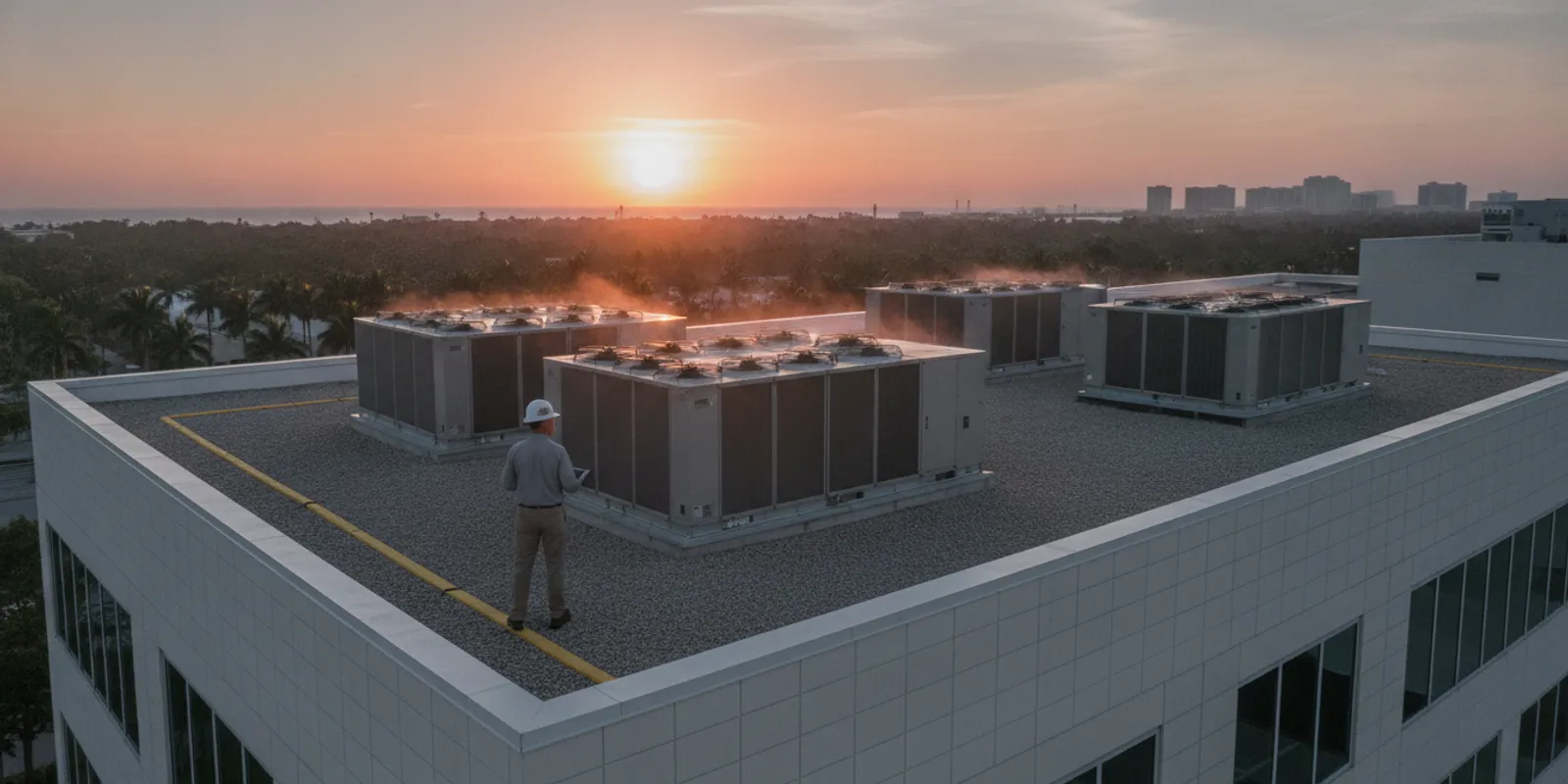
Commercial HVAC replacement is a major decision for a property owner or facilities manager. The right project can improve comfort, reduce disruption, and give a business more dependable climate control. The wrong approach can lead to rushed equipment choices, unexpected site work, and repeated service calls. This guide explains how to recognize replacement conditions, compare options, plan the work, and request a useful estimate for a commercial property in Florida.
Talk with a commercial HVAC professional
When does a commercial HVAC system need replacement?
Replacement is not based on age alone. A system may continue to serve a building well with regular maintenance, while another may become unreliable sooner because of heavy operating hours, poor sizing, salt air, neglected maintenance, or changing occupancy. Look for a pattern of problems rather than one isolated failure.
Frequent or increasingly expensive repairs
Repeated compressor, blower, electrical, control, or refrigerant-related problems can change the repair-versus-replacement decision. Ask for a written explanation of the failure and the expected life of the repaired component. If several major parts are failing together, replacing one part may only postpone a larger project.
Uneven temperatures and comfort complaints
Hot or cold zones, weak airflow, long run times, and rooms that never reach the thermostat setting may indicate more than a faulty part. Possible causes include duct problems, incorrect airflow, poor zoning, building changes, or equipment that no longer matches the space. An assessment should separate a correctable distribution issue from a system that is no longer suitable.
Unplanned shutdowns
A commercial failure can affect employees, customers, inventory, tenants, or operating hours. If the equipment repeatedly shuts down during peak cooling demand, reliability may deserve more weight than the short-term cost of another repair. Businesses that depend on temperature control should consider the operational impact of an outage when setting a replacement timeline.
Building use has changed
Renovations, added offices, altered layouts, new equipment, extended operating hours, and changes in occupancy can all affect heating and cooling demand. A replacement project is an opportunity to confirm the load, airflow, controls, and distribution instead of simply matching the old unit.
What should you evaluate before choosing replacement?
Start with the building and its operating needs. A commercial HVAC replacement should fit the property, not just the available equipment catalog. Gather recent service records, utility information, comfort complaints, operating schedules, and any documentation from earlier renovations.
- Building use: Note office, retail, restaurant, warehouse, medical, educational, or other uses, along with spaces that need special temperature control.
- Operating schedule: Record occupied hours, seasonal demand, weekend use, and areas that must remain conditioned after closing.
- Equipment history: List installation dates, repeated failures, prior replacements, and parts that have become difficult to obtain.
- Air distribution: Identify rooms with weak airflow, hot spots, unusual noise, odor complaints, or comfort differences between zones.
- Access and logistics: Consider roof access, crane or lift needs, electrical service, drainage, curb dimensions, and the location of existing equipment.
- Business constraints: Define acceptable downtime, tenant notice requirements, noise limits, and any critical areas that need temporary conditioning.
Commercial properties in coastal Florida may also need an evaluation of outdoor exposure and corrosion risk. The assessment should account for the actual site conditions and the equipment's installation environment rather than relying on a generic replacement recommendation.
How do you compare commercial HVAC replacement options?
Ask each provider to explain the proposed system in terms that connect to your building's needs. Comparing only the equipment price can hide differences in installation scope, controls, warranties, start-up procedures, and the amount of work required to keep the business operating.
| Option or decision | When it may fit | What to confirm |
|---|---|---|
| Repair existing equipment | The failure is isolated and the system remains reliable and suitable for the building. | Repair scope, expected service life, parts availability, and any related defects. |
| Like-for-like replacement | The current capacity and distribution still match the building's use. | Measurements, curb or connection compatibility, code requirements, controls, and start-up testing. |
| Reconfigured replacement | Renovations, comfort complaints, or operating changes show that the existing arrangement is no longer a good fit. | Load calculation, zoning, ductwork, electrical needs, drainage, controls, and construction schedule. |
| Phased replacement | The property has multiple systems and the owner needs to manage cash flow or disruption. | Priority areas, temporary measures, compatibility between phases, and a long-term replacement sequence. |
New construction and replacement work are not the same decision. A Northwest Energy Efficiency Alliance market assessment reports that a substantial share of light commercial equipment is sold to replace HVAC systems in existing buildings, which reflects how often replacement projects must work within an occupied property's constraints. Read the light commercial HVAC market assessment for that market context.
What should a commercial HVAC replacement estimate include?
A useful estimate should make the scope understandable before work begins. It should not simply list a unit and a total price. Ask for enough detail to compare proposals fairly and identify possible changes to the building.
- Equipment type, capacity, model information, and intended application.
- Removal and disposal of existing equipment.
- Crane, lift, roof, curb, access, or rigging requirements.
- Refrigerant, piping, duct, electrical, controls, drain, and support work.
- Permits, inspections, start-up, commissioning, and owner training when applicable.
- Expected schedule, work hours, shutdown windows, and protection for occupied areas.
- Warranty information and the process for requesting follow-up service.
- Items not included, such as structural repairs, asbestos-related work, or upgrades outside the HVAC scope.
Requesting the same information from each bidder helps prevent a low initial price from becoming a higher final cost. It also gives the facilities team a record of what was recommended and why.
How can you limit disruption during replacement?
Replacement planning should begin before the equipment fails. Coordinate the project with occupants, tenants, vendors, and other contractors. Confirm which areas can be unconditioned, whether work must occur outside normal business hours, and how staff will be notified if the schedule changes.
Plan the shutdown
Identify the equipment that must be turned off, the expected duration, and any areas that require temporary cooling. A written shutdown plan is especially important for spaces with temperature-sensitive operations, customer traffic, or strict tenant requirements.
Confirm site access
Review parking, loading areas, roof entry, security procedures, elevators, gates, and staging space. Delays can occur when a contractor cannot reach the equipment or when access arrangements were not approved in advance.
Coordinate related work
If the project includes electrical, roofing, controls, ceiling, or duct modifications, clarify who is responsible for each part. Commercial HVAC service may involve several trades, and unclear responsibility can delay testing or closeout.
Schedule testing and handoff
Do not treat installation as complete when the equipment is merely running. Ask what checks will be performed, what settings will be documented, and what information the property team will receive. The final handoff should identify filters, controls, maintenance access, warranty contacts, and any recommended follow-up work.
Should you repair or replace commercial HVAC equipment?
Use a structured comparison instead of relying on a single dollar figure. Consider the immediate repair, the likelihood of additional failures, the effect of downtime, the equipment's suitability for current building use, and the timing of the replacement. A repair may be reasonable when the problem is limited and the system remains dependable. Replacement may make more sense when repairs are recurring, comfort problems continue, or the equipment no longer supports the property's needs.
Ask the contractor to explain both paths when practical. The explanation should include the condition found, the risks of waiting, and the work required for each option. You can also ask whether a phased plan would address the most vulnerable equipment first without committing the entire property to one project immediately.
What questions should facilities managers ask?
Before approving a commercial HVAC replacement, ask:
- What evidence shows that replacement is preferable to repair?
- How was the proposed capacity selected for this building?
- What existing components can remain, and what must be modified?
- How long will each area be without normal heating or cooling?
- What access, lifting, electrical, drainage, or structural work is included?
- Who will coordinate permits, inspections, controls, and final testing?
- What does the warranty cover, and who should the property team contact later?
- What maintenance schedule will help protect the new equipment?
For a broader look at the company's commercial capabilities, review the commercial HVAC service page. Property owners can also explore the main HVAC services page and the Space Coast service areas before requesting an assessment.
How can Florida property owners prepare for a replacement assessment?
Prepare a short project brief with the property address, building use, approximate conditioned area, operating schedule, equipment locations, recent complaints, repair history, and the outcome you want. Include photographs of equipment labels and access points if they are safe to take. Share any plans or records that show renovations, additions, unusual loads, or previous HVAC work.
It is also helpful to identify the decision-maker, the preferred project window, and the budget process before the visit. If financing or staged work is part of the discussion, the financing information can help you understand one available path, subject to the provider's current terms and approval requirements.
Space Coast Cooling & Plumbing serves commercial customers across Brevard County, including Cocoa, Melbourne, Palm Bay, Titusville, Merritt Island, and nearby Space Coast communities. The company provides commercial HVAC service and states that it offers upfront pricing, trained technicians, and 24/7 emergency availability. Confirm the scope and timing for your property during the consultation.
Use the company information page to learn more about Space Coast Cooling & Plumbing, or review the maintenance plans page when planning ongoing care after replacement.
Request a commercial HVAC replacement assessment
Frequently Asked Questions
How long does commercial HVAC replacement take?
The schedule depends on equipment availability, access, permits, lifting needs, related construction, and the number of systems involved. A provider should give you a project sequence after reviewing the property and should identify expected shutdown periods.
Can a commercial HVAC system be replaced in phases?
Often, a phased approach can be considered for properties with multiple units or zones. The plan should prioritize reliability and critical areas while confirming that each phase will work with the building's long-term design.
Does a replacement always require new ductwork?
No. Existing ductwork may be reusable if it is appropriately sized, accessible, and in suitable condition. The assessment should identify leakage, airflow, insulation, damage, or layout issues that could limit the performance of new equipment.
What should happen after installation?
The contractor should complete start-up checks, verify operation, explain controls, document equipment information, and provide warranty and maintenance guidance. Keep those records with the property's service history.
Get help evaluating the next step
Contact Space Coast Cooling & Plumbing about your property
A careful assessment can help you choose a commercial HVAC replacement plan that fits the building, protects daily operations, and gives your team a clearer path from recurring problems to dependable service.