
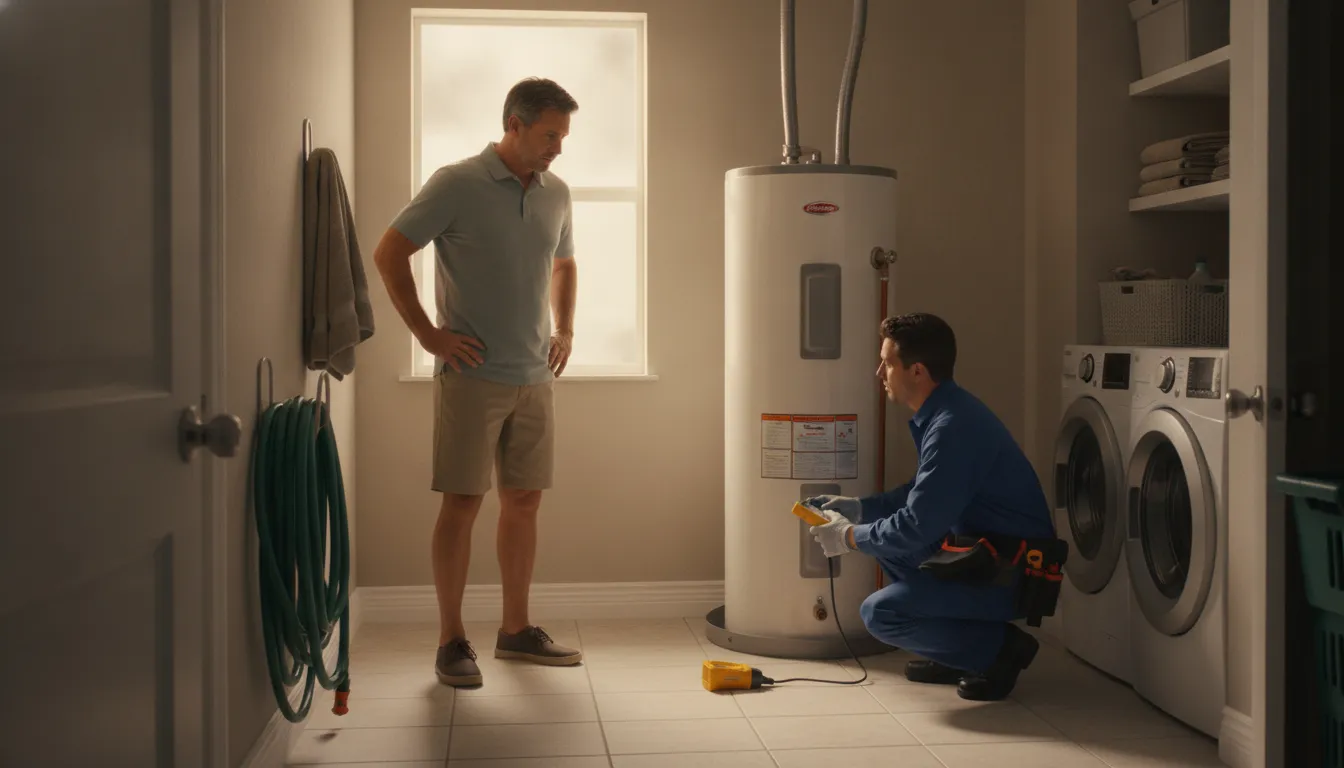
When an electric water heater stops keeping up, the cause is not always obvious. A cold shower, a tripping breaker, a leak, or a new rumbling sound can involve different parts of the system. This electric water heater repair guide explains what Space Coast homeowners can safely observe and when trained service is the right next step.
Schedule water heater service with Space Coast Cooling & Plumbing
Electric water heater repair may involve the power supply, controls, heating components, plumbing connections, or the tank itself. You can note symptoms, observe the breaker without repeatedly resetting it, and look for visible water. Electrical diagnosis, panel access, and component repairs should be handled by a qualified professional.
Start by separating simple observations from work that requires tools or contact with electricity. Knowing what changed, when it started, and whether water is present will make the first evaluation more useful.
What Should You Check First When an Electric Water Heater Stops Working?
When an electric water heater stops producing hot water, begin with observations rather than repairs. A single symptom does not identify the cause. The issue may involve the power supply, controls, heating components, plumbing, or another condition that requires professional testing. Careful notes can help a technician understand what changed without putting you at risk.
Note when the problem started
Think about the timing. Did the water turn cold suddenly, or has the supply become less reliable over several days? Note whether every fixture is affected or whether the problem seems limited to one faucet or shower. Also note how much hot water is available. A tank with no hot water has a different service history from one that delivers hot water briefly before turning lukewarm.
Write down whether the issue happens at a particular time of day or after heavier household use. A busy morning, visiting guests, or higher demand may affect recovery. That observation does not prove the heater is operating normally. If the pattern continues after normal use, include that detail when requesting plumbing service.
Look, listen, and observe without opening the heater
Check the electrical panel only from a normal standing position. Note whether the water-heater breaker appears to be in its usual position. If it has tripped, do not repeatedly reset it. A breaker that trips again can indicate a fault or an unsafe electrical condition. Leave electrical diagnosis, testing, and repairs to a qualified professional.
Look around the heater and nearby plumbing for visible water. Notice whether moisture appears at a fitting, valve, connection, or near the tank. Do not remove covers or take the unit apart. If water is collecting near electrical equipment, stay out of standing water and do not use electrical tools in the area. Protect nearby belongings only if you can do so without touching electrical components.
New popping, rumbling, or hissing sounds are also worth recording. Note when the sound occurs and whether it happens alongside poor heating or visible moisture. Sounds can have more than one explanation. Avoid assuming that one noise confirms a specific failed part.
These observations give a Space Coast technician a useful starting point. Electrical work and water-heater repair belong with a trained professional. The technician can inspect the equipment, explain the findings, and present an appropriate next step.
Common Electric Water Heater Problems and What They May Mean
Water heater symptoms can point to several conditions. A single sign does not establish a definite diagnosis. An electric tank may have an issue with power, controls, heating components, connections, plumbing, or the tank itself. Noting the pattern can help a qualified technician. Electrical repairs and work inside the heater should not be treated as a do-it-yourself project.
No hot water
No hot water may be related to an interrupted power supply, a control problem, a heating component, or another fault. If the breaker has tripped, observe its position without repeatedly resetting it. If the breaker appears normal but the water remains cold, the cause still cannot be confirmed from that observation alone. Opening access covers or testing electrical parts requires qualified service.
Hot water runs out quickly
Some homeowners have hot water in the morning but run out much sooner than expected later in the day. Inconsistent or quickly depleted hot water may relate to household demand, settings, recovery, heating performance, or plumbing conditions. Keep track of when the temperature changes and whether the problem affects every fixture or only one. Persistent changes deserve an evaluation, especially when they occur alongside unusual sounds, a leak, or a breaker problem.
Repeated breaker trips
A breaker that trips once can have several possible explanations, but the next observation matters. If it stays on and the heater still produces no hot water, the inspection may start with the power supply, controls, or heating components. If it trips again after being reset, treat that pattern as a different and more urgent safety signal. Do not keep resetting the breaker to restore hot water. Repeatedly energizing equipment that is not operating correctly can increase the risk of damage or injury.
Repeated trips require prompt qualified attention because the fault may involve the heater or its electrical connections. Leave the breaker alone after it trips again, keep access covers closed, and do not test live components. If water is also present near the heater or electrical equipment, keep clear of standing water while arranging professional help.
Leaks, rust, or visible corrosion
Water around a heater may come from a fitting, valve, nearby plumbing connection, or the tank. If the tank shell appears dry but moisture starts at a nearby threaded connection, valve, or pipe joint, the issue may be localized to that connection or fitting. If water appears from the tank body, seam, or base and returns after the surrounding connections are dry, the tank itself needs prompt professional evaluation. These observations do not establish a diagnosis, but they help a technician choose the right inspection path. If it is safe to do so, protect nearby belongings and shut off the water supply. Do not enter standing water or touch electrical equipment when water may have reached it.
Rust or corrosion around a connection, valve, or tank can be a sign of aging, a leaking component, or another condition that needs inspection. Corrosion does not automatically prove that the entire water heater must be replaced. The location, extent, recurrence, and overall condition help determine whether repair, maintenance, or replacement is appropriate.
Popping, rumbling, or hissing sounds
New or unusually loud sounds can be unsettling, but noises do not point to one guaranteed cause. Popping, rumbling, or hissing may occur during heating or when water is moving through the system. Record when the sound occurs and whether it is becoming more frequent. Note whether it appears with poor heating, a leak, or a change in water temperature.
Routine maintenance can be part of keeping a water heater operating reliably. For general product guidance, ENERGY STAR publishes residential water-heater criteria; that information does not replace an on-site diagnosis. Space Coast Cooling & Plumbing provides water-heater repair and maintenance for traditional tank units, including electric models, across Brevard County. For broader preventive-care information, see the water heater maintenance guide.
When Should You Schedule Electric Water Heater Repair?
A professional boundary is important because an electric water heater combines electrical connections, heated components, pressurized plumbing, and a large volume of water. A homeowner can document symptoms and make limited visual observations. Electric water heater repair should not become a trial-and-error project. If the next step involves opening the unit, testing a component, or working where water and electricity may meet, arrange qualified service.
Use this handoff process to protect yourself, your home, and the equipment:
- Stop at the observation stage. Note whether the water is completely cold, inconsistent, or simply running out faster than usual. Record when the problem began, whether a breaker has tripped, where you see water, and whether unusual sounds occur during heating.
- Do not repeatedly reset a tripped breaker. Repeated resets can leave an underlying electrical fault unaddressed. If the breaker trips again, leave it alone and request professional evaluation rather than treating the reset as a repair.
- Keep access covers closed. Electrical panel work, removing access covers, testing wiring or components, and replacing a thermostat or heating element require appropriate training and test equipment. Do not test live wiring yourself.
- Do not drain the tank for component work unless a qualified professional is handling it. Draining may be part of certain repairs or maintenance. The process involves hot water, plumbing connections, valves, and equipment-specific steps.
- Back away from water near electrical equipment. Do not enter standing water, touch controls with wet hands, or use electrical tools while standing in water. Shut off the water supply only if you can do so without approaching an electrical hazard.
- Ask for an inspection and clear options. A service visit should distinguish a repairable component issue from a leak, recurring fault, maintenance need, or condition that may make replacement worth discussing.
Space Coast Cooling & Plumbing provides water-heater repair and maintenance, leak detection and repair, and water-heater replacement as part of its plumbing services. For homeowners in Brevard County, the safest choice is to describe what you observed and let a qualified professional handle electrical diagnosis, component testing, and work near water.
Repair, Maintenance, or Replacement: Which Fits the Problem?
Choosing between electric water heater repair, maintenance, and replacement is not always obvious from the first symptom. A leak, unusual sound, or loss of hot water can have more than one possible explanation. The right next step depends on what an inspection finds, including the condition of the tank, connections, controls, heating components, and surrounding plumbing.
Use the comparison below as a conversation guide, not as a remote diagnosis. A qualified technician can explain whether the problem appears isolated and repairable, whether routine service may help protect the system, or whether replacement is more practical.
| Option | Decision signals | Appropriate next step | What to ask |
|---|---|---|---|
| Repair | A specific symptom or localized leak needs evaluation. The overall system may still be serviceable. | Arrange an inspection and ask which component or connection is affected. | What was found, and are related conditions present? |
| Maintenance | The system operates but needs routine attention, or you want its condition reviewed. | Schedule appropriate inspection and maintenance for the unit. | What should be monitored after maintenance? |
| Replacement | Inspection shows broader deterioration, recurring problems, or a tank-related leak. | Discuss options based on demand, installation conditions, and plumbing. | What caused the recommendation, and what work is included? |
Maintenance is not a guarantee that a water heater will avoid every future problem. A single symptom does not automatically mean replacement is necessary. A repair recommendation should be based on the inspected condition rather than an assumption about the unit's age or the sound it makes.
Space Coast Cooling & Plumbing provides repair, maintenance, installation, and replacement services for traditional tank and tankless water heaters across Brevard County. If inspection indicates that a new system may be appropriate, you can review water heater installation and replacement service and ask questions before deciding.
How to Prepare for Water Heater Service in Brevard County
Preparation can help a technician understand what happened and evaluate the water heater safely. Before requesting electric water heater repair in Cocoa, Melbourne, Palm Bay, Titusville, Merritt Island, or another Brevard County community, write down the main symptom in your own words. Note whether the water is completely cold, takes longer than usual to heat, or runs out quickly. Include when the issue began and whether it happens every time or only during certain periods.
Record what you observed
- Note whether a breaker has tripped. If it trips again, do not repeatedly reset it or open access panels.
- Identify where water appears, such as near a connection, valve, drain area, or tank.
- Write down when you hear popping, rumbling, or hissing.
- Record visible rust, corrosion, moisture, or changes in water temperature.
- Share the make, model, approximate age, and recent service information if available.
Make the work area accessible
Clear stored items away from the water heater so the equipment and nearby connections can be viewed. Keep children and pets away during an inspection. If water is near electrical equipment, do not enter standing water, handle electrical components, or use electrical tools while standing in it. Shut off the water supply only if you can do so without approaching an electrical hazard.
Ask what the visit will cover
Ask whether the evaluation will address the symptom, the source of any leak, and the condition of the surrounding plumbing. You can also ask what work is recommended, what is included in the scope, and whether you will receive upfront pricing before approving repairs. A clear explanation helps you compare repair, maintenance, and replacement options without deciding based on one symptom alone.
For routine care questions, see the water heater maintenance guide. Space Coast Cooling & Plumbing provides water heater repair and maintenance for homeowners across Brevard County, with a focus on clear explanations and no-pressure decisions.
Before the visit, gather recent service records if they are easy to find. Note whether the heater is in a garage, closet, utility room, or another enclosed area. Mention recent plumbing work or changes in household use. These details can help the technician understand the setting and ask better questions. They do not replace an inspection.
It is also reasonable to ask what happens if the first suspected cause is not confirmed. A clear service conversation should explain the findings, separate urgent safety concerns from routine recommendations, and identify which work is optional. You can ask for the scope in writing before approving work.
Contact Space Coast Cooling & Plumbing for electric water heater repair guidance.
Frequently Asked Questions
Can an electric water heater be fixed?
Often, yes. The right solution depends on what an inspection finds, such as a power issue, control problem, heating component failure, connection leak, or tank condition. A symptom alone does not identify the cause. A qualified professional can determine whether repair, maintenance, or replacement is more practical.
What should you do when an electric hot water heater is not working?
Observe whether the breaker appears tripped, note visible water, and record when the problem began. Do not repeatedly reset a tripping breaker, open access covers, test wiring, or work on the heater yourself. If water is near electrical equipment, avoid standing water and arrange qualified service.
What is the most common problem with electric water heaters?
There is no single cause for every no-hot-water or inconsistent-temperature complaint. Possible sources include interrupted power, controls, heating components, demand, or plumbing conditions. Leaks, unusual sounds, repeated breaker trips, and corrosion also need evaluation.
Is it worth repairing a hot water heater?
That depends on the inspected condition, recurrence of the problem, leak location, parts availability, and overall system condition. A repair may make sense when the tank and surrounding components are serviceable. Replacement may be considered when problems recur or the tank is compromised.
Contact Us for a Clear Evaluation
If an electric water heater problem keeps returning, a professional evaluation can clarify whether the issue calls for a focused repair or a broader next step. Share what you have noticed, and the team can review the situation with you.
To ask Space Coast Cooling & Plumbing for a clear evaluation, contact us through the online form.