
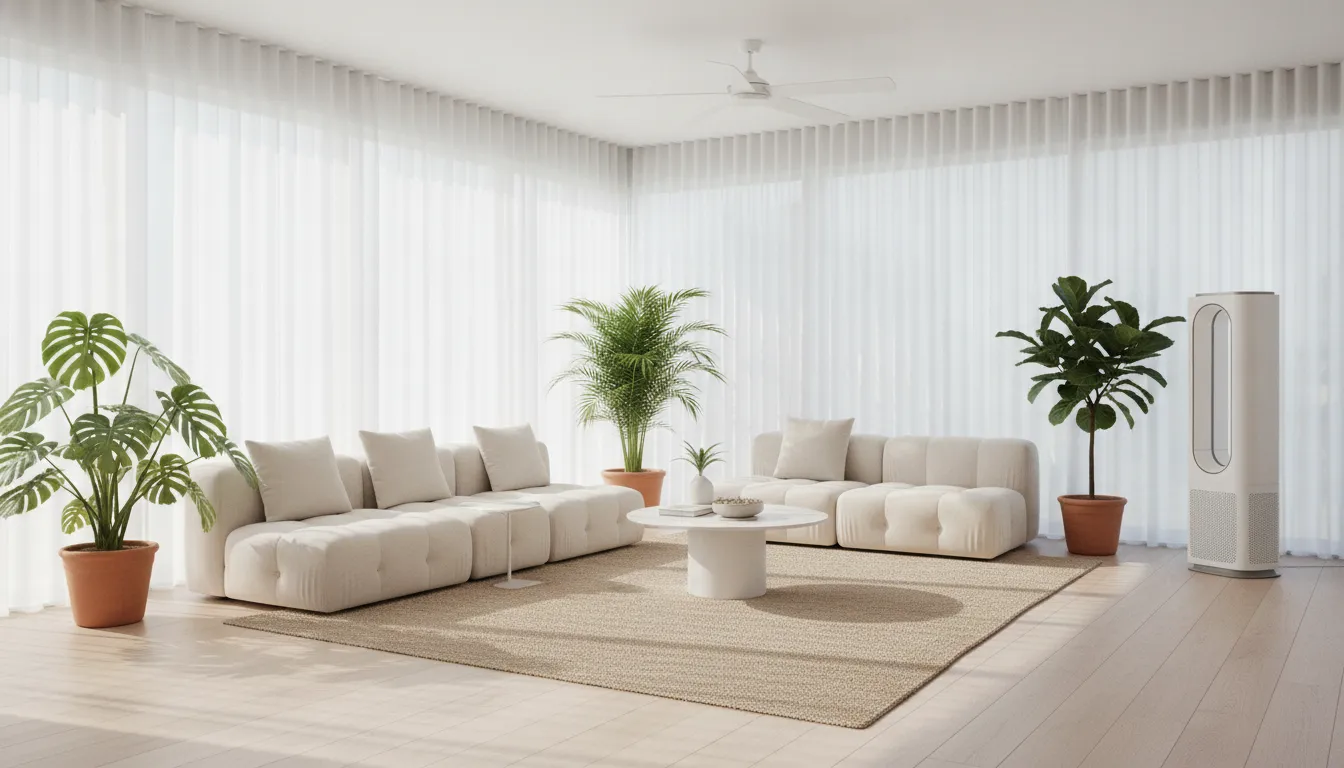
Florida homes work hard against heat and moisture. When humidity stays high, mold, musty odors, dust mites, pollen, and pet dander can become harder to control. Especially in a home that stays closed while the air conditioner runs. The good news is that cleaner indoor air usually starts with a few practical improvements rather than one oversized purchase.
To learn how to improve indoor air quality florida homeowners should start with humidity control. Use the right filter, and consider a professional assessment to identify problems that routine cleaning cannot solve.
A properly maintained HVAC system can help manage moisture and move filtered air, while dehumidifiers, air purifiers, UV lights, and advanced filtration can address specific concerns. The best combination depends on your home's humidity, ductwork, occupants, and allergy concerns. For a broader look at available solutions, see our Indoor Air Quality and HVAC Cost Guides, then begin with the Florida conditions that make indoor air management especially important.
Ready to breathe easier in your Brevard County home? Schedule your indoor air quality assessment with Space Coast Cooling & Plumbing today, and get a clear next step instead of guessing.
Why Florida homes have unique indoor air quality challenges
Florida homes face a different indoor air quality environment than homes in drier climates. Warm temperatures and subtropical humidity can keep moisture levels elevated for much of the year. In Cocoa, Melbourne, Titusville, and other Brevard County communities, air conditioning often runs for long stretches. Windows stay closed, and outdoor air does not always circulate freely through the home. That combination can trap moisture, odors, and airborne particles indoors.
Humidity is the first issue to address because it affects both comfort and mold risk. The EPA recommends keeping indoor relative humidity between 30% and 50% to help prevent mold growth. Moisture control is also the key to mold control, especially in bathrooms, laundry areas, closets, and rooms with limited airflow. A properly operating air conditioner removes some humidity as it cools, but an oversized, poorly maintained, or short-cycling system may not run long enough to dehumidify effectively. You can review the EPA's moisture and mold guidance for more detail.
Florida's closed-home environment can also concentrate everyday allergens. Pollen enters through doors, clothing, and small air leaks. Dust mites thrive when humidity remains high, while pet dander can continue circulating through the return-air system long after it is released. A musty odor may signal excess moisture or mold growth, not simply a need for air freshener. If moisture is left unchecked, cleaning surfaces alone will not solve the underlying problem.
The need for source control is easy to underestimate. According to the EPA, indoor levels of many pollutants may be two to five times higher than outdoor levels, and occasionally much higher. Indoor air can contain particles from cooking, cleaning products, dust, and pets, along with biological contaminants associated with damp conditions. The EPA notes that exposure to poor indoor air quality may contribute to immediate effects such as irritated eyes, headaches, dizziness, and fatigue. These symptoms can have many possible causes, so they should not be treated as proof of one specific indoor pollutant.
Coastal living adds another consideration. Salt-laden air can enter through doors, windows, and mechanical openings, contributing to corrosion around outdoor HVAC components and increasing the importance of regular maintenance. The practical approach is to identify the source first, then address moisture, filtration, ventilation, and equipment condition together. That is the foundation of improving indoor air quality in a Florida home instead of masking symptoms with fragrances or temporary fixes.
How to Improve Indoor Air Quality in a Florida Home With These Five Methods
Florida homes face a steady mix of heat, humidity, dust, pollen, and pet dander. The most reliable approach is not one gadget. It is a layered plan that controls moisture, captures particles, keeps equipment clean, and addresses problems inside the duct system.
- Control humidity with a whole-home dehumidifier and properly sized AC. Moisture control is the foundation of indoor air quality because mold needs damp conditions to grow. The EPA recommends keeping indoor relative humidity between 30% and 50% to help prevent mold growth. A properly sized air conditioner should remove moisture while it cools. But a whole-home dehumidifier can provide more consistent control when the AC cycles off or the home remains humid. An HVAC professional can evaluate both the equipment and the home's actual humidity levels before recommending a solution.
- Upgrade your HVAC filter and replace it on schedule. A higher-MERV filter can capture more airborne particles, including dust and allergens, but the filter must match the blower and ductwork. Installing a filter that is too restrictive can reduce airflow and strain the system. Check the filter monthly and replace it at least every 90 days, or sooner if it looks clogged. Homes with pets, construction dust, or heavy cooling demand may need more frequent changes. A clean filter protects the equipment as well as the air moving through the rooms.
- Add a HEPA air purifier for finer particle control. Portable or whole-home HEPA systems can help reduce small particles that pass through a standard HVAC filter. According to the CDC, HEPA filters can remove at least 99.97% of particles measuring 0.3 micrometers in diameter, including many dust, pollen, and mold-spore particles. Select a purifier sized for the room or air volume, and follow the manufacturer's schedule for filter replacement. Avoid ozone-generating products, which may irritate the lungs rather than solve the source of the problem.
- Consider UV lights and advanced whole-home IAQ systems. UV treatment installed inside an HVAC system can help inhibit microbial growth on the evaporator coil, where moisture and darkness can support buildup. Advanced systems may also combine improved filtration, air purification, and activated carbon for odor or VOC concerns. These options work best when chosen for a specific issue, not as a substitute for humidity control or routine maintenance. A technician can explain what each technology addresses and what it does not.
- Schedule professional duct cleaning every three to five years, then maintain the system. NADCA recommends air duct cleaning every three to five years. Cleaning can remove accumulated dust and debris, especially when visible buildup, renovation dust, pest contamination, or persistent musty odors are present. Ask for a professional assessment rather than assuming cleaning is needed on a fixed calendar. Duct leaks also deserve attention because they can waste energy and allow unwanted pollutants into the home. Pair any duct work with regular HVAC maintenance, including filter checks, coil cleaning, drain-line care, and inspection. Review these HVAC maintenance plans to see how scheduled service can keep the system operating cleanly and efficiently.
These steps reinforce one another. Better filtration cannot compensate for excessive humidity, and duct cleaning cannot replace a clogged filter. Address the conditions in your home, then build a maintenance schedule that keeps each part working as intended.
Controlling humidity: the key to Florida indoor air quality
In a Florida home, humidity control is often the first and most important step toward cleaner, more comfortable air. Warm, damp conditions support mold growth and can make a home feel clammy even when the thermostat shows a comfortable temperature. The Environmental Protection Agency recommends keeping indoor relative humidity between 30% and 50% to help prevent mold growth. Moisture control is the key to mold control, so start by measuring the problem rather than guessing.
Use your air conditioner as the first line of defense
Your air conditioner does more than cool the rooms. As warm indoor air passes over the system's cold evaporator coil, moisture condenses and drains away. That makes the AC the primary dehumidifier in most Florida homes. A clean filter, unobstructed airflow, and a properly operating condensate drain all help the system remove moisture as it runs.
However, an AC system is designed mainly to meet the home's cooling load. On mild but muggy days, it may satisfy the thermostat quickly without running long enough to remove much moisture. An oversized system can have the same problem. If your home feels damp, smells musty, or consistently measures above 50% relative humidity even while the AC is operating. Have the system evaluated instead of lowering the thermostat repeatedly.
When a whole-home dehumidifier makes sense
A whole-home dehumidifier can remove moisture independently of the cooling cycle. That is useful when the AC cannot keep up with Florida's humidity. When the home is closed for long periods, or when you want tighter humidity control without overcooling the living space. A properly selected and installed unit can maintain more consistent humidity levels, supporting comfort and indoor air quality. Whole-home dehumidifiers should be matched to the home's size, layout, and existing HVAC system rather than selected by capacity alone.
For a practical starting point, place a reliable hygrometer in a central living area and check it at different times of day. Aim for 30% to 50% relative humidity. If readings remain high, look for wet spots, condensation, plumbing leaks, or an AC that short-cycles. Use bathroom exhaust fans during showers and a kitchen exhaust fan while cooking to remove moisture at the source. Do not simply seal the home without a plan for adequate ventilation, because trapped moisture can continue to affect hidden areas.
Routine inspections can catch dirty coils, drain problems, and airflow issues before they undermine humidity control. Space Coast homeowners can review available maintenance plans to keep the equipment supporting their home's air quality through Florida's long cooling season.
Air purifiers, UV lights, and filtration: what actually works
These technologies solve different indoor air quality problems, so the best choice depends on what is circulating through your home. A filter catches particles as air moves through the HVAC system. A portable or whole-home purifier can add another layer of particle control. UV treatment works inside the equipment, while activated carbon targets odors and some gaseous pollutants. The goal is not to install every option. It is to match the equipment to the problem and make sure the HVAC system can handle it.
| Option | Best for | How it works | Important consideration |
|---|---|---|---|
| HEPA air purifier | Dust, pollen, pet dander, and mold spores | Uses a dense filter to capture fine airborne particles. The CDC says HEPA filters can remove at least 99.97% of particles measuring 0.3 micrometers. | Portable units serve individual rooms. Whole-home systems require proper sizing and planned filter replacement. |
| Higher-MERV HVAC filter | Allergens and particles moving through the ductwork | Captures more pollutants than a basic filter as air passes through the return and supply system. | A filter that is too restrictive for the equipment can reduce airflow. Confirm compatibility before upgrading. |
| UV light in ductwork | Microbial growth on HVAC cooling coils | UV treatment installed inside the HVAC system can help inhibit mold and bacteria growth on the evaporator coil. | It is not a substitute for filtration, moisture control, or cleaning. Lamp placement and maintenance affect performance. |
| Activated carbon or whole-home system | Some odors and volatile organic compounds | Carbon media adsorbs certain gases and odor compounds rather than simply trapping particles. | Media capacity varies, and saturated carbon must be replaced. Ask which pollutants the system is designed to address. |
For many Florida homes, a practical starting point is a compatible higher-quality HVAC filter. Checked monthly and replaced at least every 90 days or sooner when it is visibly loaded with dust. Higher-quality HVAC filters can capture more allergens and pollutants, but more filtration is not automatically better if it starves the blower of airflow. A technician can measure the system and recommend an appropriate filter level.
HEPA filtration is useful when fine particles are the main concern, especially in a bedroom or other frequently occupied room. UV treatment may make sense when a damp coil or air handler has a recurring microbial-growth problem. Carbon media is more appropriate when odors or certain chemical fumes are the concern. If your home has uneven comfort or limited duct access, a ductless mini-split system for targeted comfort may also be worth discussing as part of a broader assessment.
Avoid ozone-producing purifiers. The Mayo Clinic identifies ozone as a lung irritant that can cause chest pain, coughing, shortness of breath, and throat irritation. An air-cleaning product should reduce pollutants without adding another respiratory concern. Whatever equipment you choose, follow the manufacturer's schedule for cleaning and filter or lamp replacement. Otherwise, a promising solution can lose effectiveness over time.
How your HVAC system affects indoor air quality
In a Florida home, your air conditioner does more than lower the temperature. It is the primary air mover and one of the home's most important dehumidifiers. As the system runs, air from the house passes through the HVAC filter, over the evaporator coil, and back into living spaces. That makes the condition of the equipment, filter, coils, drain line, and ductwork directly relevant to the air your family breathes.
Start with the filter. Check it monthly, especially during heavy cooling season, and replace it at least every 90 days. Replace it sooner if it looks gray, loaded with dust, or visibly clogged. A dirty filter restricts airflow and makes the system work harder. It can also reduce the amount of air that reaches the coil for proper cooling and moisture removal. Follow the filter size and airflow guidance for your specific system rather than automatically choosing the most restrictive filter available.
Keep the coil and drain system clean
The evaporator coil must transfer heat and remove moisture from the air. Dust buildup on the coil can interfere with that process and create a damp environment inside the air handler. A clogged or slow condensate drain can contribute to standing water, musty odors, or moisture damage. During a professional tune-up, a technician can inspect the coil, clean accessible components, check the drain pan, and treat or clear the drain line as appropriate.
Regular maintenance helps an HVAC system operate cleanly and efficiently, while scheduled inspections can identify air-quality concerns before they become larger problems. A practical AC service guide can help you understand what a service visit should cover. You can also review why HVAC maintenance matters when deciding whether a recurring maintenance schedule fits your home.
Do not overlook the ductwork
Your ducts are the delivery path between the air handler and each room. Leaks can waste conditioned air, increase operating costs, and allow dust and other pollutants into the system or living spaces. A technician can inspect accessible duct connections, identify damaged insulation or disconnected sections, and recommend sealing where it is needed. Improving duct integrity helps the system deliver the airflow it was designed to provide.
Duct cleaning is not a substitute for fixing leaks, changing filters, or controlling moisture. However, accumulated dust and debris may warrant professional cleaning, particularly after renovations, water damage, pest activity, or extended neglect. The National Air Duct Cleaners Association recommends having air ducts cleaned every three to five years. Your home's conditions may justify a different schedule, so an inspection is more useful than cleaning on an arbitrary timetable.
When filters, coils, drains, and ducts receive consistent attention, the HVAC system can circulate air, remove moisture, and maintain comfort with less strain. That combination is a practical foundation for improving indoor air quality in a Florida home.
When to call a professional for indoor air quality testing
Sometimes basic steps, such as changing the filter or running a bathroom exhaust fan, do not explain why a home still feels stale or uncomfortable. Persistent musty or mold-like odors are a reason to look beyond surface cleaning. The same is true when indoor humidity remains high even though the air conditioner runs regularly. Florida cooling systems remove some moisture, but equipment problems, poor sizing, duct issues, or a separate humidity load can leave the home damp.
Consider a professional assessment if anyone in the household is experiencing recurring allergy or asthma flare-ups, especially when symptoms seem worse at home. Unexplained headaches, dizziness, or fatigue can also occur after exposure to indoor air pollutants, according to the EPA's indoor air quality guidance. These symptoms can have many possible causes, so testing is not a diagnosis. It is a practical way to determine whether the home has an identifiable air, moisture, or ventilation concern that deserves attention.
What a professional assessment can uncover
A professional IAQ assessment looks for the source instead of guessing at a single product. The inspection may review humidity levels, airflow, filter condition, the air handler, accessible ductwork, drainage, and signs of moisture or microbial growth. It can also help identify whether the problem is concentrated in one room or distributed through the HVAC system. Scheduled professional inspections can reveal system inefficiencies and air quality concerns before they become larger problems, as noted in Space Coast Cooling & Plumbing's HVAC maintenance guidance.
That distinction matters. A dirty filter may call for a simple replacement, while a musty odor may point to moisture near the air handler or a ductwork issue. If the source is not identified, adding an air purifier may provide limited relief while the underlying problem continues. An assessment gives you a clearer basis for deciding whether you need humidity control, filtration, duct service, HVAC maintenance, or a different solution.
Why local experience matters in Brevard County
Space Coast homes deal with year-round cooling, coastal air, and persistent Florida humidity. Space Coast Cooling & Plumbing brings more than 30 years of Brevard County experience to that local environment, with upfront, transparent service recommendations rather than a one-size-fits-all package. If you are comparing options for indoor air quality and HVAC cost guides for Brevard County Florida, a professional evaluation can help connect general advice to your home's actual conditions.
When you are unsure what is driving poor air, that uncertainty alone is a good reason to schedule an assessment. A clear inspection can replace repeated trial and error with a practical next step.
Not sure what is driving your home's stale air? Contact Space Coast Cooling & Plumbing to book an indoor air quality assessment and connect general advice to your home's actual conditions.
Frequently Asked Questions
How can I improve indoor air quality in a Florida home?
Start by controlling humidity, replacing HVAC filters regularly, and keeping the air conditioner maintained. A whole-home dehumidifier may help when indoor moisture stays high, while portable or whole-home air cleaners can reduce airborne particles. If musty odors, visible mold, or persistent allergy symptoms continue, a professional assessment can identify duct, drainage, filtration, or ventilation issues.
Why is humidity control important for indoor air quality in Florida?
Warm, humid conditions allow mold and mildew to grow more easily and can make a home feel stale or clammy. The EPA recommends keeping indoor relative humidity below 60 percent, ideally between 30 and 50 percent, to help limit mold growth. See the EPA mold guidance for general moisture-control recommendations.
Are whole-home dehumidifiers worth it for Florida homes?
They can be worthwhile when the air conditioner cannot keep humidity comfortable. Especially in a tightly closed home, during mild weather, or when the system cycles off before removing enough moisture. A whole-home unit works through the HVAC system and provides more consistent control than moving portable dehumidifiers from room to room. Proper sizing and drainage matter.
How do air purifiers help with Florida allergens?
HEPA filtration can capture airborne particles such as dust, pollen, and pet dander. Activated carbon helps with some odors and gases, while UV equipment serves a different purpose inside compatible HVAC systems. The right option depends on the particles, odors, humidity, and airflow conditions in your home.
How often should HVAC filters be changed in a Florida home?
Many homes need a filter change every one to three months. And monthly replacement may be appropriate during heavy cooling or when the home has pets, construction dust, or allergy concerns. Check the filter monthly and replace it when dirty. A higher-MERV filter should also be compatible with the system's airflow capacity.
Ready to Improve Your Florida Home's Indoor Air Quality?
A professional assessment can help identify humidity, filtration, or airflow concerns that are easy to miss during everyday life. Space Coast Cooling & Plumbing can help you choose practical next steps for a cleaner, more comfortable home. To schedule an indoor air quality assessment, call (321) 631-5755.