
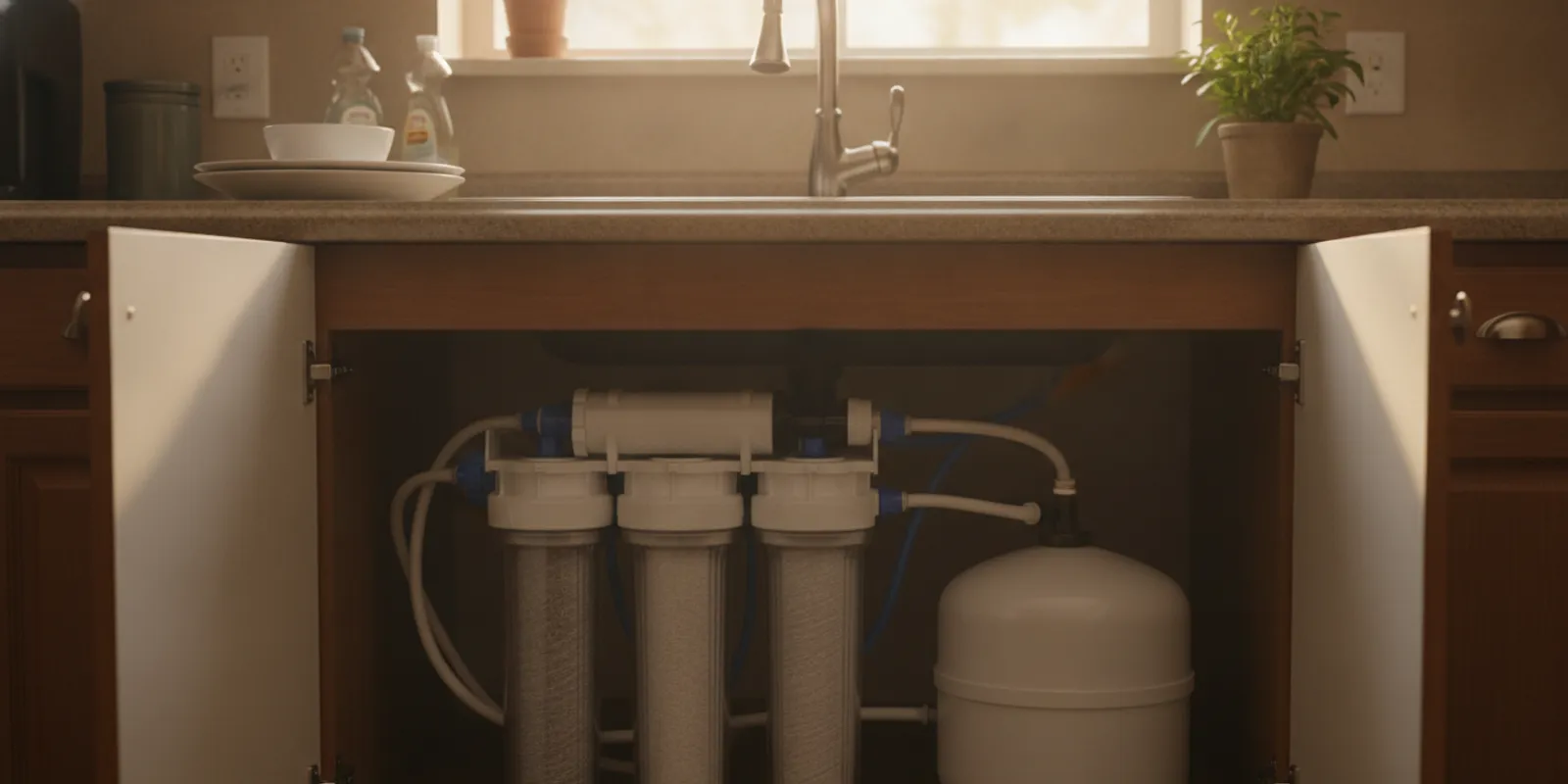
A reverse osmosis water filter is a point-of-use option some homeowners consider for drinking water at a particular tap. Before choosing one, identify the concern you want to address, check what the exact model is documented to reduce, and understand the plumbing and upkeep involved. In a Florida home, a clear decision starts with the water source and reliable information—not a broad promise that one system fixes every water issue.
Talk with a plumbing professional
What does a reverse osmosis water filter do?
Reverse osmosis, often shortened to RO, uses pressure to move water through a semipermeable membrane. The membrane separates some dissolved substances from the water that passes through it. Many household systems are installed beneath a kitchen sink and send treated water to a dedicated faucet. Depending on the model and setup, a system may also connect to a refrigerator or use a storage tank.
RO describes a treatment process, not a guarantee about every finished-water result. The substances reduced and the degree of reduction depend on the specific equipment, its verified performance claims, installation, maintenance, and operating conditions. Review the documentation for the exact model. Be cautious about a generic statement such as “removes everything”; it does not tell you which substances were tested or what conditions apply.
It also helps to distinguish a drinking-water system from treatment for the whole home. An under-sink unit serves a limited point of use. It is not automatically intended to treat water used by showers, laundry, or every fixture. Check the manufacturer’s stated application before comparing it with a whole-home treatment option.
Which water concerns should you identify first?
Start with the reason you are considering treatment. Is the concern a taste change, an odor, particles, a water-test result, or uncertainty about a private well? These situations do not all call for the same response. Appearance and taste may help you describe a change, but they do not identify its cause by themselves.
- A named substance on a test: Note the result and look for that specific substance in the performance information for a proposed system. A general filtration claim is not enough to establish a match.
- A change in taste or odor: Check whether it occurs at one faucet or at several fixtures, and whether it is new or ongoing. That pattern can help frame the question, but taste alone cannot confirm a water-quality issue.
- Cloudiness or visible particles: Consider whether the issue appears only when water first runs, after plumbing work, or throughout the home. Particles may point to a different treatment or plumbing question than dissolved substances do.
- Well-water uncertainty: Arrange appropriate testing before selecting treatment. The U.S. Environmental Protection Agency offers general drinking-water information and directs well owners to consider testing for contaminants of concern; use current guidance from the EPA’s drinking-water resources as a starting point, then consult the appropriate local or state authority about testing.
For a home using public water, you can also review information supplied by the water provider and ask what a test result means for your specific concern. For private wells, testing is especially important because the homeowner is responsible for understanding the source and its conditions. Do not buy a system simply because it has many stages or because someone describes it as suitable for all water.
If your question is about treatment choices more broadly, the company’s water filtration installation information is a useful place to learn about the related service. The goal of this article is narrower: to help you assess RO as one possible drinking-water treatment, rather than to treat all filtration products as interchangeable.
How does RO compare with other treatment approaches?
Different methods are designed for different concerns. The table below is a starting framework, not a recommendation for any particular home. A product’s published performance and the water conditions matter more than the treatment label alone.
| Approach | Typical role | Questions to check |
|---|---|---|
| Reverse osmosis | Point-of-use drinking water treatment that may reduce specified dissolved substances | Does the documentation name your concern? What are the installation, flow, storage, and replacement requirements? |
| Sediment filtration | Captures particles within the stated filter rating | Are particles the issue? What size does the filter capture, and how could it affect flow? |
| Activated carbon | May address certain taste, odor, or chemical concerns, depending on the model | Does the performance information cover the substance in question, and what are the capacity and cartridge schedule? |
| Water softening | Addresses hardness through a different process | Has hardness been measured, and what ongoing operating steps does the chosen equipment require? |
These approaches are not substitutes for one another in every situation. A system may combine several treatment stages, but more components do not automatically make it the right choice. Ask what each stage is intended to do and how that purpose connects to a documented concern. If a proposal recommends multiple devices, request a plain-language explanation of why each is included.
Likewise, a drinking-water system may be unnecessary for a concern that affects the whole plumbing system, or insufficient for a concern that requires a different response. If the symptom appears at multiple fixtures, mention that before focusing on an under-sink product. A plumber can help clarify installation questions, while appropriate water testing and the relevant public-health guidance should inform water-quality decisions.
What should you check before choosing a model?
Collect a few pieces of information before comparing products. This keeps the conversation focused on performance and practical fit instead of a long list of features.
- Write down the concern. Describe what you noticed, where it occurs, and when it began. If you have a test report, keep the full report and note the date and sampling location.
- Confirm the source. Identify whether the home uses a public water supply or a private well. If you are unsure, find out before selecting a treatment system because the testing and follow-up questions may differ.
- Match the exact claim. Ask for the manufacturer’s performance information for the specific model. Look for the substance or concern you care about and check any conditions attached to the claim.
- Verify certification details. If a product references a certification, confirm the exact model and the performance claims covered. A certification for one purpose should not be read as proof of every possible treatment claim.
- Think through daily use. Decide where a separate faucet could go, whether you want a refrigerator connection, and whether the cabinet has room for the unit and any storage tank. Ask how the system affects the available space and access to items stored below the sink.
- Ask about use and care. Get the expected filter and membrane replacement schedule from the product documentation. Ask whether the interval depends on water use or incoming water conditions, and how replacement parts are identified.
For example, if a homeowner has a report naming a specific dissolved substance, the first task is to confirm that the proposed model’s performance information addresses that substance under stated conditions. If another homeowner simply dislikes a taste but has no test information, the next step is to describe where the taste occurs and investigate the cause—not to assume RO is the answer. In both cases, the goal is to connect the concern to evidence before making a purchase.
To discuss plumbing work or system fit, you can review the company’s plumbing services and bring your questions, test results, and product information to the conversation. If you are comparing providers or planning a visit, check the company’s Space Coast service areas to see its listed coverage.
What does installation involve beneath the sink?
A typical under-sink setup needs room for the treatment components, a connection to a cold-water supply, a drain connection, and a separate faucet. The exact arrangement varies by product and by the existing sink and cabinet. Some kitchens have limited storage, unusual plumbing, or a disposal and other equipment taking up space. An installer should review the actual location rather than assume every cabinet is identical.
If you want treated water at a refrigerator, ask how the connection will be routed and whether the chosen model supports that arrangement. Think about how the tubing will reach the appliance, whether it needs to pass through cabinetry, and whether the route will leave drawers or stored items accessible. Confirm what work is included and whether any extra plumbing changes or cabinet adjustments may be needed before the job begins.
Ask how the system will be checked when installation is complete. The installer should explain how to identify the shutoff, what to look for around the connections, and what to do if you notice moisture. If there is an existing leak or damaged pipe near the intended location, address that separate plumbing issue rather than hiding it behind new equipment. The company provides water leak detection and repair and pipe repair information for homeowners dealing with those concerns.
Before approving work, make sure you know where the dedicated faucet will sit, how the unit can be reached for maintenance, and what the installation does not include. Clear expectations are useful even when the project seems small: access, routing, and leak checks affect how convenient the system is after the installer leaves.
How should you plan for maintenance?
Follow the manual for the exact system. Filter cartridges and membranes have different roles, and their replacement schedules are not universal. Timing can depend on the model, the incoming water, and how much water the household uses. Do not rely on a schedule from a different product or postpone replacement simply because the water still tastes acceptable.
At installation, ask the installer to show you where each replaceable part sits and how to find its model number. Keep the manual, purchase details, and replacement-part information together. If the manufacturer calls for flushing a new cartridge or membrane, follow that procedure. Ask whether the system has an indicator and what that indicator does—and does not—measure. An indicator is not a substitute for any testing or care instructions the manufacturer recommends.
Build a simple reminder around the published schedule. Record the installation date, replacement dates, and any change in flow or taste. If the system’s output changes sooner than expected, check the instructions and contact a qualified professional if you are unsure what to inspect. Avoid taking apart pressurized plumbing or improvising a repair beyond the product instructions.
Regular attention helps you notice small changes before they become confusing. A maintenance record is also helpful if a replacement part is difficult to identify or if another person takes over care of the home. Keep access to the unit clear so routine inspection and cartridge changes do not require moving stored items or disconnecting unrelated plumbing.
What questions should you ask before approving the work?
Use the same questions with each product or installer you are considering. Written answers make it easier to compare a specific recommendation with your water concern and household setup.
- Which concern is this model intended to address, and what document supports that recommendation?
- What is the exact brand and model, and which claims apply to that model?
- Is the system designed for one faucet or another application, and what does the manufacturer say about its use?
- What space, supply, drain, faucet, and refrigerator connections will be needed?
- What work is included, and could the current sink or cabinet setup require additional changes?
- Which filters or membranes need replacement, where can I find the part numbers, and what schedule does the manufacturer specify?
- How will the installer check for leaks and explain normal operation before the work is complete?
- What should I do if the taste, flow, or appearance changes after installation?
Good answers should connect the equipment to the concern you described and distinguish documented performance from general marketing language. If the explanation relies mainly on the number of stages, a promise that the water will be “perfect,” or an urgency to buy before you can review the details, pause and ask for the model information. You can also review the company’s plumbing and service FAQs and contact the company with questions about a plumbing visit.
Request help with your water-treatment questions
Frequently Asked Questions
Does an RO filter make any water safe to drink?
No. Do not assume a home filter makes every water source safe under every condition. Use appropriate testing and guidance, then compare the concern with the exact system’s documented performance and instructions.
Should I choose RO because my water tastes unusual?
Not automatically. Taste can have more than one cause, and it does not identify a contaminant. Note whether the change affects one tap or several, and consider testing or a professional assessment before choosing a treatment method.
Can an under-sink RO system treat the whole house?
Many household RO units are intended for point-of-use drinking water, such as a dedicated faucet. Whole-home treatment has different equipment and sizing considerations. Check the application stated for the exact model rather than assuming the systems serve the same purpose.
How often do RO filters need replacement?
Use the schedule for your specific model. Replacement timing can vary with the equipment, water conditions, and household use. Follow the manufacturer’s instructions and keep a record of service dates.
What is a practical next step?
Before deciding, write down your water concern, confirm whether the home uses public water or a private well, and gather any available test results. Then compare those facts with the performance information, installation needs, and maintenance schedule for the exact system you are considering.
If you would like to discuss the plumbing side of the project, contact Space Coast Cooling & Plumbing with your questions and system details. A focused conversation can help clarify the installation requirements without treating one filter as a universal answer.
Choosing carefully means matching the treatment to a defined concern and understanding how the system will fit into your kitchen and routine.