
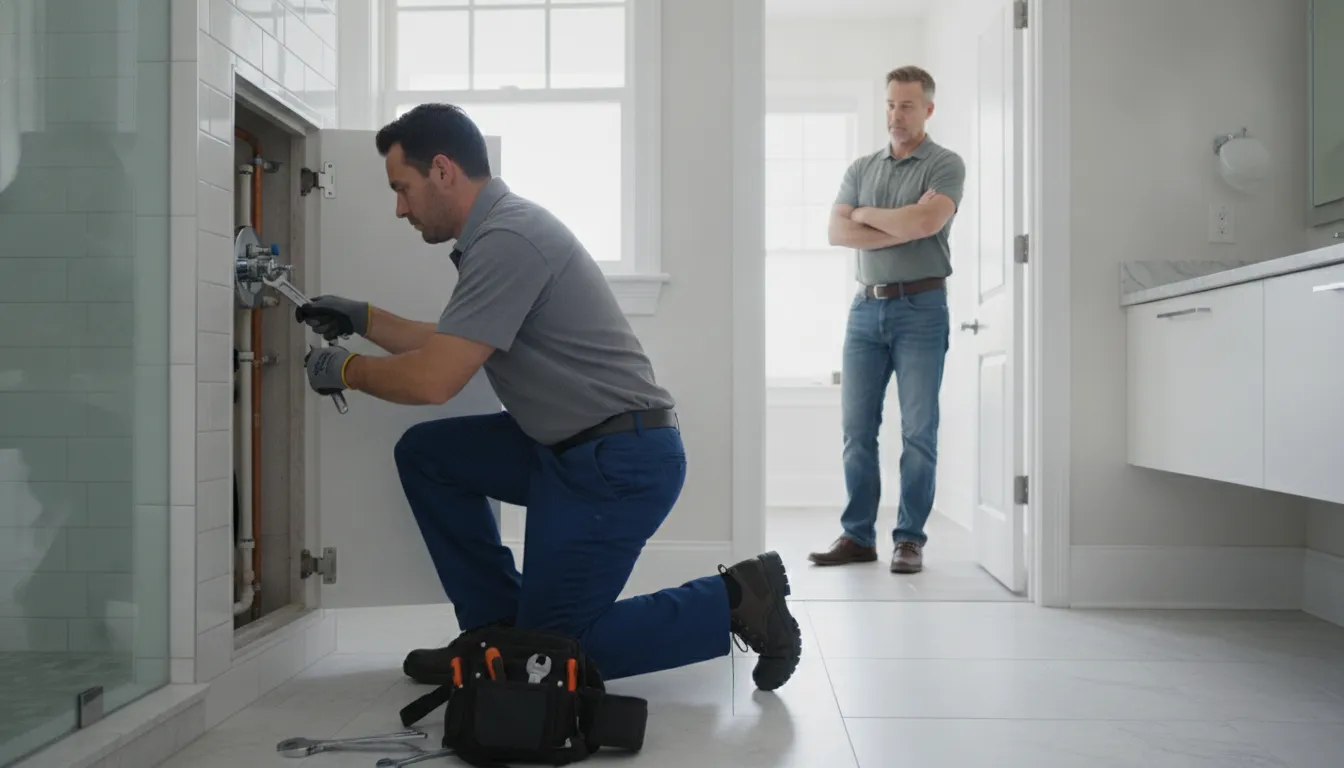
A shower that suddenly turns cold, stays hot, drips after you shut it off, or loses pressure may have a problem inside the shower valve. The valve controls how hot and cold water mix and how water reaches the showerhead. When its cartridge, seals, connections, or internal parts wear out, the symptom may appear at the handle or behind the wall.
Shower valve repair is usually needed when temperature changes are hard to control, water continues dripping after shutoff. Pressure drops at one shower, or moisture appears around the wall or ceiling below it.
Homeowners can document symptoms and check visible areas. A plumber should handle work that requires opening the wall, cutting pipe, or removing a stuck valve.
Some shower problems come from a clogged showerhead, a worn handle, or a whole-home pressure issue rather than the valve itself. The goal is not to guess at a hidden repair. It is to recognize the pattern, limit water damage, and give a plumbing professional useful information about what changed.
Contact Space Coast Cooling & Plumbing for help with a shower valve problem.
What does a shower valve do?
A shower valve is the control assembly behind the trim plate and handle. In a single-handle shower, it balances hot and cold water as you turn the handle. In a two-handle shower, separate controls regulate the hot and cold sides. Some valves also include pressure-balancing or temperature-limiting features that help reduce sudden changes when another fixture uses water.
The decorative handle and trim are only the visible portion. The working parts can include a cartridge, washers, seals, retaining clips, stems, or mixing components. The exact design depends on the age, brand, and style of the fixture. That is why a replacement part should match the existing valve instead of being selected only by appearance.
A shower valve issue can be easy to confuse with a showerhead restriction or a water-heater problem. If every faucet in the home has the same temperature or pressure change, the cause may be outside the shower. If only one shower behaves differently, the valve or nearby fixture deserves closer attention.
Valve symptoms versus showerhead symptoms
| What you notice | Possible area to check | When to stop troubleshooting |
|---|---|---|
| Weak spray only at the showerhead | Showerhead screen, mineral buildup, or flow restrictor | Stop if the fitting is corroded or begins leaking at the wall. |
| Temperature changes at one shower | Valve cartridge, balancing part, or handle assembly | Call a plumber if temperature remains unsafe or unpredictable. |
| Low pressure at several fixtures | Home supply, shutoff, pressure regulator, or broader plumbing issue | Arrange an evaluation instead of changing the shower valve first. |
| Water appears around the wall or ceiling | Supply connection, valve body, drain, or shower enclosure | Stop using the shower and request leak detection. |
This comparison is only a starting point. A visible symptom does not identify the hidden part with certainty. A plumber can isolate the source before recommending repair or replacement.
Does a shower that changes temperature need valve repair?
Temperature changes are one of the clearest reasons to investigate a shower valve. You may set the handle at a familiar position, then notice that the water becomes much hotter or colder than expected. The change may happen while the shower is running, when another fixture is used, or when the handle is moved only slightly.
A worn cartridge or pressure-balancing component can make the valve less consistent. In older fixtures, mineral deposits or damaged seals may also affect how the internal parts move. A loose handle can make the control feel imprecise, but tightening the visible screw does not correct a failing part behind the trim.
Observe the pattern without disassembling the valve. Note whether the issue occurs only in one bathroom, whether another faucet is running, and whether the shower ever becomes too hot to use safely. If the shower temperature is unpredictable, do not keep testing it against your skin. Stop using it until the cause is assessed.
Safe observations to record
- Whether the temperature changes while the handle stays still.
- Whether the problem happens when a toilet, faucet, washing machine, or other shower uses water.
- Whether the handle feels loose, stiff, gritty, or difficult to turn.
- Whether the shower is single-handle or multi-handle.
- Any brand name or model marking visible on the trim or handle.
These details help a plumber prepare for the appointment and distinguish a control issue from a broader pressure or supply concern. Do not remove the trim plate simply to look farther into the wall. A missing seal or damaged opening can allow water into the wall cavity.
Why does a shower drip after the handle is shut off?
A few drops that drain from the showerhead immediately after use may be leftover water in the shower arm or head. A continuing drip, a drip that returns after the fixture has been idle, or water that comes from behind the trim is different. It can indicate that the valve is not fully stopping the flow.
Inside the valve, a cartridge, stem, washer, or seal may be worn or damaged. Corrosion or mineral buildup can prevent a part from seating correctly. If the drip is at the handle or trim plate, the leak may be reaching the front of the wall. If it is inside the wall, the visible water may be only a small clue to a larger problem.
Place a dry towel around the trim and check it after the shower has been off for a while. Do not seal around the trim with caulk before the source is known. Caulk can hide the path of water and make future inspection harder. If the drip continues, limit use of that shower and schedule a plumbing inspection.
A leak that reaches the wall, baseboard, floor, or ceiling below needs prompt attention. Space Coast Cooling & Plumbing provides leak detection and plumbing repair across Brevard County. You can also review the local plumbing services guide for an overview of situations that may need professional help.
Can low shower pressure be caused by the valve?
Yes, but the valve is not the only possible cause. A clogged showerhead can restrict spray at the outlet. A partially closed shutoff, a pressure problem affecting the home, or buildup in a supply line can also reduce flow. When low pressure affects only one shower and the rest of the home's fixtures work normally, the shower valve becomes more likely to be part of the problem.
Start with a visual comparison. Run the affected shower and compare it with another shower or faucet without changing hidden plumbing. Notice whether hot and cold flow are affected equally. If one side is weak, the valve or its internal passage may be restricted. If both sides are weak at multiple fixtures, changing the shower valve may not solve the actual issue.
Checks homeowners can make without opening the wall
- Confirm the handle is fully open according to the fixture's normal range. Do not force a stiff handle.
- Look for a visible shutoff that may have been closed during another repair. Do not remove access panels or disturb a concealed valve.
- Compare pressure at another nearby fixture and record whether the issue is isolated.
- Inspect the showerhead for obvious surface buildup. Only remove it if the connection turns easily and does not flex the pipe in the wall.
- Stop if the fitting, trim, handle, or wall connection moves, leaks, or shows corrosion.
Never use a tool to force a seized shower component. Twisting the valve body or shower arm inside the wall can damage a connection that was not leaking before. A plumber can determine whether the restriction is in the head, cartridge, valve body, or supply piping.
What does moisture around the shower wall or ceiling mean?
Moisture near a shower should be treated as a possible leak until the source is clear. A damp trim plate, bubbling paint, soft drywall, stained ceiling, musty odor. Or peeling baseboard can indicate water escaping from the valve, a supply connection, the shower pan, grout, or another part of the enclosure. The valve is one possibility, but the symptom should not be ignored.
Water can travel along framing or pipe before it becomes visible. A ceiling stain below the bathroom may appear far from the actual leak. Repeatedly using the shower to see whether the stain returns can increase damage. If the area is wet, stop using the fixture, keep people away from electrical equipment or unsafe flooring, and arrange an inspection.
Take photos of the moisture, note when it appears, and record whether it follows shower use. If you can safely reach a nearby shutoff without removing finishes, you may close it. Do not cut drywall, pull tile, or open a ceiling to find the valve unless a qualified professional has directed the work and the area is safe.
For hidden or difficult-to-locate water problems, professional leak detection can help identify the source before unnecessary demolition. The sooner the source is isolated, the easier it is to protect surrounding materials and plan the correct repair.
When should a plumber handle shower valve repair?
A plumber should handle the repair when the work goes beyond a visible handle adjustment or a simple observation. Opening a wall, cutting or soldering pipe, extracting a stuck cartridge, replacing a valve body. Or correcting a hidden leak can affect water supply, wall finishes, and the rest of the plumbing system.
Professional help is especially appropriate when you notice any of the following:
- Water continues to drip after the shower has been off for an extended period.
- The shower changes from hot to cold unexpectedly or cannot maintain a safe temperature.
- Moisture appears at the trim, wall, floor, baseboard, or ceiling below.
- The handle or cartridge is stuck, corroded, cracked, or difficult to identify.
- The valve is inaccessible behind tile, drywall, a tub surround, or another finished surface.
- Low pressure affects one shower and basic visible checks do not explain it.
- A previous repair used a mismatched part or the problem returned soon after repair.
- You are unsure how to shut off the water or cannot stop the flow.
Tell the plumber what you observed, when it began, and whether the problem is isolated to one shower. Include photos of the trim, handle, stains, or access area if they can be taken safely. A clear description is more useful than removing parts and possibly changing the evidence.
Request plumbing help for a leaking, dripping, or hard-to-control shower valve.
Repair or replacement: what happens during a professional evaluation?
A professional evaluation begins with the symptom and the accessible parts, not with an assumption that the entire valve must be replaced. The plumber may check the handle movement, trim, showerhead, nearby fixtures, visible connections, and the pattern of temperature or pressure changes. If there is moisture, the inspection may focus on tracing the source before any finish is opened.
If the valve uses a replaceable cartridge or stem and the valve body is sound, a targeted repair may be possible. If the body is corroded, damaged, inaccessible, or incompatible with available parts, replacement may be the more dependable option. The appropriate approach depends on the fixture design, condition, access, and local plumbing requirements.
Ask what was found, what part is being recommended, and what access the work requires. Space Coast Cooling & Plumbing emphasizes upfront pricing and clear explanations before work begins. The company serves homeowners and businesses in Cocoa, Melbourne, Palm Bay, Titusville, Merritt Island, Rockledge, Cocoa Beach, Cape Canaveral, and surrounding Space Coast communities.
Frequently asked questions about shower valve repair
Can I replace a shower valve myself?
A homeowner may be able to document symptoms or identify the visible fixture style. But replacing a valve often involves shutting off water, accessing concealed plumbing, and making secure connections. If the valve is behind a finished wall, stuck, corroded, or connected to piping you cannot confidently identify, have a plumber handle the work. A small mistake can create a hidden leak.
Do I need a plumber to replace a shower valve?
You should call a plumber when the valve is inaccessible, the water will not shut off. The component is stuck, the wall shows moisture, or the repair requires cutting pipe or opening finishes. A plumber can also help when temperature or pressure symptoms may come from a larger plumbing issue rather than the visible valve.
How do I know whether the shower valve or showerhead is the problem?
If only the spray pattern is weak, inspect the showerhead for obvious buildup without forcing the connection. If temperature control is inconsistent, water continues after shutoff, or the problem affects the handle and one shower only, the valve deserves attention. If several fixtures have low pressure or temperature changes, request a broader evaluation.
How long does a shower valve last?
There is no single lifespan that applies to every valve. Water conditions, fixture quality, use, maintenance, corrosion, and prior repairs all affect service life. Repeated leaks, difficult operation, unstable temperature, and unavailable replacement parts are practical reasons to ask whether repair or replacement makes more sense.
What should I do if water is leaking behind the shower wall?
Stop using the shower, protect nearby flooring, and shut off an accessible water supply if you can do so safely. Do not open the wall or keep running the shower to test the leak. Take photos and arrange plumbing or leak-detection service so the source can be identified before damage spreads.