
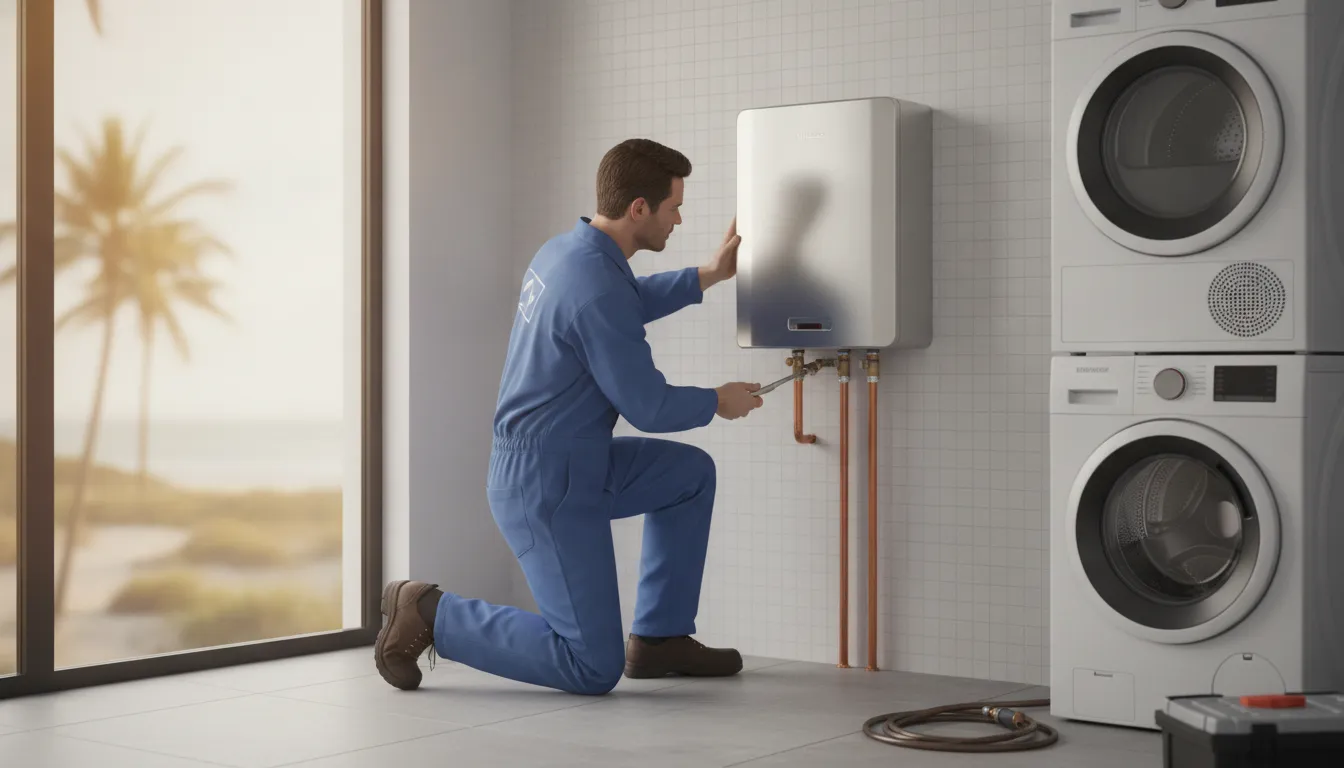
Replacing a storage water heater with a tankless system can mean a higher upfront bill, especially when a Brevard County home needs gas-line, electrical, venting, or code updates. Before you compare quotes, schedule a professional water-heater assessment so the system is sized for your household and existing utilities. Our plumbing services cost guide can also help you put the project in context.
Book tankless water heater installation with Space Coast Cooling & Plumbing.
The tankless water heater installation cost florida homeowners typically see is about $1,800 to $4,500 installed. Your final price depends on the unit, fuel type, flow-rate requirements, labor, permits, and whether the home needs a gas-line or electrical upgrade.
Understanding how those costs fit together makes it easier to compare gas and electric options and decide whether tankless is a practical long-term investment. Start with the typical Florida installation breakdown.
How much does a tankless water heater cost to install in Florida?
For most Florida homeowners, a tankless water heater installation costs about $1,800 to $4,500 from start to finish. That range includes the unit, labor, required connections, permits, and removal of the old water heater. A straightforward replacement may land near the lower end, while a home that needs new gas piping, electrical work, or venting changes can move toward the upper end. The best way to narrow the number is to have a qualified plumber evaluate your home's water demand and existing connections before choosing a model.
The equipment itself is only part of the investment. Electric whole-home units commonly cost about $500 to $1,200, while gas tankless units generally range from $700 to $2,000 for the unit alone. Gas models can cost more because the installation may require changes to gas supply and venting. The U.S. Department of Energy also notes that gas-fired units typically provide higher flow rates than electric models. So household size and simultaneous hot-water use can affect which option is appropriate.
For a typical retrofit, installation labor may add $400 to $900. That work can include disconnecting the old heater, adapting water lines, mounting the new unit, connecting controls, testing temperature and flow, and completing startup procedures. If the existing setup is not ready for the selected system, additional work may include:
- Gas line or electrical upgrades: Budget approximately $300 to $800 when the home needs added capacity or a new connection.
- Permits and old-heater removal: These items can add about $200 to $500, depending on the project and local requirements.
- Location and venting changes: Moving the heater or installing a gas model in a new location can require more materials and labor than a direct replacement.
Capacity is another important cost driver. A system must match the home's peak demand, including showers, laundry, and appliances that may run at the same time. Selecting a unit based only on the purchase price can lead to inadequate hot water or an unnecessary electrical and gas upgrade. Ask for a written estimate that separates equipment, labor, permits, removal, and any required utility work. That makes it easier to compare proposals and understand exactly what you are paying for.
For additional context on plumbing project pricing, review our plumbing services cost guide before scheduling an installation.
Gas vs electric tankless water heaters: which is better in Florida?
Both fuel types can provide hot water on demand, but the better choice depends on your home's existing utilities, household demand, and available installation space. Gas models usually cost more for the unit itself, while electric models may be simpler when a home does not already have a suitable gas connection. Comparing the full installation, not just the equipment price, gives you a more realistic view of tankless water heater installation cost in Florida.
| Fuel type | Typical unit cost | Installation needs | Best fit |
|---|---|---|---|
| Electric | $500-$1,200 for the unit | May require adequate electrical capacity, dedicated circuits, and wiring changes. It does not require gas piping or combustion venting. | Homes without gas service, smaller households, and point-of-use applications where demand is limited. |
| Gas | $700-$2,000 for the unit | Requires a suitable gas supply, correct venting and clearances, and possibly a new gas line or related upgrades. Condensing models also need compliant condensate removal. | Larger households or homes that need higher flow rates and may run several hot-water fixtures close together. |
Gas-fired tankless water heaters generally produce higher flow rates than electric models. That matters when a household may run a shower while a washing machine or dishwasher is using hot water. However, no tankless system has unlimited capacity. Typical output is about 2 to 5 gallons per minute, and the largest gas-fired model may still struggle with several simultaneous uses in a large household. A professional installer should calculate the practical maximum flow rate and required temperature rise before recommending a unit.
Electric equipment can be a practical choice when the home has no natural gas service or when the installation is limited to one fixture or a smaller demand zone. The tradeoff is that whole-home electric systems may need substantial electrical capacity. A panel or service upgrade can change the project cost significantly, so the existing electrical system should be evaluated before choosing a model.
Energy use is another consideration. For homes using 41 gallons or less of hot water daily. Demand water heaters can be 24% to 34% more energy efficient than conventional storage tank heaters, according to the U.S. Department of Energy. The right fuel choice still depends on demand, utility availability, and installation requirements. Review our tankless vs traditional water heater guide before deciding whether the technology fits your home.
Tankless water heater brands and models: what affects price?
The brand name matters, but the model's capacity and design usually have a greater effect on the estimate. A compact point-of-use unit may cost far less than a whole-home system sized to serve several fixtures. The right choice depends on how much hot water your household uses at the same time, not simply on selecting the most recognizable label.
Capacity and flow rate
Tankless heaters are rated by flow, measured in gallons per minute (GPM). A larger home may need a higher-capacity model if showers, laundry, and a dishwasher could run together. If one unit cannot meet that demand comfortably, an installer may recommend two units or separate units for high-demand appliances. ENERGY STAR notes that separate tankless heaters can be sized for specific needs, and its guide to whole-home tankless water heaters explains how efficiency and capacity work together.
- Lower-capacity models: Often fit a smaller home, a guest suite, or a point-of-use application.
- Higher-capacity models: Cost more but can better support multiple fixtures and a larger household.
- Multiple-unit designs: May solve high demand without forcing one unit to handle every fixture.
Brand tier and heater design
Entry-level models generally have fewer control options and a narrower capacity range. Mid-range and premium models may offer improved controls, freeze protection, recirculation compatibility, longer parts availability, or stronger warranty coverage. Those features can raise the equipment price, although the value depends on how the system will be used and maintained.
Gas models typically cost more than electric models. As a general equipment-only reference, electric tankless units are commonly priced around $500 to $1,200, while gas units often range from $700 to $2,000. Condensing gas models can reach higher price points because they recover more heat through a secondary heat exchanger and require additional venting and condensate considerations.
Installation requirements can change the model's final price
A model that fits the household's flow needs may still require upgrades before it can be installed. A new gas line or electrical upgrade can add approximately $300 to $800. Gas supply, venting, and the existing service should be evaluated before choosing a brand or model. Comparing written estimates for the complete installation, rather than comparing equipment prices alone, gives Florida homeowners a more realistic view of tankless water heater installation cost.
Labor costs for tankless water heater installation in Brevard County
When comparing the tankless water heater installation cost florida homeowners see in estimates, labor should be treated as its own line item. The price of the heater is only one part of the project. Labor reflects how much work is needed to adapt your home's existing plumbing, gas, electrical, venting, and drainage setup for a demand-style system.
For a straightforward retrofit, installation labor commonly falls between $400 and $900. That range assumes the existing connections are reasonably accessible and the new unit can be installed without major changes. A simple replacement in the same location may stay near the lower end. Relocating the heater, opening finished walls, or correcting older connections can move the project toward the upper end.
Other project items can add to the labor total. Permits, electrical service upgrades, and removal of the old water heater may add approximately $200 to $500, depending on what the installation requires. If the home needs a new gas line or an electrical upgrade to support the selected model, that work may add another $300 to $800. These costs are not signs that a contractor is charging for the unit twice. They pay for separate materials, skilled work, inspections, and code-related improvements. Cost ranges for plumbing repairs and replacements can vary for the same reason, so it helps to get a written, itemized estimate before comparing proposals.
Why retrofit complexity matters
Gas and electric systems create different installation requirements. A gas model may need an appropriately sized gas supply, approved venting, and adequate clearances. An electric model may require a dedicated, high-amperage circuit and electrical panel capacity. The installer should also confirm that the chosen system can meet the home's hot-water demand without overloading the available flow rate.
That evaluation is especially important when several fixtures may run at once. A professional should review the home's expected usage, inspect the existing connections, and explain whether upgrades are necessary before work begins. Proper installation matters: ENERGY STAR's whole-home tankless water heater guidance explains why correct sizing and installation support reliable, energy-efficient operation.
For a clear scope and fewer surprises, ask for an itemized estimate that separates the unit, base labor, permits, removal, and gas or electrical work. Space Coast Cooling & Plumbing can review your current setup and discuss water heater installation services for your Brevard County home.
Is a tankless water heater worth the upfront cost in Florida?
For many Florida homeowners, a tankless water heater can be worth paying more upfront. But the right choice depends on household demand, maintenance expectations, and how long you plan to stay in the home. A storage tank may have a lower purchase price, while a properly sized tankless system can deliver longer service life and lower standby energy waste over time.
Long-term value comes from service life and efficiency
The U.S. Department of Energy reports that most tankless water heaters have a life expectancy of more than 20 years. Compared with roughly 10 to 15 years for conventional storage water heaters. That longer lifespan may reduce the frequency of full replacements, especially when the system receives appropriate maintenance. ENERGY STAR similarly highlights a longer lifespan for gas tankless systems in its whole-home tankless water heater benefits and savings guide.
Energy savings can also improve the long-term value. For homes using 41 gallons or less of hot water per day, demand water heaters may be 24% to 34% more energy efficient than conventional tank models. Tankless systems heat water when it is needed, so they avoid the standby heat losses created when a storage tank repeatedly reheats water that is not being used. Actual savings vary with water use, utility rates, unit efficiency, and installation design, so efficiency alone should not be treated as a guaranteed payback.
Florida maintenance affects the calculation
Florida homeowners also need to budget for regular maintenance. Local water conditions can contribute to lime and scale buildup, and tankless systems often require annual lime and scale removal. The Florida Home Energy resource on tankless water heaters identifies annual scale maintenance as an important consideration. Skipping that service can reduce performance and make the system less attractive financially, even if the equipment itself has a long rated life.
When a tank may still be the better value
A conventional tank may make more sense when the lowest initial price is the priority, the household expects to move soon. Or hot water demand is modest enough that the added efficiency will not offset the installation premium. Tankless systems also need to be sized for the home's peak demand. If several showers, appliances, or fixtures run at once, a single unit may not provide enough flow for every use. A professional evaluation can compare expected usage, available electrical or gas service, maintenance needs, and the home's ownership timeline before you commit.
Financing a tankless water heater installation: GreenSky and other options
A tankless water heater can be a worthwhile upgrade, but the upfront price deserves a realistic place in your household budget. In Florida, a complete installation commonly falls between $1,800 and $4,500, depending on the unit, home layout, required electrical or gas work, and installation complexity. Financing can help Brevard County homeowners spread that cost over manageable monthly payments instead of postponing a needed replacement.
GreenSky is one financing option that some home improvement contractors offer. Depending on the approved terms and current promotion, a homeowner may be able to choose a promotional period, fixed monthly payments, or another structured payment arrangement. Availability, interest rates, fees, and eligibility vary, so review the agreement carefully and ask what happens when a promotional period ends.
Other possibilities may include manufacturer financing specials, a bank or credit-union home improvement loan, or a contractor payment plan. Manufacturer offers can sometimes apply to a specific brand or model rather than every installation. A personal loan or home improvement loan may provide a predictable schedule, while a contractor plan can be convenient when it is clearly documented. Compare the total repayment amount, not only the monthly payment, before choosing an option.
Ask about financing when you request your quote for water heater installation services. A professional evaluation should identify the recommended system, the work needed to connect it safely, and the complete project price. Request those details in writing so you can compare financing offers against the actual scope of work. It is also worth asking whether permits, removal of the old heater, upgrades, and future maintenance are included or billed separately.
Financing should support a sound installation decision, not pressure you into a system that does not fit your home. Discuss your household's hot-water demand, available gas or electrical capacity, and budget with a qualified plumber before signing an agreement.
Frequently Asked Questions
What is the average cost to install a tankless water heater in Florida?
A complete Florida installation typically costs $1,800 to $4,500, including the unit, labor, and standard project requirements. The final quote depends on whether you choose gas or electric, the home's existing connections, system capacity, permits, and any required gas or electrical upgrades. A written estimate should separate equipment, labor, and additional work.
Is $1,900 a fair price for a tankless water heater installation?
It can be a reasonable price for a straightforward installation, especially when existing plumbing, electrical service, or gas connections are suitable. Confirm what the quote includes before comparing it with other bids. A lower price may exclude permits, removal of the old heater, venting, a required circuit, or other site-specific work.
How long does a tankless water heater installation usually take?
A simple replacement may take several hours, but a retrofit can take longer if the installer must modify water lines. Install a larger electrical circuit, upgrade gas piping, or adjust venting. The contractor should inspect the installation location and explain the expected schedule before work begins.
Does installation cost depend on choosing gas or electric?
Yes. Electric units often need high-amperage circuits, while gas units may require correctly sized gas piping, venting, and condensate drainage for some models. Gas systems generally provide higher flow rates, while electric systems can be a practical fit when the home's electrical service supports the demand. A qualified contractor can size the unit for your simultaneous hot-water needs.
Ready to plan your tankless water heater installation?
A professional assessment can help you compare system options, confirm your home's requirements, and understand the installation scope before work begins. Contact Space Coast Cooling & Plumbing to discuss tankless water heater installation for your Brevard County home.