
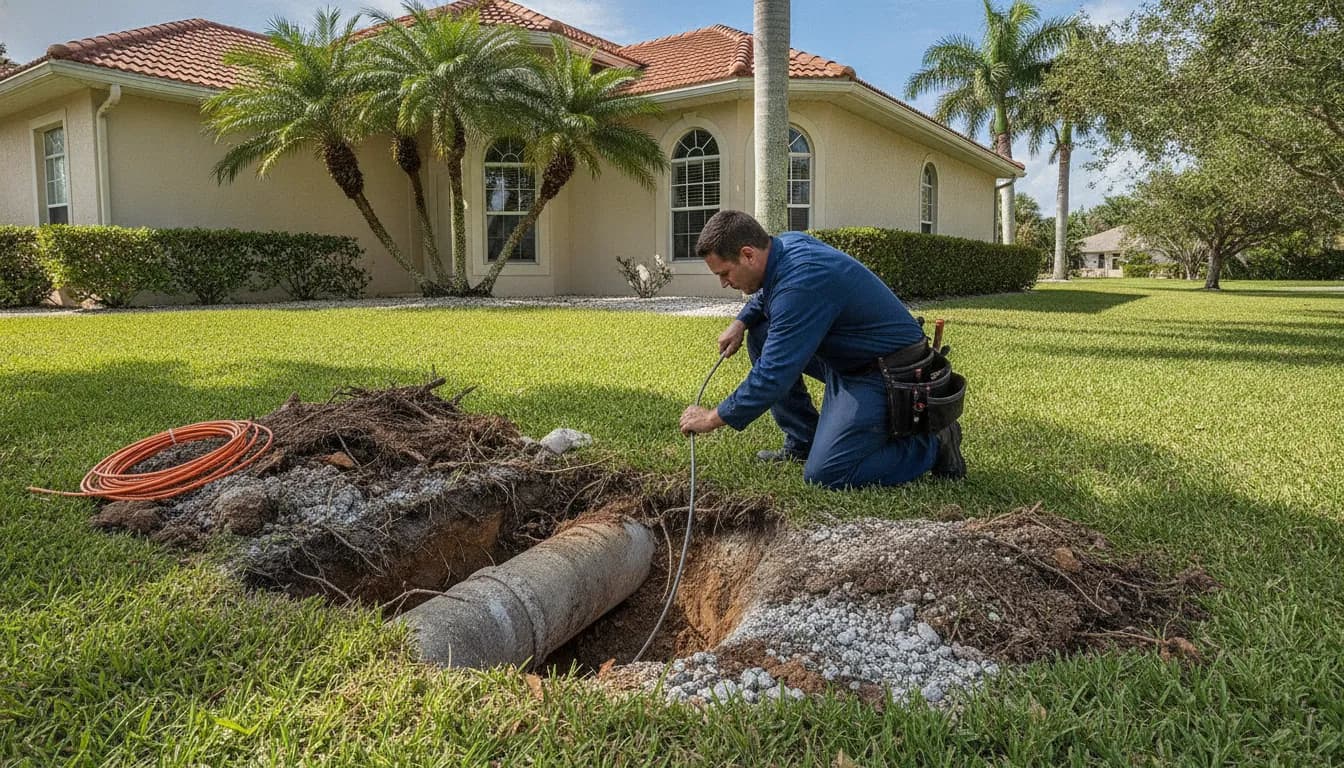
When a sewer camera finds roots inside your line, the problem is more than an inconvenient clog. Roots can enter through small cracks or loose joints while seeking moisture, then grow into blockages that cause slow drains, gurgling, unpleasant odors, or sewage backups. Schedule a professional inspection before repeated backups damage your home, and review our complete plumbing repair cost guide to understand the factors that can affect repair decisions in Brevard County.
Contact Space Coast Cooling & Plumbing to book a sewer camera inspection and get a clear answer about your root intrusion before the problem worsens.
Tree root intrusion sewer line problems are usually addressed by clearing the roots. Inspecting the pipe's condition, and choosing between ongoing maintenance, relining, or replacement when damage is severe.
Tree root intrusion sewer line damage can often be cleared with professional mechanical cutting or another appropriate cleaning method. But roots may return if cracks or failing joints remain. A sewer camera inspection helps determine whether the line needs cleaning, repair, relining, or replacement.
The right fix depends on how roots entered the pipe, the material and age of the line, and whether the surrounding pipe is still structurally sound. Understanding how roots find these weak points is the first step toward preventing another disruptive backup.
How Do Tree Roots Get Into Sewer Lines?
Tree roots do not need a large opening to reach a sewer pipe. They follow moisture and nutrients in the soil, then enter through a small crack, loose joint, or failing connection. As roots grow inside the line, they can catch paper and debris, narrow the passage, and eventually contribute to slow drains, backups, or sewage overflows.
Most sewer pipes are designed to carry wastewater, not to keep surrounding soil completely dry. When a joint separates slightly or a pipe wall develops a hairline crack, water can escape into the soil. That damp area becomes attractive to nearby roots, especially during periods when the surrounding ground is less moist. A root tip can work into the opening and continue growing wherever it finds water.
The problem can become self-reinforcing. As roots expand, they place pressure on the opening and create a rough surface inside the pipe. More roots can follow the same path, forming a dense mass that restricts flow. The wastewater may still move at first, so a homeowner might notice only occasional gurgling or a drain that takes longer to empty. Once the root mass catches enough debris, the line can clog quickly.
Pipe age and material also affect the risk. Older homes may have clay or cast-iron sewer lines with joints that have loosened over time. Some older properties may also contain Orangeburg pipe, a bituminized fiber material that is particularly vulnerable to root invasion. These materials do not automatically mean a sewer line will fail, but they make the condition and tightness of the joints more important to evaluate.
Root intrusion is not just a minor landscaping issue. The U.S. Environmental Protection Agency identifies tree roots as a frequent source of sewer blockages and recognizes root intrusion as one of the leading contributors to sanitary sewer overflows. EPA guidance on sanitary sewer overflows explains how roots can enter through cracks or joints while seeking moisture.
A sewer camera inspection can show whether roots are present, where they entered, and whether the pipe itself is cracked, separated, or collapsed. That distinction matters because cutting away the visible roots may provide only temporary relief when the opening remains. Addressing the damaged section may be necessary to prevent the same blockage from returning.
Signs You Have Tree Root Intrusion in Your Pipes
Tree root intrusion can develop quietly before it becomes a sewage backup. The earliest clues often appear as changes in how fixtures drain, unusual sounds, or wet areas outside. Paying attention to these patterns can help you schedule an inspection before a blockage disrupts your household.
Slow drains throughout the house
A single slow sink usually points to a local fixture or branch-drain problem. Root intrusion is more concerning when several fixtures drain slowly throughout the entire house. You may notice the kitchen sink, bathroom sinks, shower, and toilet becoming sluggish around the same time. This broader pattern can indicate that wastewater is meeting resistance in the main sewer line rather than in one room.
Gurgling, sewage odors, and repeated backups
Listen for bubbling or gurgling sounds after a toilet flush, shower, or washing-machine cycle. Those noises can occur when trapped air and wastewater move around an obstruction in the sewer line. Sewage or rotten-egg smells coming from multiple drains are another warning sign, especially when the odor returns after cleaning the affected fixture.
Repeated backups deserve prompt attention, particularly when plunging or drain-cleaning products provide only temporary relief. Roots can create an obstruction that continues to collect paper and other waste. The result may be a backup that keeps returning, rather than a one-time clog that clears and stays gone. The EPA identifies tree roots as a frequent cause of sewer blockages that can result in sewage backups and overflows: EPA sewer overflow guidance.
Unusual green or wet patches in the yard
Walk the area where your sewer line is likely to run from the home toward the street. An unexplained strip of unusually lush, fast-growing grass or a wet, soft patch can indicate moisture escaping from a damaged sewer pipe. This clue is more meaningful when it appears alongside slow drains, odors, or recurring backups. Do not assume that a green patch proves root intrusion, since irrigation, rainfall, and other leaks can create similar conditions.
A camera inspection confirms the cause
These symptoms can point to a sewer-line problem, but they cannot show whether roots are present, where they entered, or how much damage has occurred. A professional camera inspection provides a live view inside the pipe and can locate the obstruction and assess the pipe's condition. It is the only reliable way to confirm tree root intrusion sewer line problems before choosing between cleaning, repair, relining, or replacement.
If several warning signs are appearing, schedule a sewer camera inspection in Brevard County so the next step is based on what is actually inside the pipe.
Why Florida Tree Roots Are Especially Aggressive in Sewer Lines
Brevard County homeowners deal with a longer root-growth season than homeowners in colder climates. Florida's warm, humid conditions and frequent rainfall support vigorous root growth throughout much of the year. That does not mean every tree will damage a sewer line. But it does give roots more opportunities to find moisture and nutrients around a cracked pipe or loose joint.
Roots naturally follow favorable conditions underground. The University of Florida's Institute of Food and Agricultural Sciences explains that roots may grow beneath hardscape when soil oxygen and moisture are more suitable there. A small leak from a sewer connection can create the same kind of attractive pathway. Once roots reach that opening, they can continue growing inside the pipe and trap paper, grease, and other debris. Read more from UF/IFAS about urban tree roots.
Warm weather keeps the problem active
In Melbourne, Palm Bay, Cocoa, and nearby Space Coast communities, root intrusion is not limited to one short spring season. Florida's consistent growing conditions can make tree roots an ongoing concern. If a sewer line has a weak connection, periodic cleaning may control a minor intrusion, but roots can return as the plant continues to grow. That is why repeated slow drains, gurgling fixtures, or sewer backups deserve more than a quick drain-clearing visit.
The risk also depends on what was planted and where it was planted. Trees with aggressive root systems, including certain willows and maples, can create problems when placed too close to underground utilities. Mature trees may send roots well beyond the visible canopy. So the trunk's distance from the house does not always show how close the root system is to the sewer route. Before planting large trees or shrubs, homeowners should identify the location of the private sewer line and leave appropriate room for future growth.
Why root intrusion deserves prompt attention
Tree root intrusion is more than a landscaping concern. The Environmental Protection Agency identifies it as one of the leading contributors to sanitary sewer overflows. A blockage can begin with symptoms that seem manageable, then worsen until wastewater backs up into the home or surfaces in the yard. If several fixtures drain slowly, the yard develops an unexplained wet or unusually lush area, or a backup keeps returning after cleaning. A sewer camera inspection can show whether roots are involved and how far the damage extends.
Early diagnosis gives Brevard homeowners more options. A professional can determine whether recurring cleaning is reasonable or whether the pipe needs a more lasting repair. The goal is not to remove a healthy tree unnecessarily. It is to address the failed pipe section before Florida's year-round growing conditions turn a small opening into a larger plumbing emergency.
Tree Root Removal Methods: Cutting vs Chemical vs Hydro Jetting
When roots are blocking a sewer line, the right removal method depends on how dense the growth is. Whether the pipe is structurally sound, and how often the problem returns. A plumber may use mechanical cutting, a chemical root inhibitor, or high-pressure water to restore flow. These methods can relieve an active blockage, but they do not all address the damaged pipe that allowed roots to enter in the first place.
The U.S. Environmental Protection Agency identifies mechanical root cutters and chemical root-control products as common professional approaches for sewer root management. The EPA also notes that minor root infiltration may require periodic professional cleaning. So homeowners should view cutting and chemical treatment as maintenance when the underlying pipe remains compromised, not as a guaranteed permanent repair. See our plumbing repair cost guide for broader cost context.
| Method | What it does | Best fit | Important limitation |
|---|---|---|---|
| Mechanical root cutting | A rotating cutter breaks through roots inside the pipe and clears the immediate obstruction. | Dense growth causing slow drains, gurgling, or a sewage backup when the pipe is still usable. | Roots can grow back through the same crack or loose joint, making periodic cleaning necessary. |
| Chemical root inhibitors | A professional applies a root-control product intended to kill or slow root growth inside the line. | Follow-up maintenance after cleaning or limited infiltration that is not causing a major structural failure. | It does not rebuild a broken pipe or permanently seal the entry point. Treatments may need to recur. |
| Hydro jetting | High-pressure water scours the pipe walls and flushes loosened roots, sludge, and other buildup from the line. | Heavy buildup or a stubborn blockage that needs thorough cleaning after the line is evaluated. | It may clear the passage without correcting a cracked, collapsed, or badly deteriorated pipe. |
How professionals choose between the methods
A sewer camera inspection helps show whether roots are occupying one joint, filling a longer section, or entering a pipe that is already damaged. That information matters before aggressive cleaning. If the pipe has adequate structure, cutting or hydro jetting services may restore flow, followed by a maintenance plan when roots continue to return. Chemical inhibitors may be considered as part of that recurring plan, but they should not be treated as a substitute for a repair evaluation.
When roots have structurally compromised the line, repeated cleaning can become an expensive cycle. The affected section may need repair, replacement, or trenchless lining to create a more durable barrier against new intrusion. A professional can explain the findings, the expected maintenance interval, and whether the condition justifies a larger repair.
When Does Tree Root Intrusion in Your Sewer Line Require Replacement?
Tree root intrusion sewer line problems do not automatically mean your yard needs to be dug up. If roots are blocking an otherwise sound pipe, professional cutting or cleaning may restore flow. Replacement becomes more likely when the pipe itself is cracked, collapsed, badly separated at the joints, or too damaged to hold its shape after the roots are removed.
When cleaning is only a temporary solution
Root cutting can clear an immediate blockage, but it does not close the crack or loose joint that allowed the roots inside. Small amounts of infiltration can often be managed with periodic professional cleaning, especially when the pipe remains structurally sound. In Florida, that may mean planning for recurring maintenance because warm, humid conditions support year-round root growth. The U.S. Environmental Protection Agency notes that severe root intrusion may require the affected section to be repaired, replaced, or relined.
Look more closely at the pipe when symptoms return soon after cleaning. Repeated backups, slow drains throughout the house, sewage odors, or a wet and unusually lush strip of yard can point to a continuing leak or obstruction. A sewer camera inspection provides a live view of the line, shows where the roots entered. And helps determine whether the problem is limited to buildup or involves structural damage. That information is more useful than choosing replacement based only on the age of the home or the presence of nearby trees.
Trenchless repair may avoid a full excavation
If the damaged section is accessible and suitable for rehabilitation, pipe lining can create a new, seamless pipe inside the existing one. A resin-impregnated liner is inserted into the old pipe and hardened in place. This trenchless approach can restore the pipe's interior without removing the entire driveway, patio, landscaping, or lawn.
Pipe bursting is another trenchless option. It breaks apart the old line while pulling a new pipe through the same general path. It can be useful when the existing pipe is too damaged for lining or when a new pipe diameter is needed. Although the property and site conditions determine whether it is appropriate. Ask the plumber to explain why lining, bursting, or excavation best fits the camera findings. For background on potential repair approaches and cost factors, see this sewer repair cost guide.
Full excavation is generally reserved for situations such as a collapsed line, extensive structural failure, severe displacement, or access limitations that make trenchless work unsuitable. Modern PVC and properly relined pipes have tighter, more durable joints that can resist future root penetration better than many older pipe materials. The practical goal is not the biggest repair. It is to correct the damaged section, restore dependable flow, and reduce the chance that the same roots return.
Most homeowners with root-related sewer symptoms need an inspection and a targeted solution, not an automatic full dig-up. A camera report can separate a manageable cleaning issue from damage that calls for repair or replacement.
How to Prevent Tree Roots From Damaging Your Sewer Line
Preventing tree root intrusion starts before roots reach the pipe. A few planning and maintenance habits can reduce the chance of backups, foul odors, wet spots, and expensive yard excavation. These steps are especially useful in Florida, where warm weather and regular rainfall support root growth through much of the year.
-
Find the sewer line before planting
Identify the route of the sewer line from your house to the municipal main before adding trees, shrubs, or large landscape plants. Check your property records, look for cleanouts, and ask a qualified plumber to help locate the line when its path is unclear. The University of Florida Institute of Food and Agricultural Sciences recommends planning utility locations carefully because cutting roots near existing utilities can seriously harm established trees. Its guidance is available in this utility installation guide. Treat the line as a protected corridor rather than planting directly above it.
-
Keep trees at least 10 feet from sewer pipes
As a practical minimum, plant trees at least 10 feet away from sewer pipes. Allow more room for mature trees with broad or aggressive root systems. Willow and certain maple varieties can be more likely to seek out leaking joints or cracks. Ask a local nursery about mature root spread, not just the size of the young tree in its container. Never assume a narrow planting bed will contain roots as the tree grows.
-
Choose landscape plants with care
Distance matters, but species selection matters too. Avoid placing aggressive-root trees near the sewer route, especially if the property has older clay, cast iron, or other pipes with vulnerable joints. A tree does not need to be directly over the line to create a problem. Roots follow moisture and nutrients in the soil, so a small leak can attract growth from outside the immediate planting area. If you are replacing a tree near underground utilities, select a lower-risk species with advice from a qualified local landscaper.
-
Keep drains clear and respond to warning signs
Do not flush grease, food waste, wipes, or other inappropriate materials. Keeping household drains clear helps maintain flow and prevents minor obstructions from becoming more severe when roots are present. Pay attention to slow drains throughout the home, gurgling, repeated backups, or a wet and unusually lush patch of grass. Do not wait for sewage to return into the house before investigating.
-
Schedule periodic maintenance and camera inspections
Routine maintenance can identify developing root growth before it causes a major blockage. Florida's year-round growing conditions make periodic checks more useful than treating sewer care as a one-time project. A sewer camera inspection in Brevard County provides a direct view of the pipe and can show the location and severity of intrusion without immediately digging up the yard. Consider an inspection if your home is older, has a history of backups, or sits near mature trees.
-
Know which section you are responsible for
Homeowners are generally responsible for the sewer line on their property, including the section connecting the house to the municipal main. Confirm local requirements and your utility's boundary before an emergency occurs. Knowing who to call and where the line runs can shorten the response when symptoms appear. While early professional attention may prevent a small root problem from becoming a damaged pipe.
These precautions cannot eliminate every risk, but they make root-related sewer problems easier to detect and less likely to become a surprise emergency.
Contact Space Coast Cooling & Plumbing to schedule a sewer camera inspection and the right root-intrusion repair for your Brevard County home.
Frequently Asked Questions
How can I tell whether tree roots are blocking my sewer line?
Warning signs include slow drains throughout the house, gurgling sounds, recurring backups, sewage odors, or an unusually wet or lush patch of yard. These symptoms can have other causes, so a sewer camera inspection is the most dependable way to confirm root intrusion and locate the affected section.
Can tree roots be removed without replacing the sewer pipe?
Sometimes. A professional may clear the blockage with a mechanical root cutter or use an approved chemical root-control product, depending on the pipe condition. If the roots entered through a crack, separated joint, or badly damaged section, removal alone may provide only temporary relief. Severe intrusion may require relining or replacing the affected pipe. The EPA identifies root cutting, chemical control, and repair or replacement as common responses to root-related sewer blockages: EPA sewer overflow guidance.
How serious is tree root intrusion in a sewer line?
It can become serious when roots restrict flow or damage the pipe enough to cause a sewage backup or an overflow. Do not ignore repeated symptoms, especially if multiple fixtures drain slowly or wastewater appears in the yard. Prompt inspection helps distinguish a manageable obstruction from a structural pipe problem.
Will tree roots grow back after sewer line cleaning?
They can. Cleaning removes the roots that are inside the pipe, but it may not correct the crack or joint that attracted them. Florida's warm, humid conditions and frequent rainfall support year-round root growth, so periodic inspection or maintenance may be appropriate after the initial repair. A plumber can recommend the next step after viewing the pipe's condition.
Can I fix tree root intrusion myself?
It is safer to avoid do-it-yourself cutting, digging, or chemical treatments. Without a camera inspection, you may miss a collapsed or cracked pipe, and digging near an established tree can damage significant roots. A professional inspection can identify the blockage, protect your property, and match the repair to the actual condition of the line.
Ready to Address Tree Root Intrusion?
Contact Space Coast Cooling & Plumbing to schedule a professional sewer camera inspection and root-intrusion repair for your Brevard County home.
A camera inspection can help identify where roots entered the line and guide the right repair approach. Our team can review the symptoms you are seeing and explain the next practical step for your sewer line.