
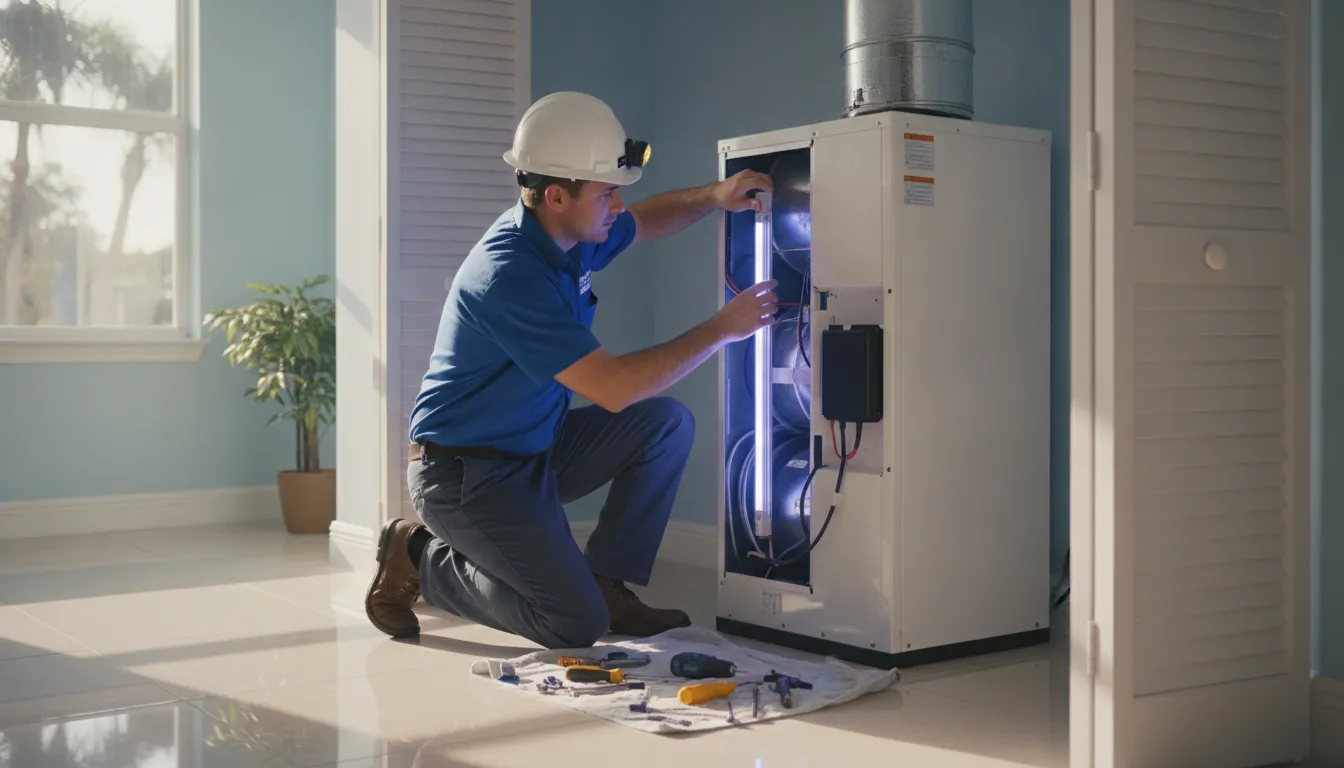
Florida homeowners ask a practical question before adding another component to the HVAC system: can ultraviolet light really improve indoor air quality? In a warm, humid climate, moisture can support biological growth on cooling coils and in drain pans. So the placement and purpose of the equipment matter as much as the lamp itself. This guide explains where UV systems fit within a broader indoor air quality plan.
Yes, UV air purifier installation florida homeowners choose can be worthwhile when a UVGI system is properly designed, shielded, and installed inside the HVAC system. It works alongside a suitable air filter, not as a replacement for filtration. And its performance depends on factors such as UV intensity and how long air remains in the treatment zone. The goal is targeted microbial control, not a magic fix for every indoor air concern.
Understanding what the light does, where technicians install it, and what it can realistically address makes it easier to decide whether this upgrade suits your home. Start with the basic operation of an HVAC-integrated UV purifier.
What Is a UV Air Purifier for HVAC and How Does It Work?
An in-duct UV air purifier is a small germicidal ultraviolet system installed inside or alongside your home's HVAC equipment. Unlike a portable purifier that cleans air in one room, an HVAC-integrated unit treats air as it moves through the central system. The lamp emits germicidal UV-C light into a controlled area, often near the evaporator coil, above the drain pan, or within an accessible section of ductwork.
As air passes through the treatment zone, UV-C energy can inactivate certain microorganisms by damaging their DNA or RNA. That damage prevents them from replicating. The process is not designed to make particles disappear, and it does not replace a properly sized HVAC filter. Instead, it adds another layer of indoor air quality support for microorganisms that pass through the system or settle on treated surfaces. The CDC explains how germicidal ultraviolet light inactivates microorganisms at the genetic level.
Where is a UV-C lamp installed?
Placement depends on the equipment layout, available access, and the intended purpose of the system. A lamp positioned near the cooling coil and drain pan can help limit mold and slime growth on those damp surfaces. In other installations, the lamp is placed in a return or supply duct so moving air receives exposure while the HVAC system operates.
Florida's long cooling season and humid conditions make coil and drain-pan placement especially relevant. Moisture and warmth can support biological growth inside equipment when maintenance or drainage problems are present. UV light may help keep treated surfaces cleaner, but it cannot correct standing water, poor drainage, dirty filters, excessive humidity, or an underlying HVAC defect.
Does the light neutralize everything in the air?
No. Results depend on the UV dose, which is affected by lamp intensity, airflow speed, and how long microorganisms remain in the treatment zone. The CDC notes that exposure time and UV intensity determine delivered dose. The EPA likewise reports that in-duct UVGI can be effective when the system is properly designed and installed, rather than treating every UV product as equally effective.
That is why professional design matters. The lamp must be positioned for useful exposure, safely shielded from occupants, and wired correctly for the HVAC system. A UV purifier works best as one part of a broader IAQ plan that includes filtration, humidity control, clean equipment, and regular service.
Does a UV Air Purifier Actually Improve Indoor Air Quality?
Yes, a UV air purifier can improve indoor air quality, but it is not a universal solution. Its effectiveness depends on how the system is designed, where the lamp is installed, and how long microorganisms remain exposed to the light. In other words, a properly installed system can provide useful microbial control, while an underpowered or poorly placed lamp may deliver limited results.
UV systems work by exposing microorganisms in the HVAC airstream to germicidal ultraviolet light. The CDC explains that the delivered UV dose depends on both light intensity and residence time, or how long the air and microorganisms remain within the UV zone. Air moving too quickly, a lamp with insufficient intensity, or an installation that does not provide adequate exposure can reduce performance. This is why the equipment specification and placement matter as much as the presence of a UV bulb. The CDC's germicidal ultraviolet guidance provides more detail on these design factors.
Research also supports a measured, realistic benefit. One peer-reviewed study reported a significant reduction in airborne and surface-borne bacteria when active germicidal ultraviolet disinfection was used in a controlled environment. That finding supports UV as a tool for reducing certain microorganisms. Not as proof that every home will experience the same result or that all indoor contaminants will be removed. Review the study's findings for its testing conditions and limitations.
What UV Purification Does and Does Not Remove
A UV lamp treats susceptible microorganisms that pass through its exposure zone and can also help address microbial growth on nearby HVAC surfaces, such as coils. It does not physically capture dust, pollen, pet dander, or other particles. It also does not replace a properly sized, high-efficiency air filter. The EPA describes UV air cleaners as complementary to high-efficiency filtration, not a substitute for it. Filtration captures particles, while UV adds another type of treatment for certain biological contaminants.
For Florida homeowners considering indoor air quality improvements, the strongest approach is usually layered: maintain the HVAC system, use the right filter. Control humidity, and consider UV when the equipment and home conditions make it appropriate. A professional evaluation can determine whether the airflow, lamp location, and exposure time are adequate before you invest in installation.
UV Air Purifiers and Mold Growth in Florida HVAC Systems
Florida's warm, humid air creates a demanding environment inside an air conditioner. As the system removes moisture, condensation collects on the cooling coil and in the drain pan. Those damp surfaces can accumulate organic debris and support mold or slime growth when they are not kept clean. Growth in these areas can restrict airflow, interfere with heat transfer, and contribute to recurring maintenance problems.
A properly positioned UV system can help address that specific HVAC concern. The U.S. Environmental Protection Agency explains that UV lights installed over cooling coils can prevent mold and slime from growing on the coil and in the drain pan. The same guidance notes that keeping these components cleaner can improve HVAC efficiency: EPA residential air-cleaner guidance.
Why Florida humidity makes coil protection important
In a dry climate, an HVAC coil may have less sustained moisture exposure. In Brevard County, however, air conditioners often operate through long, humid cooling seasons. Moisture, dust, and limited airflow around a neglected coil can create conditions where biological growth is more likely. That is why UV installation may be especially useful for Florida homeowners who have persistent humidity. Musty odors near supply vents, or a history of dirty coils and drain pans.
UV light does not remove every source of moisture, and it does not replace coil cleaning, drain maintenance, proper filtration, or humidity control. Instead, it works as one part of a broader indoor air quality strategy. A technician should inspect the coil, drain pan, ductwork, filter, and system airflow before recommending equipment.
Supporting efficiency and system longevity
Reducing biological buildup can help the coil transfer heat as designed and may reduce the strain associated with restricted or dirty components. It cannot make an aging system new, but it can support cleaner operation between scheduled service visits. A coil that stays cleaner is also easier for a technician to inspect during maintenance. Making it simpler to spot drainage or airflow issues before they become larger repair concerns.
For Florida homeowners considering UV air purifier installation, the best result comes from matching lamp placement and output to the equipment, then keeping the system maintained. That approach supports HVAC longevity without treating UV as a cure-all. Ask for an evaluation of the existing coil condition and humidity concerns before selecting a system.
UV Light vs HEPA Filter vs Whole-Home Air Purifier: Which Is Better?
These three approaches improve indoor air quality in different ways, so the best choice depends on what you want to control. A UV air purifier installation in Florida is designed primarily to address microorganisms inside the HVAC system. HEPA filtration is built to capture airborne particles. A whole-home air purification system is a broader setup that may combine filtration, air cleaning, and other treatment technologies throughout the home's airflow.
| Approach | What it addresses | Where it sits | Primary role |
|---|---|---|---|
| In-duct UV air purifier | Microorganisms exposed to germicidal UV light | Inside the HVAC cabinet or ductwork, often near the coil | Provides supplemental disinfection and helps limit biological growth on HVAC surfaces |
| HEPA filter | Fine airborne particulates, such as dust and other suspended particles | In a compatible return-air or whole-home filtration assembly | Physically captures particles as air passes through the filter |
| Whole-home air purifier | Depends on the equipment, but may address particles and selected airborne contaminants | Integrated with the central HVAC system | Delivers home-wide air treatment rather than relying on a single portable room unit |
UV light is not a replacement for high-efficiency filtration. The EPA describes UV air cleaners as a complementary technology that can add disinfection capability, rather than substitute for a suitable filter. In practical terms, a filter and UV system solve different problems: the filter captures particles. While UV treatment can inactivate certain microorganisms that receive an adequate dose of light. The results depend on system design, airflow, UV intensity, and exposure time.
For many Florida homes, combining technologies makes more sense than choosing one as a universal solution. High humidity can encourage microbial growth around cooling coils and drain pans, while everyday household dust still needs effective filtration. A properly selected whole-home system may bring those functions together, but it should be matched to the HVAC equipment and home's needs. A professional assessment can determine whether UV, HEPA filtration, or a combination is appropriate, without adding equipment that does not solve an actual IAQ concern.
Learn more through our indoor air quality guide for Florida homeowners.
How Much Does UV Air Purifier Installation Cost in Florida?
The cost of UV air purifier installation in Florida depends on the purifier model, the available space inside your HVAC system. Electrical access, and whether the system is installed near the evaporator coil or in the ductwork. As a planning estimate, many homeowners should expect equipment to fall in the low-to-mid hundreds of dollars. Professional labor to add several hundred dollars, and a complete installation to land in the mid-hundreds to over $1,000 for more complex systems. These are broad budgeting ranges, not a substitute for a written quote.
A basic setup may involve one lamp and straightforward access to the air handler. A more involved project can require additional shielding, a mounting kit, electrical work, or modifications to fit the existing equipment. The installer should also confirm that the lamp is positioned to treat the intended area and that UV-C light cannot escape into occupied spaces. The EPA recommends professional installation for safe integration into existing HVAC ductwork, including proper placement, shielding, and wiring. EPA guidance supports treating these details as part of the installation, not optional add-ons.
Remember the future lamp replacement cost
Installation is only part of the ownership cost. UV lamps have a rated service life and may need periodic cleaning and replacement to maintain their output. Depending on the system, future lamp replacement may range from a smaller parts-only expense to a higher service visit that includes access, inspection, and labor. Ask whether the estimate includes the lamp, mounting hardware, electrical connection, warranty, and the expected replacement schedule.
The best way to compare prices is to request a firm, itemized quote from a licensed local HVAC professional. A good quote should explain what the equipment does, where it will be installed, how occupant exposure is prevented, and what maintenance will cost over time. That approach helps Florida homeowners choose a properly integrated system rather than simply selecting the lowest advertised price.
Is a UV Air Purifier Worth It for Florida Homeowners?
For many Florida homeowners, a UV air purifier can be worthwhile, especially when a home has persistent humidity. Recurring musty odors, or concerns about microbial growth around the HVAC system. It is most useful as one part of a broader indoor air quality plan. Not as a replacement for a properly sized filter, moisture control, or routine HVAC maintenance.
Florida's warm, humid conditions can encourage biological growth on cooling coils and in drain pans. According to the EPA's residential air cleaner guidance, UV lights installed over cooling coils can help prevent mold and slime growth in those areas and may support efficient system operation. That makes the technology especially relevant when the HVAC system is exposed to heavy cooling demand and elevated indoor moisture.
When the investment makes sense
A UV system is generally a stronger fit for homeowners who plan to maintain it, have a suitable HVAC configuration, and want added microbial control alongside filtration. It may also make sense when a professional identifies recurring coil or drain-pan growth that cleaning and moisture corrections alone have not fully addressed. The best results depend on the system's design, UV intensity, airflow, and exposure time. So a properly selected unit matters more than simply adding a lamp to the equipment.
It is not a cure-all for allergies, dust, or every indoor odor. UV does not capture particles the way a filter does, and it cannot correct duct leaks, dirty equipment, excessive humidity, or an underlying water problem. Keep filtration and humidity management in place, then use UV as a complementary measure.
Safety and maintenance are part of the value
Professional installation is important because UV-C light must be shielded from occupants. The CDC notes that HVAC UV systems should prevent direct eye and skin exposure. Lamps also need regular cleaning and replacement at the end of their rated service life to maintain output, as the EPA guidance explains.
In short, UV air purifier installation in Florida is worth considering when humid-air and HVAC microbial concerns are part of the problem. And when the system will be safely installed and maintained. A home evaluation can determine whether UV, improved filtration, moisture control, or a combination is the most practical next step.
Frequently Asked Questions
Are UV air purifiers effective in humid Florida homes?
They can be effective when the system is properly designed and installed. Florida's warm, humid conditions can encourage biological growth on cooling coils and drain pans, where an HVAC-integrated UV system may help control mold and slime. Results depend on UV intensity, airflow, and how long air remains in the treatment zone, so installation quality matters. The EPA explains that in-duct UV systems work best when properly designed and installed.
How do UV air purifiers work in HVAC systems?
A UV system places germicidal ultraviolet light inside the air handler or ductwork. As microorganisms pass through the treatment area, the light damages their DNA or RNA and prevents them from reproducing. The CDC describes this as inactivation rather than physical removal. That is why UV treatment works alongside, rather than instead of, a properly sized air filter.
Is professional installation required for a whole-home UV air purifier?
Professional installation is the safest choice. A technician must select the right location, integrate the lamp with the existing HVAC equipment, shield occupants from direct UV-C exposure, and complete the wiring correctly. EPA guidance recommends professional integration of UV lamps into existing HVAC ductwork.
Do UV air purifiers kill mold in Florida AC systems?
UV light can help prevent mold and slime from growing on cooling coils and in drain pans, but it is not a complete mold-remediation solution. Existing contamination, water leaks, poor drainage, and excessive indoor humidity still need to be addressed. Keeping the system clean and maintaining proper filtration are important parts of the overall approach.
Are UV air purifiers safe for my Florida home?
They can be safe when installed inside the HVAC system with proper shielding. Direct exposure to UV-C can harm eyes and skin, so the lamp should not shine into occupied spaces or escape from the ductwork. A qualified technician can verify placement, shielding, wiring, and ongoing maintenance, including lamp cleaning and replacement at the manufacturer's rated service life.
Ready to Schedule Your UV Air Purifier Installation?
A properly selected and installed UV air purifier can complement your HVAC filtration and support a cleaner indoor environment in Florida's humid climate. If you are considering UV-C for your home, Space Coast Cooling & Plumbing can help you choose an approach that fits your system and indoor air quality goals. Schedule a UV air purifier installation with Space Coast Cooling & Plumbing through our contact page.