
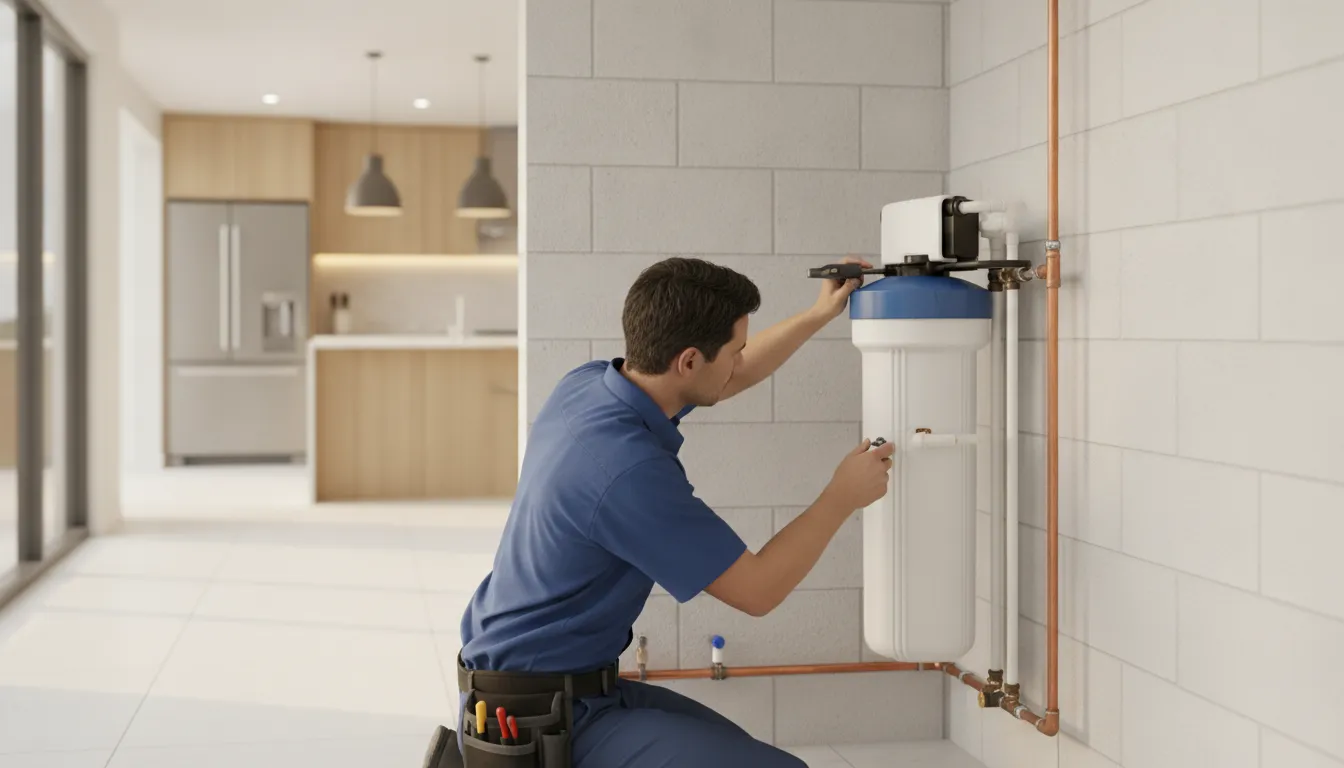
Water that tastes like chlorine, leaves spots on dishes, or creates stubborn mineral buildup can make everyday routines frustrating. Before choosing equipment, Florida homeowners should identify whether the home uses municipal water or a private well, review available water-quality information, and consider a professional evaluation. Space Coast Cooling & Plumbing can help homeowners in Cocoa, Melbourne, Palm Bay, and nearby Brevard County communities compare practical options. For broader plumbing planning, see our plumbing services guide, or contact us to schedule service.
Schedule a water quality consultation for your Florida home.
The best water filtration system for home florida depends on the contaminant concern and where treated water is needed. A whole-house, or point-of-entry, system treats water entering the home, while a point-of-use filter, such as reverse osmosis under the kitchen sink, focuses on one drinking-water tap. Florida DEP identifies these as distinct treatment approaches, so testing and water-source information should guide the choice.
That distinction also affects installation, maintenance, and cost. Start by looking at the water conditions Florida homeowners commonly encounter and why they can make filtration worth considering.
Why Do Florida Homeowners Need a Water Filtration System?
Florida water can be safe to drink and still create everyday problems inside your home. If you are seeing spots on dishes, buildup around faucets, or noticing a chlorine smell when you run the shower. A water filtration system may improve your water's taste and household experience. Space Coast homeowners can contact our team for help choosing a practical solution based on their water source and concerns.
Hard water can leave visible buildup
Minerals in hard water can collect on shower doors, fixtures, glassware, and appliances. Over time, that residue may make cleaning more difficult and leave dishes looking cloudy even after a full wash cycle. Some homeowners also notice dry-feeling skin after bathing or a change in how soap lathers. These signs do not identify a specific contaminant by themselves, but they are useful reasons to test the water before selecting a filter or softener.
Municipal water still has a trip to make
Homes connected to a public water system receive treated water. But the quality concerns you notice at the tap may be aesthetic rather than a sign that the utility has failed. Taste, odor, and color are among the reasons the Environmental Protection Agency says homeowners may consider treatment units. Public water customers should receive a Consumer Confidence Report from their utility each summer. That report includes certified lab results that can help you understand what the utility is monitoring: EPA home water treatment guidance.
Utility treatment does not necessarily address every concern that develops after water enters your property. The utility's responsibility and treatment standards apply to the supplied water, while plumbing inside the property can affect what reaches your faucet. A carbon filter, under-sink system, or whole-house setup may be appropriate depending on whether your priority is drinking water, shower water, or both.
Private well owners carry the responsibility
Many Florida homes use private wells instead of a municipal supply. Private wells are not regulated under the federal Safe Drinking Water Act. So the homeowner is responsible for maintaining the well, monitoring water quality, and arranging treatment when needed. The Florida Department of Health recommends annual testing for coliform bacteria and nitrates. Well water can also vary from one property to the next, which is why testing should come before buying equipment. A qualified professional can use those results to recommend filtration that addresses the actual concern rather than relying on a one-size-fits-all product.
Whole-House vs Point-of-Use Water Filters: What's the Difference?
The simplest way to compare these systems is to ask where you want the water treated. A whole-house filter, also called a point-of-entry or POE system, is installed where the main water line enters the home. It treats water before it travels to showers, sinks, washing machines, and other fixtures. A point-of-use, or POU, system treats water at one specific faucet, most often the kitchen sink. The Florida Department of Environmental Protection identifies POE, POU, and ion exchange as three basic categories of home water filtration systems.
Whole-house filtration treats water throughout the home
A POE system can make sense when the concern affects more than drinking water. For example, if testing identifies contaminants that could pose risks through drinking, skin contact. Or inhalation during a shower, treating the incoming supply addresses the issue throughout the house. These systems may use granular activated carbon or other treatment stages selected for the contaminant involved. The exact configuration should also account for the home's expected water flow, not just the test results. Florida DEP explains how filtration type and system configuration relate to water-quality concerns.
- Provides treated water at multiple fixtures, not only one faucet.
- Can address concerns involving bathing, showering, laundry, and drinking.
- Works well when the source water has a contaminant that needs treatment across the home.
Point-of-use filters focus treatment where you drink
A POU system is more targeted. It can be a practical choice when the primary goal is improving water used for drinking and cooking. While the rest of the home's water does not need the same treatment. Reverse osmosis is a common POU option. The Florida DEP notes that RO systems are generally installed under the kitchen sink and are intended for potential ingestion concerns involving inorganic substances such as nitrate. Arsenic, or lead. Filter or membrane components must be exchanged as needed to maintain performance.
- Concentrates treatment at a drinking-water tap.
- Can provide a focused option when the concern is limited to ingestion.
- Fits under-sink applications without treating every fixture in the home.
For a Florida homeowner, the right choice depends on the water source, test results, and how broadly the concern affects the home. A whole-house system is not automatically better than a POU filter. And a POU filter is not a substitute for whole-home treatment when exposure may occur during bathing or other household use.
Water Softeners vs Water Filtration: Which Does Your Florida Home Need?
These systems are often discussed as though they solve the same problem, but they target different water concerns. A conventional water softener uses ion exchange to reduce hard-water minerals, which can contribute to scale on faucets, showerheads, fixtures, and water-heating equipment. A water filtration system is selected for contaminants, chlorine taste, odors, sediment, or other water-quality concerns. Florida homes may need one system, the other, or both, depending on the water source and test results.
| Feature | Water softener | Water filtration system |
|---|---|---|
| Purpose | Reduce hard-water minerals and limit scale buildup. | Improve water quality by addressing specific contaminants, taste, odor, or sediment concerns. |
| What it removes | Calcium and magnesium hardness through an ion-exchange process. | Depends on the technology. Carbon, reverse osmosis, and ion-exchange systems address different contaminants. |
| Best for | Spotted dishes, mineral deposits, dry-feeling skin, and scale affecting plumbing fixtures or appliances. | Chlorine taste, unpleasant odor, sediment, or a tested contaminant that requires targeted treatment. |
| Typical setup | Usually installed at the point of entry, with a resin tank and periodic salt or brine regeneration. | May be point-of-entry for the whole home or point-of-use at one tap, such as an under-sink reverse osmosis unit. |
Ion exchange is not the same process as carbon filtration, even though the equipment can look similar. The Florida Department of Environmental Protection explains that ion-exchange filters can use specialized resin for nitrate removal and require periodic regeneration with brine in certain applications. That distinction matters: a softener should not be treated as a universal filter, and a carbon filter should not be assumed to remove hardness minerals.
Many homeowners in Melbourne, Palm Bay, Cocoa, and nearby Brevard County communities benefit from a combination. A softener can address scale throughout the home, while a carbon or reverse osmosis system can improve water at drinking taps or address a documented contaminant. The right configuration depends on the water source, test results, and household flow demand. Florida filtration systems are commonly categorized as point-of-entry, point-of-use, or ion-exchange systems by the Florida Department of Environmental Protection.
How Reverse Osmosis Systems Work and What They Remove
Reverse osmosis, often called RO, is a point-of-use water treatment system designed to improve the water you drink and use for cooking. Instead of treating every fixture in the house, it usually connects to one dedicated faucet at the kitchen sink. That focused approach can be useful when your main concern is the quality, taste. Or safety of drinking water rather than water used for bathing, laundry, and outdoor tasks.
How the treatment process works
When you turn on the RO faucet, water moves through several treatment stages before reaching your glass or cooking pot. A typical system first uses prefilters to catch sediment and reduce substances that could affect later components. The water then passes through a semipermeable membrane. This membrane allows water molecules through while holding back many dissolved impurities. A final polishing filter may improve taste before the treated water reaches the faucet.
The exact configuration varies by water source and the contaminants being addressed. For a homeowner in Melbourne, Cocoa, or another Brevard County community. The practical result is a separate stream of treated water for drinking, making coffee, preparing meals, and filling a pet's bowl. It does not automatically mean that every faucet in the home receives the same treatment.
What can reverse osmosis remove?
Florida Department of Environmental Protection guidance identifies RO as a point-of-use option for potential health risks associated with ingesting water. It specifically discusses inorganic substances such as nitrate, arsenic, and lead. RO can therefore be considered when testing or reliable water-quality information points to a concern that this type of membrane system is designed to address. It should not be selected simply because it sounds like the most powerful option. The treatment method needs to match the actual water conditions.
RO systems are commonly installed under the kitchen sink, and their filters or membrane components must be exchanged as needed to maintain performance. If replacement is delayed, water quality and flow can suffer. A professional can evaluate your water source, available cabinet space, expected drinking-water demand, and maintenance requirements before recommending a system. For more technical background, review the Florida Department of Environmental Protection's water filtration guidance.
How Much Does a Whole-House Water Filtration System Cost in Florida?
There is no single Florida price for a whole-house water filtration system because the right setup depends on your water source. The contaminants identified in testing, household size, and expected water flow. If you are comparing options, request a free estimate after a water professional reviews your home's needs rather than choosing a system from a broad advertised price.
As a general planning guide, these are estimates, not guaranteed quotes:
- Point-of-use under-sink filters: A basic system serving one drinking-water tap may cost roughly a few hundred dollars installed. More advanced reverse osmosis equipment can cost more, especially when additional filtration or installation changes are needed.
- Point-of-entry carbon systems: A typical whole-house carbon system commonly falls in the approximate range of $800 to $3,000 installed. This type treats water as it enters the home, so filtered water can reach multiple fixtures.
- More complex whole-house systems: A multi-tank setup that combines carbon filtration with a softener, ultraviolet treatment, or other components can cost more than the basic range. The final design should match the problem being addressed instead of adding equipment that your water does not require.
Water testing is one of the most important factors in an honest estimate. A household with chlorine taste or odor concerns may need a different configuration from a Florida home dealing with hardness, sediment, iron, or private-well concerns. Flow demand matters as well. A system that works for a small household may not perform properly when several showers, appliances, or irrigation fixtures operate at the same time.
Advertised package prices can also vary widely. For context, one national water-treatment provider lists whole-house packages above $4,000. Which shows why homeowners should compare the equipment, installation scope, maintenance requirements, and warranty instead of comparing a single number. That pricing is not a quote for Space Coast Cooling & Plumbing or a typical recommendation for every home.
For homeowners in Melbourne, Cocoa, Palm Bay, Titusville, or nearby Brevard County communities. A professional evaluation can identify whether you need a whole-house system, a drinking-water filter, a softener, or a combination. For a broader look at every plumbing service available, our plumbing services guide covers costs, repairs, and answers for the home. Ask for a clear estimate that explains the recommended components and why each one is included.
How to Choose the Right Water Filtration System for Your Florida Home
A simple checklist can narrow your options quickly: identify your water source, test for specific contaminants. Decide whether you need treated water throughout the house or only at one tap, and estimate your household's peak flow demand. If you are in Brevard County and notice unpleasant taste or odor, sediment, staining, or recurring buildup, do not choose a filter based only on a product label. The right system depends on what is actually in your water and how your household uses it.
Test your water before choosing equipment
Start with a current water test. Municipal-water customers can review their utility's annual Consumer Confidence Report, which summarizes certified laboratory results and compares them with national drinking-water regulations. A private well requires more personal oversight. The Florida Department of Health recommends that well owners test annually for coliform bacteria and nitrates, then investigate any additional concerns indicated by the results. A test helps distinguish an aesthetic issue, such as taste or odor, from a contaminant that requires a specific treatment method.
Testing also prevents an expensive mismatch. Florida Department of Environmental Protection guidance explains that the configuration of a filtration installation should reflect both the contaminant being removed and the home's expected flow demand. A system sized for one drinking-water tap may not supply showers, appliances, and multiple bathrooms at the same time. Conversely, a whole-house system can be unnecessary when the concern is limited to drinking water at the kitchen sink.
Match the filter type to the contamination
Different media solve different problems. A typical point-of-entry setup for certain contamination concerns may combine a five-micron prefilter, a granular activated carbon tank, and ultraviolet light for disinfection. Carbon can address some chemical compounds and taste concerns, while ultraviolet treatment serves a different purpose. A reverse osmosis system is commonly installed under the kitchen sink when the priority is treated drinking water and potential inorganic contaminants such as nitrate, arsenic, or lead. Do not assume that carbon, ultraviolet, softening, and reverse osmosis are interchangeable.
Finally, plan for ownership, not just installation. Replace cartridges, exchange membranes, service filter media, or maintain other components according to the manufacturer's specifications. Proper maintenance supports performance and water efficiency. For help interpreting test results and selecting equipment for your home's demand, consider professional water filtration system installation.
Schedule professional water filtration service for your Florida home.
Frequently Asked Questions
Do Florida homeowners need a water filtration system?
Not every home needs the same treatment. Start by identifying whether your water comes from a public utility or a private well, then review your utility's Consumer Confidence Report or test the well. Private well owners are responsible for monitoring and treating their water, and the Florida Department of Health recommends annual testing for coliform bacteria and nitrates. Florida Department of Health guidance can help you plan that testing.
What is the difference between a whole-house filter and an under-sink system?
A whole-house, or point-of-entry, system treats water as it enters the home, so filtered water reaches showers, faucets, and appliances. A point-of-use system treats water at one tap, usually for drinking and cooking. An under-sink reverse osmosis system is a common point-of-use option, while whole-house treatment may be more appropriate when a contaminant affects bathing or the home's overall water supply.
Can a water filter remove hard water buildup?
Standard carbon filtration and reverse osmosis are not the same as water softening. Hard-water minerals may require an ion-exchange softener, while a filtration system is selected for concerns such as taste, odor, color, or specific contaminants. Testing first helps determine whether your home needs filtration, softening, or a combination of treatments.
How often do home water filtration systems need maintenance?
Maintenance depends on the equipment, water quality, and amount of water your household uses. Replace cartridges, membranes, or other media according to the manufacturer's specifications, and service well systems based on ongoing test results. A system that is not maintained may lose effectiveness or waste water, even if it was correctly sized at installation.
Ready to Choose the Right Water Filtration System?
The right setup can help address your home's water concerns while fitting your household's needs and budget. For practical guidance in Brevard County, book a water quality consultation and estimate with Space Coast Cooling & Plumbing.
Book a water quality consultation and estimate for your Brevard County home.