
Florida's heat is only part of the comfort problem. When indoor air stays damp, your home can feel sticky even when the thermostat says 75 degrees, and lowering the temperature may not remove enough moisture. That can leave rooms muggy, encourage musty odors, and make your air conditioner work harder.
Schedule a professional humidity assessment for your Brevard County home.
For many homeowners, a whole home dehumidifier florida installation is worth considering when the AC cannot keep indoor moisture comfortable on its own. A properly sized system can work with your HVAC equipment to control humidity throughout the home, including during periods when cooling demand is low. The right choice depends on your home's moisture levels, ductwork, comfort concerns, and budget. The U.S. Department of Energy identifies improved humidity control and potential air-conditioning efficiency benefits as advantages of whole-home systems.
Before comparing installation costs with portable units, it helps to understand why moisture control is such a persistent issue across the Space Coast. If you are also budgeting for home comfort, our HVAC cost guide for Florida homeowners can provide useful planning context. Start by looking at how humidity affects comfort, air quality, and everyday HVAC performance.
Why Do Florida Homes Need a Whole-Home Dehumidifier?
Florida homes face moisture challenges through much of the year, not only during the hottest summer afternoons. The EPA describes the South as a hot, wet climate where moisture control can be an ongoing concern. In Brevard County, outdoor humidity can work its way indoors through everyday activities, air leaks. And open doors, leaving the home uncomfortable even when the thermostat shows a normal temperature. The EPA recommends using air conditioning and dehumidification to reduce moisture in hot, humid climates: learn more about controlling moisture in your home.
Many homeowners first notice the problem as sticky or muggy air. The rooms may feel clammy, bedding may seem damp, or a musty smell may linger after cleaning. You might also see condensation on windows or notice that closets and bathrooms stay humid long after showers. These signs do not automatically prove that a whole-home dehumidifier is needed, but they are useful clues that indoor moisture deserves attention.
Why lowering the thermostat may not solve the problem
Your air conditioner removes some moisture as it cools the air. However, the system may not run long enough to remove sufficient moisture during mild weather or when the cooling load is low. The U.S. Department of Energy notes that homeowners sometimes lower the thermostat below their preferred cooling level to chase a muggy feeling. But this approach is not always effective for moisture removal. The result can be an overly cold home that still feels damp.
A whole home dehumidifier Florida homeowners install as part of a properly designed comfort system can address humidity more directly. It can help manage moisture when the air conditioner is not actively cooling, rather than relying on colder indoor temperatures as a substitute for humidity control. The Department of Energy identifies improved humidity control as a key benefit of whole-home equipment. It also notes that better moisture management may create opportunities to size cooling equipment differently in some applications, although that decision requires a professional evaluation.
What humidity can mean for your home
Excess moisture affects more than comfort. According to the CDC, keeping indoor relative humidity between 30% and 50% is the best way to help prevent mold growth. A simple humidity monitor can show whether your home regularly exceeds that range. If the air feels muggy, smells musty, or produces recurring window condensation, ask an HVAC professional to evaluate the source and recommend a practical solution for your home.
Whole-Home vs Portable Dehumidifier: Which Is Better for Florida?
For a Florida homeowner dealing with sticky air, musty odors, or rooms that never seem comfortable, the better choice depends on the size of the problem. A portable unit can help in one bedroom or a small enclosed space. A whole-home system is designed to manage moisture throughout the property and can be a better fit when humidity affects several rooms.
The U.S. Department of Energy identifies improved humidity control and the potential to downsize AC capacity as benefits of whole-home dehumidification. That does not mean every house needs one, but it does explain why a dedicated system can help when the air conditioner alone is not keeping up. In hot, humid weather, homeowners may lower the thermostat just to chase moisture, which can leave the home colder without solving the underlying comfort issue. Learn more about whole-home dehumidification from the Department of Energy.
| Factor | Whole-home dehumidifier | Portable dehumidifier |
|---|---|---|
| Coverage | Controls moisture across the home when properly sized and connected to the HVAC or duct system. | Usually serves one room or a limited area, so multiple units may be needed for broader coverage. |
| Installation | Requires professional placement, drainage, controls, and possible ductwork connections. | Typically plugs into a standard outlet and can be moved, although it still needs suitable drainage and airflow. |
| Cost | Higher upfront equipment and installation cost, with potential efficiency and comfort benefits over time. | Lower initial cost, but several units, repeated emptying, and replacement may reduce the long-term advantage. |
| AC integration | Works with the HVAC system and can control humidity independently of cooling demand. | Operates separately from the home's central HVAC system. |
| Maintenance | Needs routine professional attention, filter care, drain checks, and equipment maintenance. | Needs frequent tank emptying or a drain connection, plus cleaning to prevent odor and biological growth. |
| Best for | Whole-house comfort, persistent humidity, larger homes, and homeowners who want consistent control. | Single-room moisture, temporary needs, rentals, or a focused test before a larger investment. |
A portable dehumidifier can be a practical short-term answer, especially if only one space feels damp. Its limitations become more noticeable when humidity returns throughout the house, when doors stay closed between rooms, or when the unit requires constant emptying. A whole-home dehumidifier can provide more even control and continue removing moisture when the AC is not actively cooling, including during milder Florida days.
For most Brevard County homes with ongoing, property-wide humidity problems, whole-home equipment is the stronger long-term option. Proper sizing and installation matter, so an HVAC professional should evaluate the home's layout, existing system, drainage, and moisture sources before recommending one.
How a Whole-Home Dehumidifier Integrates with Your HVAC System
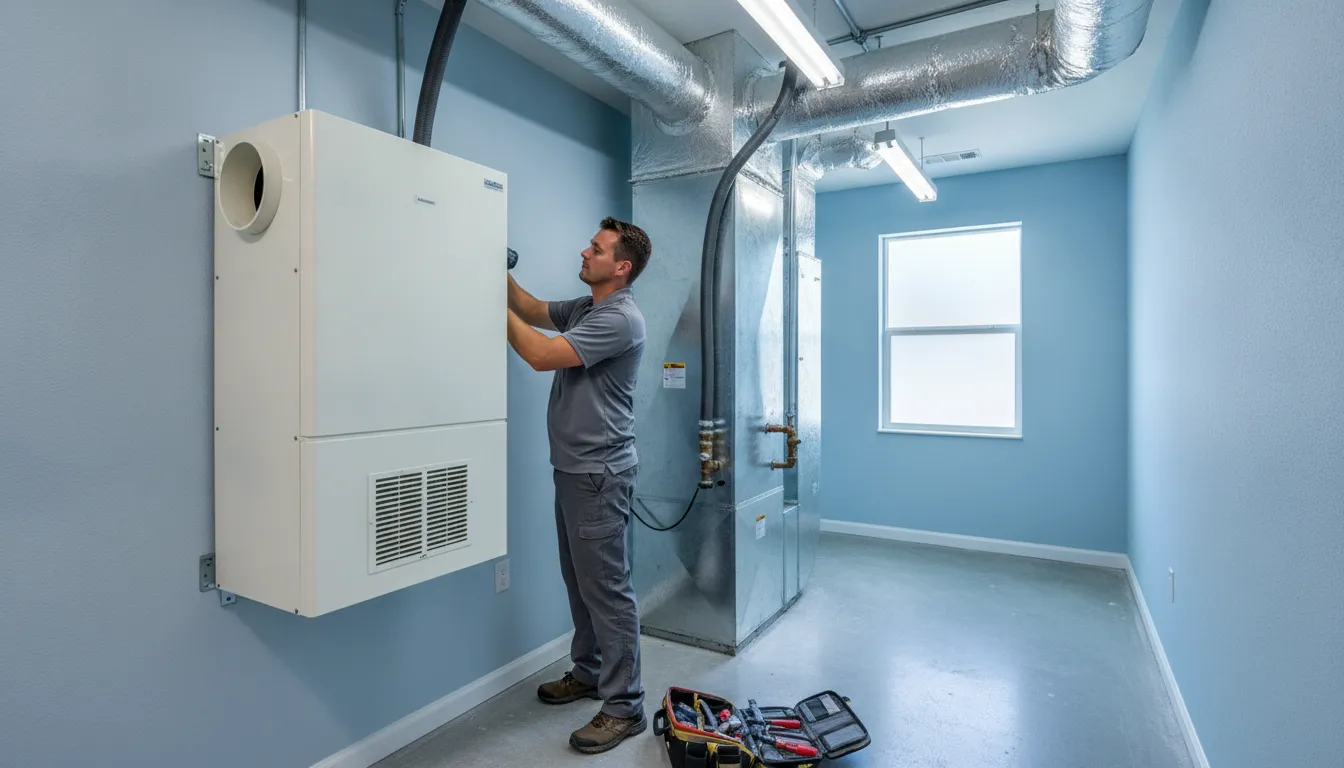
A whole-home dehumidifier is installed as part of your central HVAC system rather than placed in one room like a portable unit. The equipment connects to the air handler and ductwork, allowing humid air from across the house to be processed and returned at a more comfortable moisture level. In a Brevard County home, that means bedrooms, living areas, hallways, and other conditioned spaces can benefit from the same humidity-control strategy.
The system typically uses a humidity control or whole-home thermostat to monitor indoor conditions. When humidity rises above the selected setting, the dehumidifier can move air through its moisture-removal coil and discharge drier air through the duct system. It does not need to wait for the air conditioner to lower the temperature first. The U.S. Department of Energy notes that whole-house dehumidifiers can operate independently of the AC, which allows humidity control even when the home does not need much cooling. Learn more about whole-house dehumidifier integration.
Why AC operation is not always enough
Your air conditioner removes some moisture as it cools indoor air. But it may run for shorter periods when outdoor temperatures are moderate or the cooling load is low. During those times, the home can still feel sticky or develop a musty smell even though the thermostat shows a comfortable temperature. Homeowners may respond by lowering the thermostat, but that can overcool the house without consistently solving the moisture problem. A separate dehumidifier gives the system another way to address humidity without making the rooms unnecessarily cold.
Why professional installation matters
Proper sizing and installation determine whether the equipment works quietly, efficiently, and consistently. An HVAC professional evaluates the home's square footage, layout, insulation, air leakage, existing equipment, and duct configuration before recommending capacity. The installation also needs appropriate duct connections, drainage, electrical service, and control settings. The Department of Energy emphasizes professional installation for proper ductwork and control integration.
A portable dehumidifier can help one enclosed room, but it cannot distribute consistent control throughout a whole house. A correctly integrated system works with the home's existing air movement so humidity is managed more evenly. If your Florida home stays muggy despite normal AC operation, an HVAC evaluation can determine whether whole-home dehumidification is an appropriate solution.
Health Benefits of Controlling Indoor Humidity in Florida
Florida homeowners often notice humidity before they see a moisture problem. The air may feel sticky, bedrooms may seem stuffy, or a musty smell may return soon after cleaning. Persistent dampness can also affect indoor air quality because excess moisture creates conditions where biological pollutants, including mold, can grow. The U.S. Environmental Protection Agency explains that moisture can encourage biological pollutants in the home, making humidity control an important part of a healthier living environment.
Mold is not limited to one hidden area behind a wall. According to the Centers for Disease Control and Prevention, mold can grow on almost any surface where moisture is present, including walls, ceilings, floors, and household materials. That makes whole-home moisture control especially useful in Brevard County homes, where hot, humid weather can keep indoor humidity elevated for much of the year.
Keeping indoor humidity in a healthier range
The CDC recommends maintaining indoor relative humidity between 30% and 50% to help prevent mold growth. A whole-home dehumidifier can help maintain that range more consistently than relying on occasional portable units. It removes moisture throughout the home, including rooms that may not receive enough direct airflow from the air conditioner.
Controlling humidity may also make the home feel more comfortable without lowering the thermostat as far. When the air is less saturated with moisture, family members may feel less clammy during normal daily activities and may sleep more comfortably. This is particularly helpful for households dealing with persistent mugginess even though the AC appears to be running normally.
Reducing moisture without depending on AC alone
Air conditioners remove some moisture as they cool, but they may not run long enough to manage humidity during mild weather or periods of low cooling demand. The EPA recommends using dehumidifiers and air conditioners to reduce moisture in hot, humid climates. A properly installed whole-home system can work alongside the AC, helping manage moisture when cooling is not the primary need.
Humidity control does not replace leak repairs, ventilation, or mold remediation when those issues are present. It is one part of a broader indoor air quality plan. If your home stays damp or musty despite normal AC operation, an HVAC professional can help. An expert can evaluate moisture sources and recommend an appropriately sized solution for your Space Coast home.
How Much Does a Whole Home Dehumidifier Cost in Florida?
The cost of installing a whole home dehumidifier in Florida depends on more than the equipment itself. Home size, moisture load, unit capacity, brand, ductwork, electrical requirements, drainage, and access to the installation area can all change the final price. A straightforward replacement or retrofit generally falls in a lower installed-cost range. While a larger home or a complicated duct and control integration can move the project into a higher range.
Because Florida homes vary so much, a generic online price is best used only as an early planning figure. A contractor should evaluate the home's square footage, insulation, air leakage, existing HVAC system, and indoor humidity before recommending a model. Proper sizing matters. An undersized unit may run constantly without controlling moisture effectively, while an oversized unit may cycle too quickly and leave the home feeling damp.
What the installation estimate should include
Ask whether the quote includes the dehumidifier, labor, controls, duct connections, condensate drainage, electrical work, startup testing, and removal of any existing equipment. Professional installation also helps ensure the dehumidifier works correctly with the home's ductwork and HVAC controls. That integration is important because a whole-home system can manage moisture independently of air conditioning, including during times when the house does not need much cooling.
The U.S. Department of Energy documented a whole-house dehumidifier project in which the cost of the efficiency measure included labor, with projected air-conditioning energy savings of about 8.2%. That result is a case-study signal, not a promise of identical savings for every Florida home. Actual performance depends on the home's design, equipment, settings, weather, and maintenance. High-efficiency equipment can still be a cost-effective long-term solution when persistent humidity is making the AC run longer or encouraging homeowners to overcool the house.
How to budget for a whole-home dehumidifier
For a useful estimate, compare the installed cost with the comfort and operating problems you are trying to solve. A whole-home dehumidifier may be worth considering when the home remains sticky, smells musty, or feels damp even while the AC is running. It may also help reduce the temptation to lower the thermostat simply to chase moisture.
Space Coast homeowners can review our HVAC services, then request a free estimate based on the home's actual needs. A site-specific recommendation is more reliable than choosing a unit from a national price list. And it gives you a clearer view of both the upfront investment and the expected long-term value.
Is a Whole-Home Dehumidifier Worth It? What to Expect
For many Florida homeowners, a whole-home dehumidifier is worth the investment when the house still feels sticky. Smells musty, or develops recurring moisture problems even though the air conditioner runs regularly. It is not a universal fix for leaks, drainage problems, or inadequate ventilation, but it can provide steady humidity control when cooling alone cannot keep up. A properly selected system can make the home feel more comfortable, reduce moisture-related concerns, and help the HVAC system avoid working harder than necessary.
The best way to judge the need is with an indoor humidity reading and a professional evaluation of the home's airflow, ductwork, insulation, and moisture sources. The CDC recommends keeping indoor relative humidity between 30% and 50% to help prevent mold growth. If your home remains above that range for extended periods, especially during Florida's humid season, supplemental dehumidification may be a practical long-term solution. You can also review Space Coast Cooling & Plumbing's maintenance plans to support consistent HVAC performance after installation.
What benefits should you expect?
Most homeowners notice the difference first in comfort. Rooms feel less muggy, bedding and furniture may feel drier, and you may not need to lower the thermostat simply to fight damp air. More consistent humidity can also reduce the conditions that allow mold and other biological pollutants to grow. The EPA identifies moisture control as an important part of managing indoor mold risks. While also noting that dehumidifying appliances must be maintained so they do not become sources of biological pollutants.
A whole-home system can also operate when the air conditioner is not actively cooling. That matters during mild days, overnight, and other periods when the home needs moisture removal but does not need much temperature reduction. By handling humidity separately, the system may reduce unnecessary cooling and help limit strain on an air conditioner that is already working through long Florida seasons. These benefits are gradual and depend on correct sizing, installation, and control settings, so an estimate should consider the entire HVAC system rather than the equipment alone.
When is it not the right first step?
If you have an active plumbing leak, roof leak, standing water, condensation problem, or blocked condensate drain, address that source first. A dehumidifier cannot compensate for water entering the home. Likewise, changing filters, using bathroom and kitchen exhaust fans, and keeping the unit's drain and components clean remain essential. The EPA specifically cautions that dehumidifiers and air conditioners need ongoing care. Neglecting maintenance can reduce performance and create new odor or mold concerns.
For many households. A whole home dehumidifier Florida homeowners can rely on is a worthwhile upgrade when persistent dampness remains after basic moisture sources and AC issues are addressed. Schedule an evaluation with Space Coast Cooling & Plumbing at (321) 631-5755 to discuss your home's humidity readings, comfort concerns, and the right next step.
Get a professional humidity assessment for your Florida home today.
Frequently Asked Questions
Is a whole-home dehumidifier worth it in Florida?
It can be worth the investment when your home feels sticky, smells musty, or stays humid even while the air conditioner runs. A whole-home unit can control moisture independently of cooling, which helps prevent overcooling when your primary concern is humidity. The value is greatest when comfort problems persist during mild weather or low cooling demand. (U.S. Department of Energy)
How much does a whole-home dehumidifier cost in Florida?
The total depends on equipment capacity, ductwork, controls, electrical work, and installation conditions. A reliable estimate requires evaluating the home and existing HVAC system, so be cautious of one-size-fits-all pricing. Installation is an equipment-and-labor expense, and a properly integrated system may help the air conditioner operate more efficiently. (U.S. Department of Energy)
What are the downsides of a whole-home dehumidifier?
The main drawbacks are the upfront installation cost, space and drainage requirements, ongoing energy use, and maintenance. The unit must be sized and connected correctly, and filters, drains, and internal components need attention. Without maintenance, a dehumidifier can itself become a source of biological pollutants, according to the EPA. (EPA)
Can a whole-home dehumidifier work with my existing HVAC system?
Yes. Many whole-home systems are designed to work with central HVAC equipment and ductwork while operating independently when cooling is not needed. Professional evaluation is important because the installer must confirm airflow, drainage, controls, and available electrical capacity. The right setup provides more consistent moisture control than relying on the thermostat alone.
What humidity level should a Florida home maintain?
A practical indoor relative-humidity target is 30% to 50%. A humidity monitor can show whether the home is staying in that range and help identify when additional moisture control may be needed. If you see condensation, persistent musty odors, or visible mold, address the moisture source as well as the humidity level. (CDC)
Ready to Improve Comfort in Your Brevard County Home?
If your Florida home feels sticky, musty, or difficult to keep comfortable. A whole-home dehumidifier consultation can help you determine whether dedicated humidity control fits your HVAC system and household needs.
Book a whole-home dehumidifier consultation or HVAC service with Space Coast Cooling & Plumbing.