
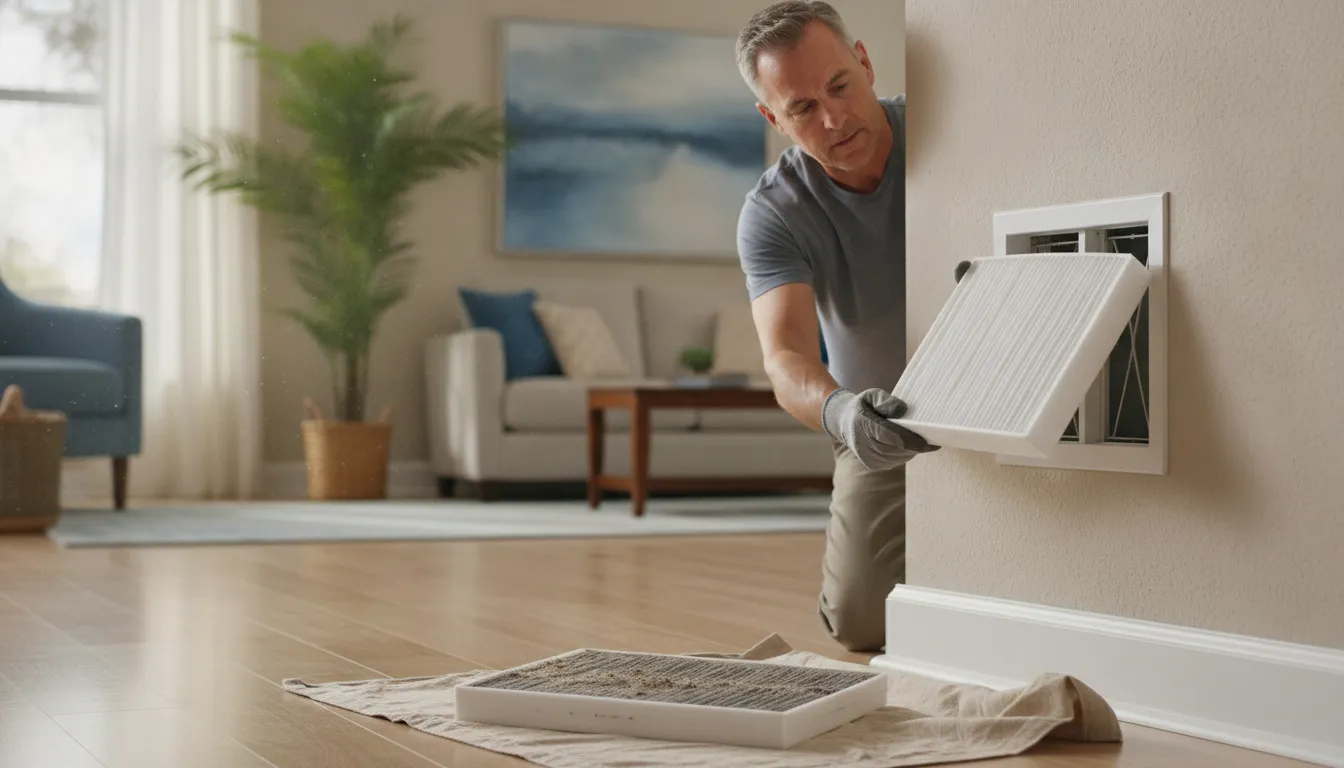
In a Florida summer, your air conditioner may run for long stretches, so a clogged filter can restrict airflow before the problem is obvious. The good news is that replacing a residential filter is usually a manageable maintenance task when you use the correct size and avoid reaching into the equipment.
To understand how to change ac filter, turn the system off, locate the existing filter, and match its dimensions. Install the replacement with the airflow arrow pointing toward the AC unit. Check the filter regularly rather than relying on one schedule. Pets, pollen, occupancy, and heavy system use can change how quickly it loads with dust. Trane also advises shutting the system down before opening the filter access. Review the manufacturer guidance for your equipment.
This guide walks through the replacement process, from finding the filter and removing it safely to checking the fit after restart. It also explains when a new filter is not enough and the right time to review AC repair warning signs instead.
Need help with your AC filter or airflow? Contact Space Coast Cooling & Plumbing.
How to Change an AC Filter Safely: 7 Steps
Replacing a residential AC filter is usually a straightforward maintenance task, but the details matter. A filter that is the wrong size, installed backward, or left loose can restrict airflow or allow unfiltered air to bypass it. Before changing the filter, check your equipment manual if you have questions about the access panel or filter type. The EPA also advises consulting the manual or an HVAC professional before making changes to an HVAC system filter. EPA filter guidance can provide additional context.
- Turn the AC system off. Set the thermostat to the off position before opening the filter access. This keeps the blower from starting while your hands are near the grille or cabinet. If the fan is set to On, turn it off as well. You do not normally need to work inside the electrical compartment, disconnect wiring, or touch refrigerant components for a filter change. Stop if the access area is damaged, wet, unusually hot, or difficult to reach safely.
- Locate the filter access. Look first at the large return-air grille, which is the grille that pulls room air back toward the HVAC system. The filter may slide behind a wall or ceiling grille. In some homes, it is inside a slot on the air handler or furnace cabinet. Filter locations vary, so do not remove random panels in search of it. Use the equipment manual or ask an HVAC professional if you cannot identify the designated access point.
- Open the grille or cabinet carefully. Release the grille clips, loosen the fasteners, or open the filter door according to its design. Support a ceiling grille so it does not drop. Do not force a stuck panel, bypass a safety latch, or open an electrical cover. If the filter is behind a panel that requires tools or exposes wiring, stop and arrange professional help instead.
- Confirm the old filter size before removing it. Check the dimensions printed on the filter frame, such as length, width, and thickness. Write them down or photograph the label. If the label is missing or unclear, use the equipment documentation rather than guessing. The replacement should fit the slot without bending, crushing, or leaving a large gap. Filter selection is separate from the replacement process, so review a guide to AC filter types and MERV ratings if you also need help comparing options.
- Find the airflow arrow and remove the old filter. Look for the arrow printed on the filter frame. Before pulling the filter out, note which way it points. Slide the filter out slowly so accumulated dust does not spill into the return opening. If it is visibly dirty, place it directly into a bag and seal the bag before disposal. Avoid shaking it indoors, especially if anyone in the home is sensitive to dust.
- Install the new filter with the arrow pointing toward the unit. Slide the replacement into the same opening and orient the airflow arrow toward the air handler or furnace, not toward the room. Press it into place gently so it sits flat and snug. A filter should not be forced into a slot, folded to make it fit, or left bowed. The EPA emphasizes that an HVAC filter must be correctly in place. If the new filter will not seat properly, remove it and recheck the dimensions and direction.
- Close the access, restart the system, and check airflow. Secure the grille or filter door before turning the thermostat back to cool. Restart the system and listen for normal operation. Check a nearby supply vent for steady airflow, and confirm that the filter door is not rattling or pulling open. If the AC will not run, airflow remains weak, unusual noise continues. Or you see icing or water around the equipment, a new filter may not be the underlying fix. Turn the system off if needed and request professional diagnosis. Space Coast Cooling & Plumbing provides AC maintenance, filter replacement, and airflow troubleshooting for homeowners across Brevard County.
Routine filter replacement should stay within the safe access points described above. Do not attempt electrical repairs, refrigerant work, compressor repairs, or internal equipment service as part of this process. Those issues require qualified HVAC help.
Where Is the AC Filter in a Florida Home?
Homes do not all place the air filter in the same spot. In many Florida houses, the filter sits behind a large return-air grille on a wall or ceiling. The return grille is the vent that pulls room air back toward the air-conditioning system. Look for a grille that is noticeably larger than the supply vents that blow cooled air into the rooms.
Common filter locations
Start by checking the main return grille, especially in a hallway, central living area, or near the air handler. Some homes have more than one return grille, and one or more of them may contain a filter. If the grilles are not designed to hold filters, the filter may be installed at the indoor air handler or furnace cabinet instead.
In a closet, garage, utility room, or attic, look for the indoor unit and the marked filter access panel nearby. Attic-mounted air handlers are common in Florida homes, but the filter may still be located at a return grille inside the living space. Follow the ductwork only far enough to identify the designated filter slot. Do not assume that the first removable panel you see is the filter access.
How to identify the correct access point
Turn the system off at the thermostat before opening a filter grille or access cover. This reduces airflow while you work and follows the safe replacement approach recommended by HVAC manufacturers. If the location is unclear, check the equipment manual, look for a filter-size label, or ask an HVAC professional. The EPA also recommends consulting the system manual or a professional before changing an HVAC filter.
Return grilles often have simple clips, tabs, or hinged covers. Support the grille as you release the fasteners, then open it gently. An air-handler filter slot may have a labeled cover or a retaining latch. Release only a latch that clearly belongs to the filter compartment. Never force a stuck cover, pry against the cabinet, or remove a panel that exposes wiring, terminals, or other electrical components. Stop if you would need tools or are unsure which compartment you are opening.
Once the filter is visible, note its printed dimensions and the direction of the airflow arrow before removing it. The arrow generally points toward the air handler or furnace, not back toward the room. If there is no obvious filter, do not insert one into a random grille or cabinet opening. Filter arrangements vary by equipment and home design, so the manual or a qualified technician is the safest way to confirm the correct location.
How Often Should You Change an AC Filter?
There is no single replacement schedule that fits every Florida home. A lightly occupied home with one resident and little indoor dust may use a filter longer than a busy household with pets. Your AC may also run for much of the year in Brevard County, which means the filter can collect more particles than it would in a mild climate. Instead of relying on a calendar alone, check the filter regularly and follow the instructions for your equipment and filter.
Start with a monthly inspection
Make checking the filter part of your monthly home-care routine. Lowe's recommends checking filters monthly, especially when an HVAC system runs constantly. Remove the filter or slide it out far enough to inspect the surface in good light. If it is visibly gray, coated with dust, or difficult to see through, replace it rather than waiting for a preset date.
A simple inspection rule is useful: if the filter looks loaded with dust or the filter material is covered across much of its surface, change it. Do not try to extend its life by vacuuming a disposable filter. Use a clean replacement with the same dimensions and the airflow direction indicated by the arrow. If you are unsure how to access the filter or what your equipment requires, consult the owner's manual before making changes.
Use the 30-to-90-day range as conditional guidance
Many homeowner guides place disposable filter changes somewhere in the 30-to-90-day range. Trane gives that range while noting that filter quality, pollen season, and pets affect the timing. Lowe's distinguishes between filter types as well, describing monthly replacement for some non-pleated filters and up to three months for some pleated filters. These are starting points, not a promise that your filter will remain effective for a specific number of days.
Choose the shorter end of the range when the AC runs frequently, several people live in the home, or pets shed indoors. Pollen, remodeling debris, construction dust, smoking, and other household particles can load a filter faster. Seasonal residents may also want to inspect the filter when returning to the home, even if the system has not operated continuously.
Account for filter type and manufacturer instructions
Filter thickness, construction, and rating affect how it should be maintained. Follow the replacement interval printed on the filter package and the guidance in your HVAC manual when those instructions differ from general advice. A higher MERV rating is not automatically a reason to delay replacement, and it should not be installed unless the system can accommodate it. The EPA recommends consulting the HVAC manual or an HVAC professional before changing the system filter and stresses that the filter must be correctly in place. See our guide to AC filter types and MERV ratings for selection considerations, then let the inspection guide your timing.
If a clean filter does not resolve weak airflow, unusual noise, icing, or persistent dust, the issue may involve more than filter timing. Stop at the filter change and arrange professional diagnosis rather than changing equipment settings or attempting electrical or refrigerant work.
How Do You Know Which AC Filter Size to Buy?
The safest place to start is the filter already installed in your system. Slide it out carefully and look along the cardboard frame for the printed dimensions. Filter sizes are usually shown as length, width, and thickness. Write down the complete size, including the thickness, before shopping. A filter that matches only two of the three measurements may not sit correctly in the slot.
If the dimensions are faded, missing, or difficult to read, check the equipment manual or the label near the return grille or air handler. The EPA recommends consulting the HVAC manual or an HVAC professional before changing a system filter. That is especially useful when you have recently moved, inherited an older system, or cannot tell which access panel holds the filter.
Measure only when the old filter does not identify the size
When you need to measure, turn off the air conditioner first. Remove the filter without forcing it, then measure the opening or the filter itself with a tape measure. Record the length, width, and depth. The actual measured dimensions may be slightly different from the nominal size printed on a replacement package. So use the equipment documentation or a knowledgeable supplier to confirm the correct match. Do not guess based on the appearance of a nearby filter, since homes can have different return grilles, air handlers, and filter slots.
A replacement should slide into place with light, even pressure. It should be snug enough that air cannot easily bypass the edges, but it should not bow, buckle, or require bending. Forcing an oversized filter can damage the frame or make removal difficult. A filter that is too small can leave gaps, allowing unfiltered air to move around it. If the filter does not fit cleanly, stop and verify the size rather than modifying it.
Check the airflow arrow and MERV rating
Before inserting the filter, find the airflow arrow printed on its frame. Point the arrow toward the air handler or furnace, in the direction the air travels through the system. Installing a filter backward can reduce its intended performance and may interfere with proper airflow. Once it is seated, make sure the access cover or return grille closes normally.
You may also see a MERV rating on the package. MERV, or Minimum Efficiency Reporting Values, describes a filter's ability to capture particles. A higher rating is not automatically the right choice for every home. The highest-rated filter must be compatible with the system's fan and filter slot. If you want to compare filter types or understand MERV choices in more detail, read our guide to AC filter types and MERV ratings. For a filter that will not fit, causes unusual airflow, or leaves you uncertain about the correct setup, have a qualified HVAC professional check the system.
| Filter detail | What to check |
|---|---|
| Dimensions | Match the length, width, and thickness printed on the old filter or listed in the equipment manual. |
| Airflow arrow | Point it toward the air handler or indoor unit, in the direction air travels. |
| MERV rating | Use a rating the system fan and filter slot can accommodate. Consult the manual before changing ratings. |
| Fit | The filter should sit flat and snug without bending, buckling, or leaving large gaps. |
What If a New Filter Does Not Fix the AC?
A clean, correctly installed filter can support normal airflow, but it cannot correct every air conditioning problem. If the system still behaves differently after replacement, avoid assuming the new filter is defective. The symptom may point to an issue elsewhere in the equipment, ductwork, controls, or drainage. A quick, safe check can help you describe the problem, but it should not turn into an attempt to repair internal components.
Persistent weak airflow or poor cooling
Check that the filter is facing the correct direction, seated fully in its track, and not collapsed or bent. Confirm that supply registers are open and that return grilles are not blocked by furniture, rugs, or other objects. If airflow remains weak throughout the home, or only one room is affected, stop there. A restriction, duct problem, blower issue, or other cause needs proper diagnosis. For related homeowner guidance, review these AC not cooling troubleshooting suggestions, then request service if the problem continues.
If the AC is not cooling, do not remove panels or handle refrigerant, wiring, capacitors, or other internal parts. You can check the thermostat setting, make sure it has power, and confirm that the disconnect or breaker has not obviously tripped. Do not repeatedly reset a breaker. If the system will not run, or it trips again, use these safe AC troubleshooting steps only as a starting point and arrange professional help.
When other symptoms appear
A filter replacement will not resolve unusual grinding, scraping, rattling, or buzzing noises. Turn the system off if the sound is severe or new, and do not attempt to locate it by opening the equipment cabinet. Likewise, visible ice on the indoor coil or refrigerant lines is not a reason to install an even more restrictive filter or continue running the system. Turn cooling off and arrange an evaluation.
Water near the indoor unit, repeated drain-pan overflow, or persistent moisture also deserves attention. Keep clear of electrical equipment and avoid pouring cleaners into a drain line unless a qualified professional has specifically instructed you. Heavy dust after a new filter is installed may mean the filter is not sealing, the return side has leakage, or another indoor-air issue is present. Filters can reduce some airborne pollution, but the EPA notes that they cannot remove every pollutant and work best alongside source control and ventilation.
Space Coast Cooling & Plumbing diagnoses airflow problems and provides AC repair and maintenance for homes across Brevard County. A professional AC tune-up can address system care beyond routine filter changes. If the issue persists, contact the AC service team for a clear diagnosis before a small filter concern becomes a larger comfort problem.
Simple Filter Habits That Help Florida Homes
A filter change is easier to manage when it becomes a small household routine instead of a task you remember only after airflow drops. Florida air conditioners may run frequently, and conditions vary from one Brevard County home to another. Pets, pollen, construction dust, occupancy, and the amount of system use can all affect how quickly a filter collects debris.
Build a repeatable replacement routine
Start with a quick visual check once a month. You do not have to wait for a fixed interval if the filter already looks loaded with dust or feels heavily coated. On the other hand, do not assume every home needs the same replacement schedule. Use the filter manufacturer's guidance, your equipment documentation, and the filter's condition as your guide.
- Put a recurring reminder on your phone or household calendar for a monthly inspection.
- Write the filter size and the installation date on a note near the return grille, or keep them in a home-maintenance app.
- Keep at least one correctly sized spare filter where you can find it. This prevents a dirty filter from staying in place simply because a replacement is not on hand.
- After removing the old filter, bag it before disposal so loose dust does not spread through the room.
Before installing a replacement, compare its dimensions with the old filter and confirm the airflow arrow points toward the air handler or furnace. A filter that is loose, bent, or installed backward cannot do its job correctly. If you are changing the filter type or rating rather than replacing it with the same kind, check the equipment manual first. The EPA advises consulting the manual or an HVAC professional before making changes to an HVAC filter.
Keep filtration in perspective
A clean, correctly installed filter supports normal HVAC operation, but it is not a complete indoor-air-quality solution. The EPA explains that HVAC filters can reduce indoor air pollution, but they cannot remove all pollutants. Filtration works best as a supplement to source control and ventilation, not as a replacement for addressing pollutant sources or bringing in clean outdoor air when conditions allow. See the EPA's guide to air cleaners and indoor air for more context.
That distinction matters if your home still has persistent dust, odors, unusual airflow, or comfort problems after a fresh filter is installed. A filter habit can prevent a simple maintenance issue, but it cannot correct every HVAC or ductwork problem. Space Coast Cooling & Plumbing provides filter replacement, AC maintenance, and airflow diagnosis for homes throughout the Space Coast. When the routine steps do not resolve the concern, professional troubleshooting can identify what is actually affecting the system.
Frequently Asked Questions
Can I change my AC filter myself?
Usually, yes. Turn the system off first, open the return grille or filter compartment, note the airflow arrow, and install a filter with the correct dimensions. If the filter is difficult to reach, the access panel is damaged. Or you are unsure which filter your equipment requires, check the owner's manual or ask an HVAC professional before proceeding.
Which way should the arrow on an AC filter point?
The arrow should point in the direction of airflow, toward the air handler or indoor unit. The filter catches particles before air reaches the equipment. If you cannot identify the return-air path, do not guess. Look for the airflow marking on the old filter or confirm the arrangement in your system documentation.
How often should I check or replace my AC filter in Florida?
Check the filter monthly, then replace it when it is visibly loaded or when the manufacturer recommends replacement. A commonly cited replacement range is 30 to 90 days, but pets, pollen, construction dust, household occupancy, and frequent cooling can shorten that interval. Source: Trane filter guidance.
What should I do if changing the filter does not improve cooling?
Confirm that the filter is seated correctly and that supply vents and return grilles are open. If weak airflow, warm air, unusual sounds, icing, or repeated shutdown continues, stop beyond-the-filter troubleshooting and arrange professional diagnosis. A filter cannot correct every airflow or cooling problem.
Ready to Get AC Filter Help?
If replacing the filter does not restore comfortable airflow, the issue may need a closer look than a filter change alone. Space Coast Cooling & Plumbing can help with filter replacement, maintenance, or troubleshooting for homeowners in Brevard County and Florida's Space Coast. To schedule help, contact Space Coast Cooling & Plumbing.