
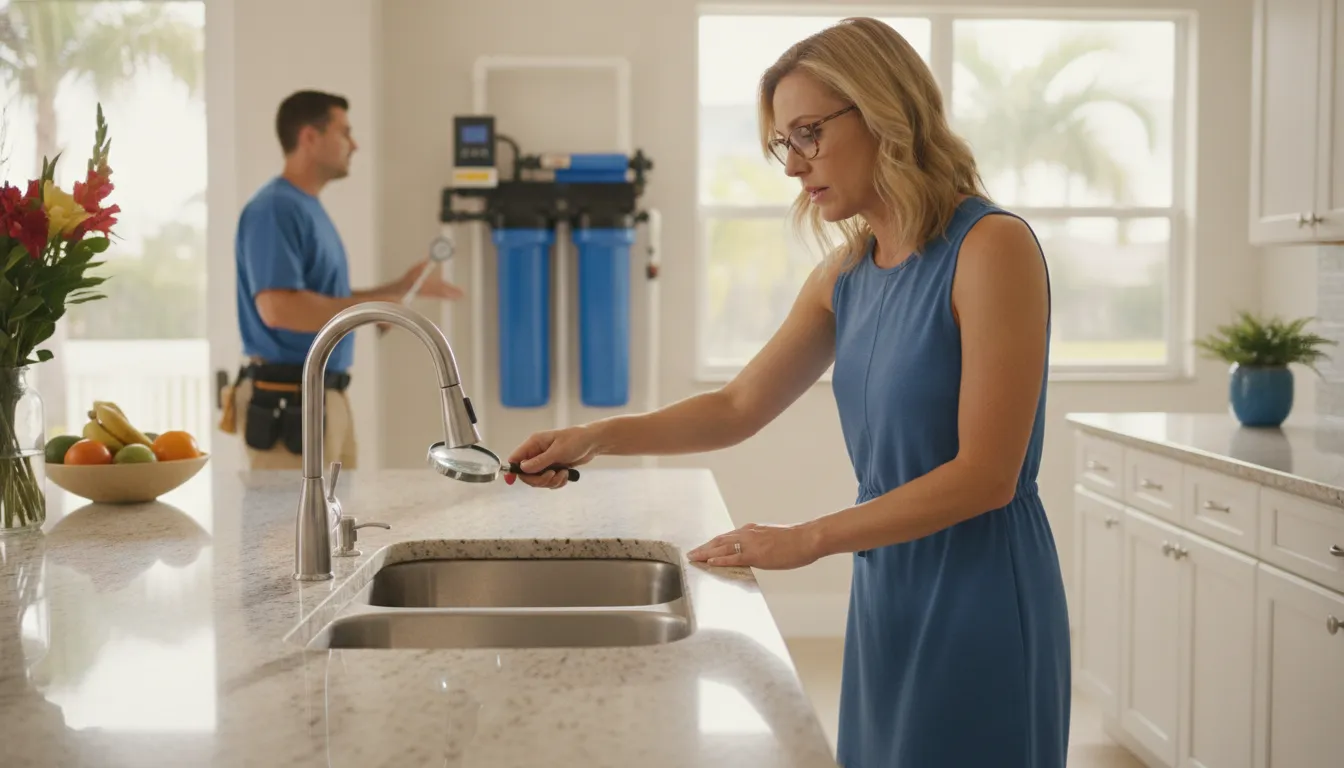
Hard water can show up in everyday ways: cloudy spots on fixtures, soap that does not rinse cleanly, or scale building inside water-using appliances. Homeowners in Cocoa, Melbourne, Palm Bay, Titusville, Merritt Island, and nearby Brevard County communities need to match treatment to the water source and the home's needs.
Talk with Space Coast Cooling & Plumbing about your home's water treatment needs.
A water softener system for home use is designed to reduce hardness by exchanging calcium and magnesium for sodium or potassium ions. The process can help limit scale, but a softener is not a universal purifier and does not remove every contaminant. The EPA explains how cation-exchange softeners work and why homeowners should match treatment to actual water conditions.
That distinction matters when choosing between a softener, a whole-home filter, or another treatment approach. A system selected for hardness may address scale and cleaning concerns, while a different concern may call for a different evaluation. Starting with the water concern keeps the decision focused and avoids expecting one device to solve every issue. Space Coast Cooling & Plumbing has served Brevard County since 1994, helping homeowners start with practical questions instead of a one-size-fits-all product. First, it helps to understand what softening changes in the water, and what it leaves untouched.
What Does a Water Softener System for Home Use Actually Do?
A water softener is designed to address one specific water-quality issue: hardness caused primarily by dissolved calcium and magnesium. These minerals can enter water as it moves through rock and soil. When hard water travels through household plumbing, it may leave mineral scale on fixtures and inside appliances. It can also make soap more difficult to rinse away.
How ion exchange changes hard water
Most residential softeners use a process called cation exchange. Water passes through a tank containing resin beads. The beads attract calcium and magnesium ions, then exchange them for sodium or potassium ions. This reduces the hardness minerals that create scale. The basic process is explained by the U.S. Environmental Protection Agency.
The result is not that the water becomes universally purified. Rather, the system is doing a targeted job within the home plumbing system. It treats hardness before water reaches many of the faucets, fixtures, and appliances connected to the softened line. The right setup depends on the home's water source, plumbing layout, and water-quality needs.
Why homeowners notice the difference
Hardness minerals can build up as scale on plumbing components and water-using appliances. By reducing those minerals, a softener can help protect appliances from scale buildup. That can be particularly useful for equipment that regularly heats water, where mineral deposits may accumulate over time.
Homeowners may also notice changes during everyday cleaning. Hard water can make it difficult to rinse soap from surfaces, dishes, and hands. With less hardness interfering with rinsing and lathering, household chores may feel easier. However, the practical result varies with the home's water and the equipment's settings. A softener should be selected and adjusted for the actual conditions rather than treated as a universal fix.
What a softener does not treat
A softener should not be confused with a whole-home filter or a disinfection system. Its primary purpose is mineral hardness removal. According to the EPA, cation-exchange softeners do not remove bacteria or viruses. They are not intended to address every possible contaminant or water-quality concern.
- Targets calcium and magnesium hardness minerals.
- Can help reduce scale in plumbing and appliances.
- May improve soap rinsing and lathering.
- Does not serve as a bacteria or virus removal system.
If you are unsure whether hardness is the main issue in your Brevard County home, start with a water-quality assessment and a review of your existing plumbing. That information can help determine whether a softener, a filter, or another treatment approach is the better fit.
Do Space Coast Homes Need a Water Softener?
There is no single answer for every home in Cocoa, Melbourne, Palm Bay, Titusville, Merritt Island, or elsewhere in Brevard County. A water softener system for home use makes the most sense when testing shows substantial hardness and the results match the problems you are experiencing. It should not be treated as an automatic upgrade for every Space Coast property.
Local water quality can vary depending on the water source. Municipal systems and private wells may not produce the same mineral profile, and conditions can differ from one area or home to another. The EPA notes that water hardness can be substantial above 180 milligrams per liter, or 10 grains per gallon. It recommends installing a softener only at that level or when a local water authority or health and safety code recommends one. Read the EPA water softener factsheet, publication 832-F-26-006 for consumer selection guidance.
Testing matters because visible symptoms alone do not prove that hardness is the cause. Spots on dishes, soap that is difficult to rinse, or scale around fixtures can be clues, but they do not tell you the actual hardness level. A test gives you a starting point for deciding whether softening is appropriate, whether a different treatment is needed, or whether no treatment equipment is necessary.
- Consider a softener after testing if the measured hardness is substantial and scale is affecting fixtures, water heaters, or other appliances.
- Ask more questions first if you notice taste, odor, discoloration, or another concern that hardness treatment may not address.
- Do not assume a well or municipal connection tells the whole story; the source can influence water quality, but a property-specific result is more useful than a broad local assumption.
Hard water may make it harder to rinse soap away and can contribute to mineral scale. An ion-exchange softener can reduce the hardness minerals that create that scale, which may help protect water-using appliances. Those benefits are different from purification, however. A softener is not a bacteria or virus removal system, so it should not be selected as a universal solution for every water-quality concern.
The practical decision is to match the equipment to the test results and the household's actual needs. If hardness is below the EPA example threshold, installing a softener may add unnecessary maintenance and regeneration. If hardness is substantial, a correctly selected system may be worth evaluating, particularly when scale is affecting plumbing fixtures or appliances. A licensed plumbing professional can help interpret the results and determine whether softening, filtration, or another approach better fits the home.
How Do You Choose the Right Water Softener Size?
The right system is not chosen by household size alone. It should match the hardness of your water and the amount of water your household typically uses. A home with a private well, frequent laundry, or several occupants may have different treatment needs than a smaller home on a municipal supply. Testing the water first helps prevent choosing a unit that is too small, regenerates too often, or is larger than necessary.
- Test the water hardness. Start with a current water test or a reliable local water-quality report. Hardness is commonly associated with calcium and magnesium, but the level can vary by water source. In Brevard County, the source may be a municipal system or a private well, so do not assume every home has the same water conditions. The EPA recommends selecting a water softener based on the actual hardness level and household water use. See the EPA water softener fact sheet for consumer selection guidance.
- Describe your household's normal water use. Consider the number of people in the home and the routines that affect demand, such as showers, laundry, dishwashing, and other regular water use. You do not need to force those details into a generic online capacity chart. Give the test results and a realistic description of daily use to a qualified professional, who can evaluate the system's rated capacity for your home.
- Understand how regeneration affects operation. An ion-exchange softener periodically regenerates to flush out accumulated hardness minerals and replenish the sodium or potassium supply. The system's capacity and the hardness of the incoming water influence how frequently that happens. A unit that is undersized for the home's demand may need to regenerate more frequently. While an oversized unit may use more equipment and capacity than the home requires.
- Look for demand-initiated controls. Ask whether the model uses demand-initiated regeneration rather than regenerating on a fixed schedule. Demand-initiated controls respond to actual water use and are generally more water-efficient than time-based settings. According to the EPA, a typical regeneration cycle may use 20 to 70 gallons, while some larger systems can use up to 200 gallons. That makes capacity, control settings, and regeneration frequency important parts of the sizing decision.
- Confirm the installation requirements. Before purchasing, verify where the unit will be installed, how it will connect to the plumbing, and how regeneration discharge will be handled. Check applicable local codes and regulations, particularly if the property uses a septic system. A licensed plumbing professional can review the test results, household demand, available space, and discharge requirements together.
For most homeowners, the best choice is the smallest properly matched system that can handle the tested hardness and normal household demand without unnecessary regeneration. If water conditions or usage change, have the settings and performance reviewed rather than guessing at a replacement size.
What Is the Difference Between a Softener and Whole-Home Filtration?
A water softener and a whole-home filtration system can both be installed at the main water line, but they solve different water-quality problems. Choosing between them starts with identifying what is actually in the water and what you want the equipment to address.
An ion-exchange softener is designed for hardness. It exchanges calcium and magnesium ions for sodium or potassium ions, reducing the minerals that contribute to scale. This can help protect water heaters and other appliances from mineral buildup. It may also make soap easier to rinse, which is one reason homeowners notice a difference during cleaning.
Filtration is a broader category. A whole-home filter is selected for specific contaminants or water characteristics, rather than hardness alone. A softener is not a universal purification system. In particular, water softeners do not remove bacteria or viruses. A filter or another treatment method may be more appropriate when the concern is a contaminant that a softener is not designed to address.
| System | Primary purpose | Best fit | Important limitation |
|---|---|---|---|
| Ion-exchange water softener | Targets hardness minerals, mainly calcium and magnesium. | Homes dealing with scale, hard-water effects, or difficulty rinsing soap. | Does not remove bacteria or viruses and is not a complete water purification system. |
| Whole-home filtration | Addresses broader water-quality concerns through a filter selected for the concern being treated. | Homes seeking treatment for contaminants or characteristics outside hardness. | It may not replace a softener when hardness and scale are the primary issues. |
How the decision changes from home to home
Water quality can vary across Brevard County, including between municipal supplies and private wells. That means a solution that fits one property may not fit another. If the main concern is scale on fixtures or protection for water-using appliances, a softener may be the more direct option. If testing identifies a different contaminant concern, filtration may deserve priority. Some homes may need a combination, but that decision should follow an assessment rather than a product assumption.
Review the whole-home water filtration guide for more context on filtration. Then compare the results of water testing, the condition of the plumbing, and the household's goals before selecting equipment. A professional evaluation can help keep hardness treatment and contaminant treatment in their proper roles.
What Should Homeowners Know About Water Softener Installation?
A water softener installation is more than placing a tank near the main water line. The system needs to fit your existing plumbing, have an appropriate location for service access, and include a practical path for regeneration discharge. Planning these details before installation helps the equipment operate as intended and makes future maintenance easier.
Start with the water and plumbing layout
A qualified technician should first review the home's plumbing and the water-treatment goals. Water conditions can vary by source, so the installation plan should be based on the property's needs rather than a one-size-fits-all setup. The technician can identify where the treatment equipment should connect, how it will affect the home's water flow. And whether the proposed location leaves enough room to inspect or service the unit.
Licensed technicians integrate treatment equipment into a home's existing plumbing. That work should also account for a bypass arrangement, which allows homeowners or service professionals to isolate the softener when the system needs maintenance. Keep the equipment accessible, rather than placing it behind stored items or in a cramped area where routine checks become difficult.
Plan for regeneration discharge and local requirements
Ion-exchange softeners periodically regenerate. During that process, the system flushes out accumulated hardness minerals and replenishes its sodium or potassium supply. The installation therefore needs a suitable discharge point. Before work begins, verify the local codes and regulations that apply to water-treatment equipment, including any rules governing softened-water discharge into a sewer or septic system.
These requirements can vary by property and location. A professional installer can help evaluate the available discharge route and identify concerns before the system is connected. Addressing code questions early is preferable to discovering that the original installation plan cannot be used.
Understand the maintenance commitment
Homeowners should expect a water softener system for home use to require ongoing attention. The unit may need periodic checks, replenishment of its treatment material, and service if its controls, connections, or discharge components develop a problem. Regeneration frequency depends on the system's operation and household conditions, so maintenance expectations should be explained during installation.
Space Coast Cooling & Plumbing handles professional installations and equipment replacements, with plumbing services available for homeowners across Brevard County. Ask for clear information about the proposed work, system access, discharge setup, and service needs before approving the installation. Transparent, upfront pricing and professional service can make the planning process easier to understand.
Talk with Space Coast Cooling & Plumbing about water treatment options.
Frequently Asked Questions
What does a water softener remove?
An ion-exchange softener reduces hardness by removing calcium and magnesium ions and exchanging them for sodium or potassium ions. This can reduce mineral scale on plumbing fixtures and water-using appliances. The EPA explains this exchange process.
Does a water softener replace whole-home filtration?
No. A softener is designed primarily for hardness, while whole-home filtration addresses a broader range of possible water-quality concerns. Depending on the water source and test results, a home may need a filter, a softener, or a combination of systems.
How is the right softener size determined?
Proper sizing depends on the hardness level of the water and the household's typical daily water use. System capacity and the expected regeneration frequency should also be considered, rather than choosing a unit based only on the home's square footage. EPA guidance supports evaluating hardness and household use together.
Does softener regeneration use water?
Yes. Regeneration flushes accumulated hardness minerals from the system and replenishes its sodium or potassium supply. According to the EPA, a typical cycle uses about 20 to 70 gallons. Larger systems can use more. Demand-initiated regeneration can use water more efficiently than a fixed schedule. See the EPA fact sheet.
When should a homeowner get a professional assessment?
Consider an assessment when you are unsure whether hardness is substantial enough to justify treatment. When water-quality concerns extend beyond scale, or when you need help selecting and integrating equipment. A licensed technician can evaluate the home's plumbing, water conditions, and treatment goals before recommending a system.
Ready to Discuss Water-Treatment Options?
The right water-treatment setup depends on your home's water-quality concerns, household needs, and plumbing layout. A professional review can help you compare softening with whole-home filtration and choose an approach that fits your Space Coast home. To discuss your options and professional plumbing installation, contact Space Coast Cooling & Plumbing.