
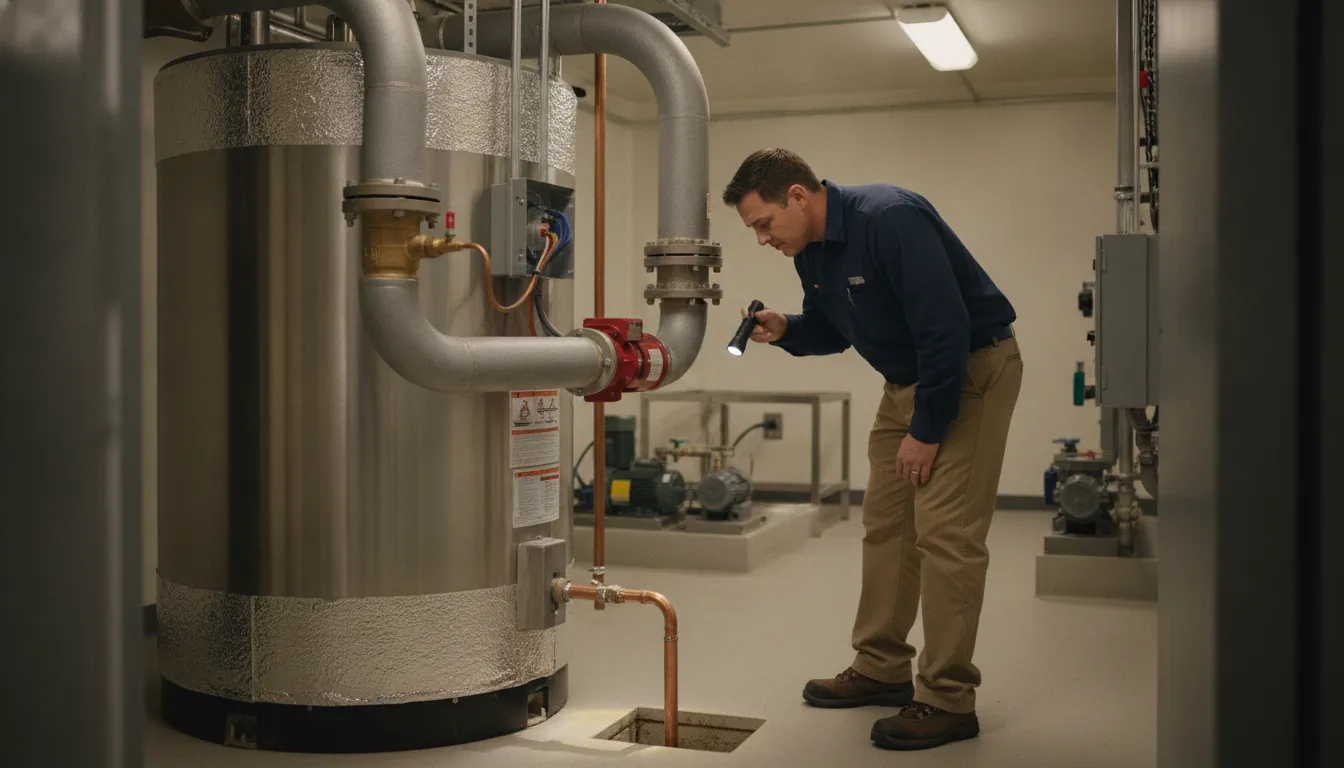
A guest shower goes cold at 7 a.m., or the dish line backs up because the rinse water will not stay hot. That is a commercial water heater repair problem, not a homeowner troubleshooting project. The unit is larger, the demand is steady, and a failed safety part can shut a kitchen, clinic, or locker room down for the day.
This guide is for property owners and facilities managers in Brevard County. It covers the signs that call for service, what a technician should check, and how to decide between a repair and a replacement. It does not walk through residential tank repairs or home cost tables.
Schedule commercial water heater repair
What Commercial Water Heater Repair Covers
Commercial water heating is built for many people using hot water at the same time. A restaurant, hotel, gym, office, church, or medical office can empty stored hot water much faster than a house. The heater, the storage tank, and the pipes that move water around the building all have to work together.
Most local businesses use one of three setups:
- Storage heaters. A large tank keeps a set amount of hot water ready. Gas models in this class often have an input above 75,000 Btu per hour.
- Circulating systems. A pump keeps hot water moving so far fixtures do not run cold for a minute or two.
- High-input instantaneous heaters. These heat water as it is used. Commercial gas models in this class are rated above 200,000 Btu per hour.
Those input lines come from the ENERGY STAR commercial water heater criteria. They are a useful way to tell a commercial unit from a house unit before anyone opens a panel.
Repair on this equipment is diagnosis plus a safe fix. A technician looks at the heat source, the controls, the safety valve, the circulating pump, and the vent or electrical supply. The goal is steady hot water at the fixtures that need it, without a leak, a scald risk, or a tripped safety device.
Space Coast Cooling & Plumbing has served Brevard County businesses and homes since 1994. Licensed plumbers handle tank and tankless water heater work, including same-day calls when hot water is out. Commercial plumbing is part of that work, with a focus on getting a building back in service.
Signs Your Building Needs Service
Do not wait for a total outage. These are the complaints that usually mean the heater, the pump, or a safety part is already failing.
- Hot water runs out during a normal rush. Breakfast service, a shift change, or back-to-back guest showers should not empty a correctly sized tank.
- Temperature swings at the same fixture. Staff describe water that is hot, then lukewarm, then hot again.
- Water on the mechanical-room floor. A puddle under the tank, at a fitting, or along the relief-valve pipe is not a housekeeping issue.
- The relief valve drips or runs. Discharge means high temperature, high pressure, or a valve that no longer seals.
- Rumbling, popping, or a pump that chatters. Scale and air in a commercial tank get loud. A circulating pump should not grind or trip its breaker.
- Rusty or cloudy hot water only. If cold water is clear and hot water is not, the tank or heat exchanger is the first place to look.
- A gas smell, soot, or a burner that will not stay lit. Leave the room and call for service. Do not keep resetting the unit.
- Error codes or a lockout on the control. Write down the code before anyone clears it. The history tells the technician what failed.
One cold faucet in a guest room is often a mixing valve or a cartridge, not the heater. Cold water at every hot fixture, or hot water that fades across the building, points back to the water heater or the loop that serves it.
What a Technician Checks First
A useful commercial visit starts with the complaint and the equipment label, not with a parts guess. Ask the technician to walk the system in this order.
- Name the equipment. Read the input rating, fuel type, gallons stored, and model. That tells you whether you have storage, a storage-type instantaneous unit, or a true instantaneous heater.
- Confirm the outage pattern. Which fixtures failed, at what time, and for how long? A loop that serves only the kitchen fails differently from a loop that serves guest rooms.
- Check the safety valve and discharge pipe. The temperature and pressure relief valve should not leak during normal use. The International Code Council treats discharge from that valve as a sign of a system problem, a heater problem, or a bad valve.
- Test the heat source. On gas units, that means ignition, flame, venting, and gas supply. On electric units, that means elements, contactors, and the breaker. On a heat pump, that means the compressor and airflow around the unit.
- Check the circulating pump and aquastat. A dead pump leaves water sitting in long pipe runs. Fixtures feel cold even when the tank is hot.
- Look for scale and failed parts that repeat. Florida water leaves mineral on elements, heat exchangers, and tank bottoms. A second failed element in a short span usually means the water, not a bad part.
- Verify temperature at the fixtures that matter. Kitchens and health-care uses have hotter setpoints than a guest lavatory. The fix is not done until those fixtures hold temperature through a normal rush.
You should get a plain summary: what failed, what was repaired, what is worn, and whether the building can stay open on this unit. If the answer is a list of part names and no fixture test, ask for the fixture test.
Repair or Replace the Commercial Unit
Repair is the right call when one part failed and the tank, heat exchanger, and venting are still sound. Replace when the vessel leaks, the same parts keep failing, or the unit cannot keep up with the way the building is used now.
| What you see | Usual next step | Why |
|---|---|---|
| One failed igniter, element, thermocouple, or pump, and the tank is dry outside. | Repair. | The vessel and heat exchanger are still doing their job. |
| Relief valve drips, and temperature or pressure is high. | Repair the cause, then retest the valve. | The valve is warning you. Replacing only the valve can hide the real fault. |
| Water from the tank body or a rusted fitting you cannot isolate. | Plan replacement. | A leaking storage vessel is not a gasket job. |
| Hot water fades every rush, and the building added fixtures or seats. | Resize, then repair or replace. | A healthy heater that is too small will keep disappointing you. |
| The same part has failed twice in a year. | Look at water quality and age before another repair. | Scale and a tired heat exchanger destroy new parts. |
| Gas odor, soot, or a burner that will not stay lit. | Shut the unit down and call service. | Combustion faults are a safety problem, not a comfort problem. |
Age matters, but it is not a date on a sticker. Ask how the tank, heat exchanger, and burners look. A commercial storage heater that still meets the building's demand, holds pressure, and has a clean flue can be worth repairing. A tank that weeps, a heat exchanger that is scaled shut, or a unit that cannot recover between rushes is a replacement conversation.
Efficiency is part of that conversation. ENERGY STAR certifies commercial gas storage and instantaneous heaters at a thermal efficiency of at least 0.94. The U.S. Department of Energy compares an 80 percent unit with 94 percent and 96 percent models and shows lower lifetime energy cost for the efficient ones. If your heater is an older atmospheric unit and it needs a major repair, get a replacement price beside the repair price. Do not approve either number until someone has checked the venting. A high-efficiency unit often cannot reuse the old flue.
This article does not quote a repair price or a replacement price. Both depend on fuel, input rating, access, code upgrades, and whether the building can be without hot water overnight. For a home-sized tank, the residential guide to what it costs to replace a water heater is a different job.
How Florida Buildings Use Hot Water
Brevard buildings do not all fail the same way. Match the complaint to the way the business uses water before you approve a part.
Restaurants and commercial kitchens
Dish machines and pot sinks need a lot of hot water in a short window. A heater that keeps up at 10 a.m. and fades at the lunch push is often short on storage or recovery. Or the circulating pump is not moving water back to the machine. Grease and hard water also coat heat exchangers. If the machine's own booster heater is the only thing that fails, say so. Do not replace the building heater for a booster problem.
Hotels, vacation rentals, and gyms
Guest turnover piles showers into the same hour. A circulating loop that has lost its pump, or a mixing valve stuck too cold, feels like a dead heater even when the tank is full. Check the far room and the room next to the mechanical room. If only the far room is cold, start with the loop.
Offices, churches, and retail
These buildings use less hot water, so a failing heater can hide for months. The warning is often a lukewarm restroom during an event, or a relief valve that has been dripping into a floor drain. Small demand does not make a dripping relief valve safe.
Clinics and light medical offices
These sites care about stable temperature and cleanable fixtures. A swinging temperature is a service problem even if nobody has run out of water. Tell the technician which rooms have to hold a set temperature and which can wait.
Safety Rules That Are Not Optional
A few items should stop the visit until they are handled. They are building-safety issues, not comfort issues.
- Relief-valve discharge. ICC guidance on water heater safety says a temperature and pressure relief valve protects both the heater and the piping attached to it. Water coming out of it means something is wrong. Do not cap the pipe or aim it at a bucket as a permanent fix.
- Gas and combustion. A gas smell, soot around the draft hood, or a yellow lazy flame means the burner is not burning cleanly. Shut the unit down if the control lets you do that safely, leave the room, and call a licensed tech.
- Scald risk at lavatories. Commercial storage tanks are often set hotter than a home tank so the kitchen or a distant loop stays hot. A mixing valve at the fixture or at the branch is what keeps a public lavatory from scalding. Do not solve a cold-water complaint by turning the tank up with no mixing protection.
- Electrical lockout. High-input electric heaters are not a household element swap. Power should be locked out before anyone opens a panel.
- Clearances and combustion air. Storage next to a commercial heater, or a louver that was boarded over, can starve a gas unit of air. That shows up as sooting and nuisance lockouts.
Florida adopts a plumbing code based on the International Plumbing Code, including a chapter on water heaters. Permits and inspections apply when a heater is replaced or when gas, electric, or venting is altered. A like-for-like part repair is a different scope from a change-out. If you are unsure which one you are buying, ask before the work starts. Our note on a plumbing permit for a water heater explains how that choice works in Florida.
What to Tell the Dispatcher
A clear call gets a faster, more useful visit. Have this in front of you:
- The business type and the address, including the suite and where the mechanical room is.
- Whether the unit is gas, electric, or heat pump, and the gallons or input rating from the label if you can read it safely.
- When the problem started, and whether it happens every day at the same time.
- Which fixtures failed: kitchen only, guest rooms, restrooms, or the whole building.
- Any leak, gas smell, error code, or recent work by another trade.
- Whether you need hot water back tonight, or you can schedule a daytime repair.
- Gate codes, roof access, and the name of the person who can approve a repair on site.
If hot water is out and you have a dinner service, a full hotel, or a clinic day ahead, say that first. Space Coast answers with a person, including nights and weekends, and stocks common parts so a straightforward repair can finish on the first trip. You can reach the team through the water heater repair service page or the contact form.
For a wider look at how commercial buildings differ from houses, read what commercial plumbing covers. If the problem is a burst line or an active flood rather than the heater, the Brevard emergency plumbing guide is the better starting point.
After the Repair
A finished repair includes a fixture check, not only a heater that fires. Before the technician leaves, confirm:
- The complaint fixture holds temperature through a few minutes of flow.
- The relief valve is dry, and the discharge pipe is open and aimed to a safe spot.
- The circulating pump runs when it should and is quiet.
- The burner flame is steady, or the electric contactor pulls in without a buzz or a hot smell.
- You have the part name, the model, and a note about anything that is worn but still working.
Then put the heater on a simple calendar. Once a year, have someone test operation, look at the relief valve, check the pump, and note scale. Kitchens and buildings on hard water often need that look more often. The homeowner version of this habit is covered in our water heater maintenance guide. The same idea applies in a business, with larger parts and less room to ignore a drip.
Watch the hot-water temperature for a week after service. If it fades again at the same hour, the repair fixed a part and missed a sizing or circulation problem. Call back with the time of day and which fixture failed. That second visit should start where the first one left off, not from zero.
If you manage more than one building, keep a one-page log for each mechanical room. Write the model, fuel, install year if you know it, and the last three service notes. The next technician will spend the visit on the fault instead of on hunting a label.
Request service from Space Coast
Frequently Asked Questions
How is commercial water heater repair different from a home repair?
Commercial units serve many fixtures at once and often use a circulating pump. Input ratings are higher, controls are more complex, and a safety fault can close a kitchen or guest wing. The visit should end with a temperature check at the fixtures that failed, not only a reset at the tank.
What does it mean if the relief valve is dripping?
It means temperature or pressure is too high, or the valve itself has failed. The International Code Council treats that discharge as a warning. Find the cause. Do not plug the pipe.
Can we keep using the building during the repair?
Often yes, if another heater or a stored tank can carry the load and there is no gas leak or active flooding. A full change-out, a gas-line change, or a venting change usually needs a planned outage. Tell the dispatcher what time of day you cannot be without hot water.
Does a commercial heater have to meet an efficiency number?
New high-efficiency models can. ENERGY STAR commercial gas heaters are certified at a thermal efficiency of at least 94 percent. An existing unit does not have to be replaced just to hit that number. It becomes part of the repair-versus-replace choice when a major part has failed.
Who should we call in Brevard County?
Call a licensed plumber who works on commercial water heaters and can test the fixtures before leaving. Space Coast Cooling & Plumbing serves Cocoa, Melbourne, Palm Bay, Titusville, Merritt Island, and nearby Space Coast towns. Start with the commercial plumber page if the building has other plumbing needs too.
Get Hot Water Back on Schedule
Commercial water heater repair is a building decision. Name the fixture that failed, keep people away from a dripping relief valve or a gas smell, and have a technician test the system under a real load. If the tank leaks, the same part has failed twice, or the building has outgrown the heater, price a replacement beside the repair.
Space Coast Cooling & Plumbing can diagnose the heater, the pump, and the loop, then give you the repair scope before work starts. Call (321) 631-5755 or send the mechanical-room details through the contact form.