
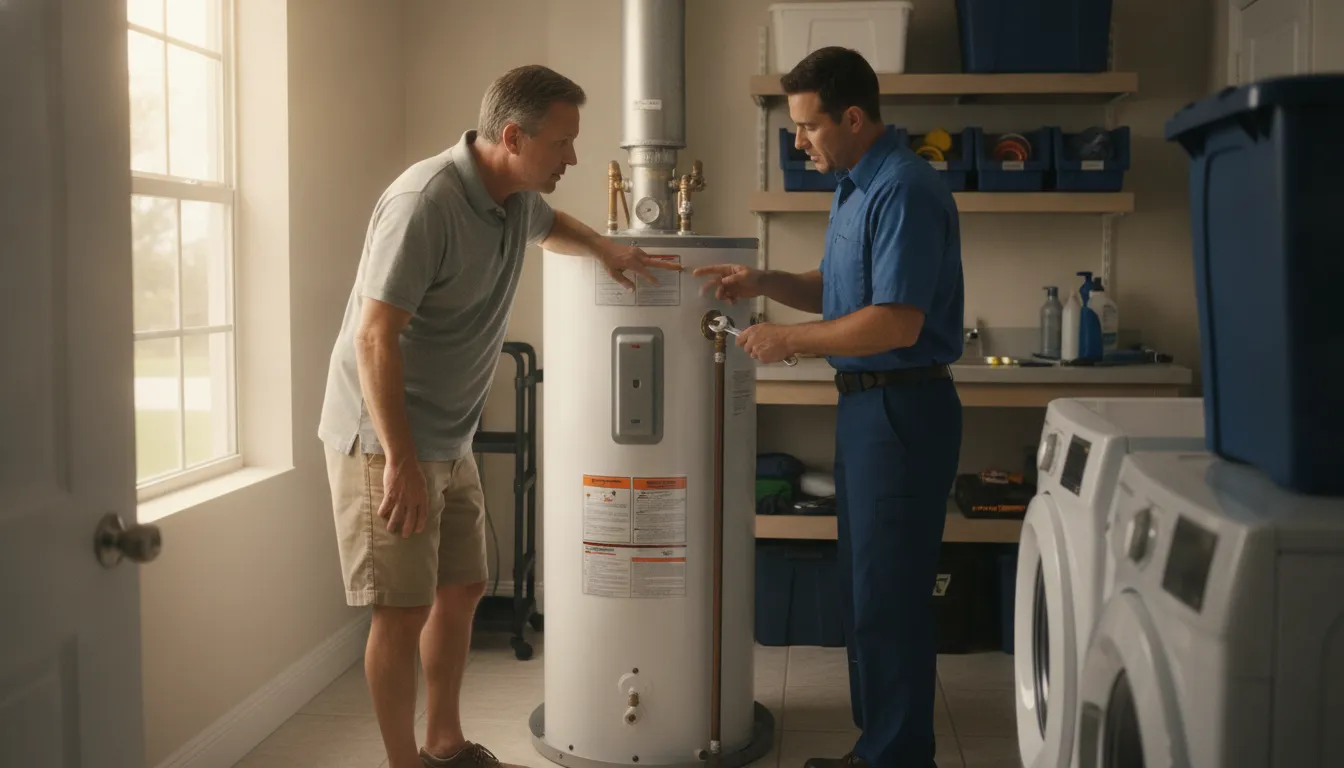
How long does a water heater last? There is no single expiration date for every home. A traditional storage-tank unit often serves for roughly 10 to 15 years, while a tankless unit may last about 15 to 20 years or more with proper care. The real answer depends on the system type, installation, water conditions, household demand, maintenance history, and what you are noticing now.
For Florida homeowners, the most useful question is not only how old the water heater is. Ask whether it is still reliable, whether moisture or corrosion is present, and whether repairs are becoming more frequent. A younger unit with one replaceable part may deserve repair. An older unit with recurring problems or a structural leak may deserve replacement planning.
This guide explains the service-life ranges, factors that can change them, symptoms that deserve attention, and the questions to ask before choosing repair or replacement. It also shows how local maintenance and a professional evaluation can help you make a clear decision.
Schedule a water heater evaluation with Space Coast Cooling & Plumbing
How long does a water heater last in Florida?
For a traditional storage-tank water heater, a practical planning range is about 10 to 15 years. Many manufacturers and home-service references describe a shorter typical range, around 8 to 12 years. Tankless water heaters commonly have a longer service-life range, often about 15 to 20 years or more with proper care. These figures are planning ranges, not expiration dates. A well-maintained unit may serve a home longer. Poor installation, heavy demand, corrosion, or neglected maintenance can shorten its useful life. These ranges are consistent with guidance from Rheem's water-heater lifespan overview.
Florida homeowners should think about age together with performance. A 10-year-old tank that produces steady hot water, shows no leaking, and has a documented maintenance history may deserve a professional evaluation rather than automatic replacement. An older unit with recurring problems or visible water damage deserves faster attention, even if it has not reached the end of a published range.
Storage models keep a reservoir of heated water ready for use. Because the tank holds hot water continuously, the system has standby heat loss and the tank itself remains exposed to water, heat, and mineral buildup. Tankless models heat water on demand and do not store the same reservoir. That design can reduce standby loss and may offer a longer service life, but it still needs correct sizing, installation, and maintenance. Flow demand, incoming water conditions, and the home's hot-water habits all matter. Rheem's water-heater lifespan overview explains the difference between these system types.
If you are comparing systems for a replacement, look beyond the largest number. A tankless unit may fit a household that values on-demand hot water and space savings. A storage tank may be a more straightforward choice when the home already has a suitable setup and predictable demand. Use the home's layout, fuel source, household size, budget, and maintenance expectations to guide the conversation. For Florida homeowners comparing options, the company's tankless water heater costs guide is a useful next step.
What changes a water heater's service life?
Two water heaters of the same age can be in very different condition. Service life depends on the equipment type, installation quality, water conditions, household demand, and whether routine care has been performed. That is why a calendar estimate should start a conversation, not end it.
Water quality and sediment
Minerals and sediment can collect inside a storage tank over time. The buildup can reduce usable capacity, affect heating performance, and make noises more noticeable. Hard or mineral-heavy water may increase the importance of an appropriate maintenance plan. Do not assume that every Florida home has the same water conditions. Ask a qualified professional how the local water supply and the home's plumbing history should affect service.
Maintenance and installation
Maintenance gives a technician a chance to look for developing problems before they become a larger leak or a no-hot-water emergency. Space Coast Cooling's plumbing operation includes annual flushing, sediment removal, and anode rod replacement. Its plumbing maintenance plan also includes an annual whole-house inspection, water heater flushing, and fixture checks. Homeowners can read more practical water heater maintenance tips without treating a checklist as a guarantee of a particular lifespan.
Installation details matter, too. Correct sizing, safe connections, proper venting where applicable, and code-compliant work all support reliable operation. Household demand also affects wear. A home with several occupants and frequent back-to-back showers places different demands on a unit than a smaller household. A system that regularly runs out of hot water may need a capacity review, not simply a new heating element.
Leaks and water loss
Check around the unit for moisture, staining, or pooling. EPA WaterSense recommends checking the home for leaks regularly and addressing identified leaks as soon as possible. A simple water-meter check can help: record the reading when no water is being used, then check again after two hours. If it changed, the home may have a leak. A water heater leak should not be ignored because a small fitting leak and a leaking tank call for different decisions.
Regular care cannot stop every failure. It can, however, help homeowners understand the unit's condition and plan service before a preventable problem becomes an urgent one.
What are the signs a water heater is nearing the end?
Age alone does not diagnose a failing water heater, but age plus symptoms is a strong reason to schedule an evaluation. Pay attention to changes you can see, hear, or feel at the tap. Homeowners do not need to identify the failed component before asking for help.
Visible leaks or moisture
Water around the base, a damp connection, staining, or repeated pooling deserves attention. A small valve or fitting leak may be repairable. Water coming from the tank itself can point to a more serious structural problem. Turn off the water supply if you can do so safely, protect nearby belongings, and arrange service rather than waiting for the leak to worsen.
Changes in hot-water performance
Running out of hot water sooner than usual, water that never gets fully hot, or temperature changes during normal use can indicate a problem. The cause could be a repairable part, a capacity mismatch, sediment, or a unit approaching replacement age. Rust-colored or cloudy water is another reason to request an evaluation, especially when the change keeps returning.
New sounds or recurring repairs
Knocking, rumbling, popping, or other new sounds may accompany sediment or heating problems. One isolated repair does not automatically mean the whole system should be replaced. Repeated service calls in a short period change the calculation, particularly when the unit is already older. Units over 10 years old are more likely to experience additional failures after a repair, according to the cited industry guidance.
Make a short record before the appointment: the approximate installation year, the symptoms, when they began, and whether the problem is constant or intermittent. If you want a symptom-focused checklist, review the company's guide to signs your water heater is failing. Bring the model information if it is easy to find, but do not remove panels or troubleshoot gas and electrical components yourself.
Early attention is about protecting the home and making a calm decision. It does not mean every symptom requires replacement. A professional can separate a fitting issue or replaceable component from corrosion, structural leakage, or a pattern of failures that makes replacement more practical.
Tank or tankless: which choice fits your home?
Tank and tankless systems solve the same household need in different ways. A storage tank keeps a reservoir of heated water. A tankless system heats water as it is needed, so it does not have the same standby heat loss. The better choice depends on hot-water demand, available space, existing connections, installation requirements, and how much maintenance the household is prepared to schedule.
| Consideration | Storage tank | Tankless |
|---|---|---|
| How it works | Stores and reheats a supply of hot water. | Heats water on demand. |
| Typical planning range | About 10 to 15 years, with many references giving 8 to 12 years. | About 15 to 20 years or more with proper care. |
| Potential strengths | Familiar setup and stored supply for normal household use. | On-demand operation, less standby loss, and a compact footprint. |
| Planning considerations | Tank condition, sediment, available capacity, and standby energy use. | Flow demand, sizing, installation requirements, and scheduled care. |
Published service-life ranges vary because equipment, water conditions, installation, and maintenance vary. A tankless system is not maintenance-free, and a storage tank is not automatically a poor choice. A household with high simultaneous demand may need a careful flow and capacity review. A household replacing an existing tank may prefer a familiar configuration if it fits the home's needs and budget.
Ask for an equipment comparison that accounts for the home's fuel source, available utility connections, number of occupants, typical shower patterns, and installation location. Also ask what routine care each option requires. The goal is not to choose the system with the longest headline lifespan. It is to select a system that can deliver reliable hot water and be maintained appropriately.
Should you repair or replace an older water heater?
The repair-versus-replacement decision should consider the unit's age, the nature of the problem, the condition of the tank, the repair estimate, and the likely value of continued service. A young unit with one replaceable part may be a reasonable repair candidate. An older unit with structural leakage, corrosion, recurring failures, or a repair estimate that approaches replacement value deserves a replacement discussion.
When repair may be reasonable
Repair evaluation often makes sense when the water heater is relatively young, the tank is not corroded, and there is no structural leak. The issue should also be limited to a component designed to be replaced. Heating elements, thermostats, and anode rods are examples of replaceable parts. Small valve or fitting leaks may also be repairable. The exact cause matters, so avoid choosing a repair based only on a symptom.
When replacement deserves consideration
Replacement becomes more practical when an older unit has recurring problems or when a repair would address one failure but leave a worn tank and other aging parts in service. Industry guidance notes that units over 10 years old have a higher likelihood of additional failures after a repair. Another published rule of thumb compares the repair estimate with the cost of a new unit. The percentages cited online are not a substitute for a current, itemized evaluation. Space Coast Cooling can help compare the condition of the existing system with available replacement options.
Visible tank leakage is especially important. Replacing a valve is different from replacing a tank that is leaking through its shell. If the system is in a finished area, a planned decision can also reduce the risk of water damage and an emergency replacement. Use the company's water heater repair service page for the repair path and its water heater replacement guide for broader planning information.
For replacement work, the company's documented service includes full removal and installation with code compliance. Ask what type, capacity, connections, and maintenance schedule fit the home. A clear explanation and upfront price give you the information needed to decide without pressure.
How to plan your next water heater decision
A little information makes a water-heater appointment more useful. Use this simple planning sequence before the unit becomes an emergency.
- Find the age. Look for the installation paperwork, service records, or the manufacturer's label. If you cannot confirm the date, write down the approximate age and the model information.
- Record the symptoms. Note leaks, noises, rusty or cloudy water, inconsistent temperatures, slow recovery, or a pattern of running out of hot water. Include when each symptom started.
- Check the area safely. Look for moisture and staining around the unit. Do not open electrical panels, disturb gas connections, or remove safety covers. If water is actively escaping, shut off the water supply only if you know how to do so safely.
- Describe household demand. Share the number of occupants, typical hot-water uses, and whether multiple fixtures are used at once. This helps a professional consider capacity rather than focusing on one component.
- Request an evaluation. Ask whether the issue appears repairable, whether the tank shows signs of corrosion or structural leakage, and what maintenance could reasonably help. Space Coast Cooling provides tank and tankless installation, repair, replacement, and maintenance for local homeowners.
- Compare the paths. If replacement is recommended, compare storage-tank and tankless options, required installation work, capacity, expected care, and the home's long-term needs. The company's replacement service includes full removal and code-compliant installation.
Regular maintenance can support better planning. EPA WaterSense recommends regular leak checks and prompt attention to leaks. Space Coast Cooling's plumbing maintenance plan includes an annual whole-house plumbing inspection and preventive water-heater flushing. These steps do not guarantee a lifespan, but they can make developing problems easier to identify.
Space Coast Cooling & Plumbing serves homeowners throughout Brevard County from its Cocoa headquarters, including Cocoa, Titusville, Melbourne, Palm Bay, Merritt Island, and nearby communities. If your water heater is aging or its performance has changed, schedule a water heater evaluation with Space Coast Cooling & Plumbing.
Frequently asked questions about water heater lifespan
Do water heaters last 20 years?
Some tankless water heaters can last 15 to 20 years or more with proper care. Traditional storage-tank units commonly have a shorter planning range. Age is only one factor, so condition, leaks, performance, and maintenance history should be considered together.
How do you know when a hot water heater needs to be replaced?
Look for an older unit combined with warning signs such as recurring repairs, visible tank leakage, corrosion, rusty or cloudy water, new rumbling noises, or unreliable hot water. A small fitting leak or replaceable component may be repairable, while a structural tank leak usually calls for a replacement discussion.
How long does a water heater last with hard water?
Hard or mineral-heavy water can contribute to sediment and mineral buildup, but it does not create one guaranteed lifespan for every home. Maintenance needs vary with water conditions, equipment, installation, and demand. Ask a qualified professional how the home's water conditions should affect flushing and inspection.
How long does a gas water heater last?
A gas storage water heater should be judged by its equipment type and condition rather than fuel source alone. Review the manufacturer's information, estimate its age, watch for leaks or performance changes, and have a qualified professional evaluate gas connections and combustion-related components.
Get a clear water heater plan
If your water heater is aging, leaking, making unfamiliar sounds, or no longer keeping up with normal use, an evaluation can help you understand the next step. Space Coast Cooling & Plumbing provides water heater repair, maintenance, tank and tankless installation, and replacement for homeowners across the Space Coast. The team can review the unit's condition, explain whether repair or replacement is appropriate, and provide upfront information for the work involved.
Do not wait for a small leak to become water damage. Contact Space Coast Cooling & Plumbing to plan your water heater service.