
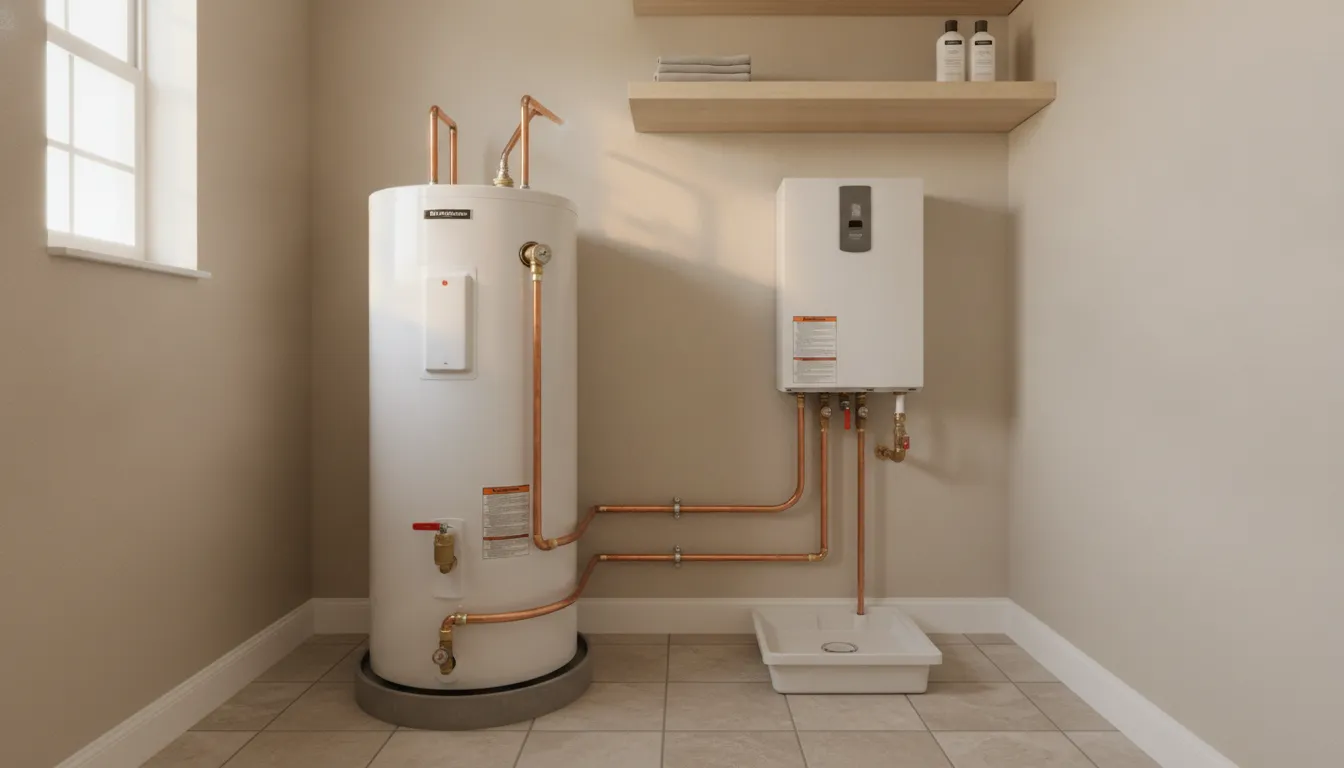
Choosing between a tank vs tankless water heater is a household decision. It is not a contest with one winner.
A traditional storage tank may suit a home that wants familiar equipment. It may also suit someone who values a predictable reserve.
A tankless system may fit someone who values wall space and on-demand heating. The right answer depends on how your family uses hot water.
It also depends on available fuel, utility connections, and the home itself. This guide compares capacity, recovery, space, fuel, installation, and maintenance. It covers household routines for Florida homeowners.
Contact Space Coast Cooling & Plumbing for a water heater assessment
How Do Tank and Tankless Water Heaters Work?
Both systems heat water for the same household jobs. They deliver hot water in different ways. A storage-tank water heater heats and holds a set volume in an insulated tank.
When a hot tap opens, heated water leaves and cold water enters. The heater then warms the replacement water.
This stored supply gives the home a reserve, but that reserve can be depleted during a busy period. A tankless water heater does not keep a large reserve hot between uses.
When a tap calls for hot water, the unit detects flow. It heats water as it passes through a heat exchanger.
ENERGY STAR describes whole-home gas tankless models as on-demand equipment. Proper sizing can support continuous hot-water delivery.
That does not mean unlimited flow under every condition. The unit still has a maximum output. Performance depends on incoming water temperature, selected temperature, fuel, and how many fixtures operate at once.
Recovery and continuous flow are different advantages
A tank system gives your home a stored supply. This can help when several people follow a predictable routine. The reserve can run out during a high-demand period.
Recovery then takes time when multiple showers or appliances use hot water close together. A tankless system can keep heating water while demand continues. It must meet the combined flow requirement.
If the system is undersized, multiple fixtures may reduce temperature or comfort. A professional sizing review should consider both flow and temperature rise. Household size alone is not enough.
Neither design is automatically better for every Space Coast home. The comparison becomes clearer when you look at actual routines, available space, existing connections, and the condition of the current equipment.
How Much Hot Water Does Your Household Need?
Hot-water demand is often the most useful starting point. Count more than the number of people in the home. Think about when showers happen.
Note whether laundry overlaps with bathing or the dishwasher runs while another fixture is open.
A home with four residents may have modest demand if schedules are spread out. A smaller home can create a difficult peak if several fixtures run together.
Tank capacity and tankless flow use different measurements
Storage tanks are discussed by volume. Tankless systems are commonly sized by gallons per minute, or GPM. ENERGY STAR says simultaneous shower, dishwasher, and clothes washer use increases the required tankless capacity.
Its buying guidance lists 2.5 GPM for a shower or bathtub. It lists 3.3 GPM for a clothes washer and 2.2 GPM for a kitchen or bathroom sink.
A dishwasher is listed at 1.3 GPM. These are planning examples, not a complete sizing formula.
Read ENERGY STAR's tankless sizing guidance for the source figures and professional planning advice.
Use this simple review before requesting an assessment:
- List the fixtures. Note every shower, tub, sink, dishwasher, and clothes washer that may need hot water.
- Identify the peak window. Write down which fixtures could operate during the same 30- to 60-minute period.
- Note comfort concerns. Record cold showers, long waits, temperature swings, or a tank that runs out during normal use.
- Consider future changes. Include a finished bathroom, a larger household, a rental conversion, or new appliances that could change demand.
Recovery affects how a tank feels in daily use
A storage tank can work well when the household uses hot water in manageable intervals. A tankless unit can be attractive when demand is spread across the day.
It can also suit a homeowner who wants to avoid storing a large volume. However, a tankless system still needs correct sizing. It also needs adequate fuel or electrical capacity.
The goal is not to pick the biggest equipment. It is to match output, temperature rise, and household timing to the home.
For storage-tank planning, see our 50-gallon tank sizing guide.
What Changes With Space, Fuel, and Installation?
Tankless equipment is compact and wall mounted. A storage tank needs floor space and clearance around the tank. That difference can matter in a tight utility room, garage, closet, or remodeled area.
A smaller footprint is useful only if the new location allows safe service access, appropriate connections, and compliance with installation requirements.
Existing fuel and venting can shape the project
For a gas tankless installation, ENERGY STAR recommends checking household demand and the existing natural-gas line. It also recommends checking electrical availability and the combustion-gas vent path.
These checks are not details to guess from a product photograph. A replacement may need different venting or gas capacity than the existing storage heater.
An installer should evaluate the actual property before equipment is selected. Electric tankless equipment has its own planning questions.
The Department of Energy's tankless transition guide notes that electric tankless units can draw substantial current.
The electrical panel should be evaluated for compatibility. A qualified installer should confirm the panel, wiring, disconnect, and available capacity before recommending an electric model.
Location and line routing matter in Florida retrofits
The DOE guide also notes that the location of a tankless unit can affect performance. Relocating equipment may require additional plumbing lines. A central location between points of use can reduce pipe length.
The best location depends on the home's layout, exterior access, vent route, drainage, and service clearance.
For either system, the installer should inspect shutoff valves, water lines, and connections. They should also review drainage and the surrounding area.
In Florida homes, the practical choice may be influenced as much by the existing installation as by the heater's feature list. Our water heater installation considerations can help you prepare questions for that visit.
How Do Maintenance Needs Compare?
Both system types need attention over time. Maintenance is not a reason to choose one model without considering water quality, fuel, installation conditions, manufacturer instructions, and household use.
| Consideration | Storage tank | Tankless |
|---|---|---|
| What is stored? | A volume of heated water remains in the tank between uses. | Water is heated as it flows through the unit. |
| Space and access | Needs floor space, clearance, and access around the tank. | Uses wall space but needs safe service access and suitable connections. |
| Planning focus | Tank volume, recovery, connection condition, and surrounding area. | Flow capacity, temperature rise, fuel or electrical supply, venting, and location. |
| Maintenance planning | Follow the model's instructions for inspection and tank-related care. | Follow the model's instructions for cleaning, scale control, and service. |
Water conditions should be part of the conversation
Mineral buildup and water conditions can affect water-heating equipment. A tankless heat exchanger may need attention when scale affects flow or heat transfer.
A storage tank also benefits from model-specific inspection and maintenance. Do not assume that a tankless unit is maintenance-free or that a tank requires the same care as a different model.
Maintenance is easier when the installation leaves room to reach valves, controls, connections, and service components.
Ask what routine care the selected model requires. Ask which tasks should be handled by a qualified professional. Also ask how the homeowner will know when service is needed.
You can also review our water heater maintenance needs before the appointment. Bring your questions to the assessment.
Keep the decision tied to the whole system
A water heater is connected to plumbing, fuel, electrical, venting, and household routines. Choosing equipment only because it has a compact profile or a familiar tank size can miss an important installation constraint.
Which System Fits Different Florida Homes?
The best tank vs tankless water heater choice depends on your goals and the property. A storage tank may be a practical fit when the current layout already supports it.
The household should have predictable demand, available floor space, and a reason to value stored hot water.
A tankless system may deserve consideration when space is limited, the household wants on-demand heating. Or a planned remodel creates an opportunity to evaluate gas, electrical, venting, and water-line changes together.
That does not make tankless the automatic upgrade. A project that needs new infrastructure may have different priorities from a straightforward replacement.
Use your household pattern, not a sales slogan
- Choose a tank-centered discussion when familiar storage matters.
- Explore tankless sizing when wall space matters.
- Compare both carefully when the home has overlapping showers, uncertain capacity, or remodeling plans.
Before choosing, gather the model and fuel type of the current heater, the number of bathrooms, the usual peak-use period, recent performance problems, and any remodeling plans.
Note whether the equipment is in a garage, utility room, closet, or another location. These details help an installer focus the assessment on the actual home.
Space Coast homeowners can compare the project with our guide to Florida tankless installation costs. An online guide cannot replace a site-specific scope.
The clearest next step is an in-home review of sizing, connections, location, and maintenance access. Space Coast Cooling & Plumbing serves Cocoa, Melbourne, Palm Bay, Titusville, Merritt Island, and nearby communities.
Ready to compare your home's options? Request a site-specific water heater assessment from Space Coast Cooling & Plumbing before selecting equipment.
Frequently Asked Questions About Tank and Tankless Water Heaters
Is a tankless water heater better than a tank water heater?
Not for every home. Tankless equipment can provide on-demand heating and use less wall or floor space. A storage tank offers a familiar reserve and may fit an existing replacement layout more simply.
The better choice depends on demand, fuel or electrical service, venting, location, maintenance access, and the home's plans.
Can a tankless water heater supply a large household?
It can when the system is correctly sized for the home's peak flow and temperature rise. ENERGY STAR explains that tankless capacity is measured in GPM.
Simultaneous showers and appliance use increase the required capacity. A professional should review likely peak fixtures rather than sizing only by the number of occupants.
Does a tankless water heater need more maintenance?
Maintenance depends on the model, water conditions, installation, and use. Tankless systems may need manufacturer-directed care for scale and heat-exchanger performance.
Storage tanks also need model-specific inspection and maintenance. Ask for the recommended service plan before choosing either system.
Will switching to tankless lower my energy bills?
On-demand heating can reduce standby losses in the right application, but actual household results vary. Usage, fuel, incoming water temperature, equipment selection, installation, and utility rates all affect operating costs.
A general efficiency claim is not a guaranteed bill reduction for your home.
What should a water heater assessment include?
An assessment should review household demand, current equipment, fuel or electrical supply. It should also review water and gas lines, venting where applicable, installation location, service access, and the scope of replacement work.
ENERGY STAR recommends an in-home estimate for customized planning. That evaluation helps keep the choice tied to the property rather than a generic comparison.
Contact Space Coast Cooling & Plumbing before choosing replacement equipment
Plan Your Water Heater Replacement
A balanced comparison is a useful starting point. Base the final choice on household demand and home conditions.
Contact Space Coast Cooling & Plumbing to schedule a water heater assessment for your Space Coast property.