
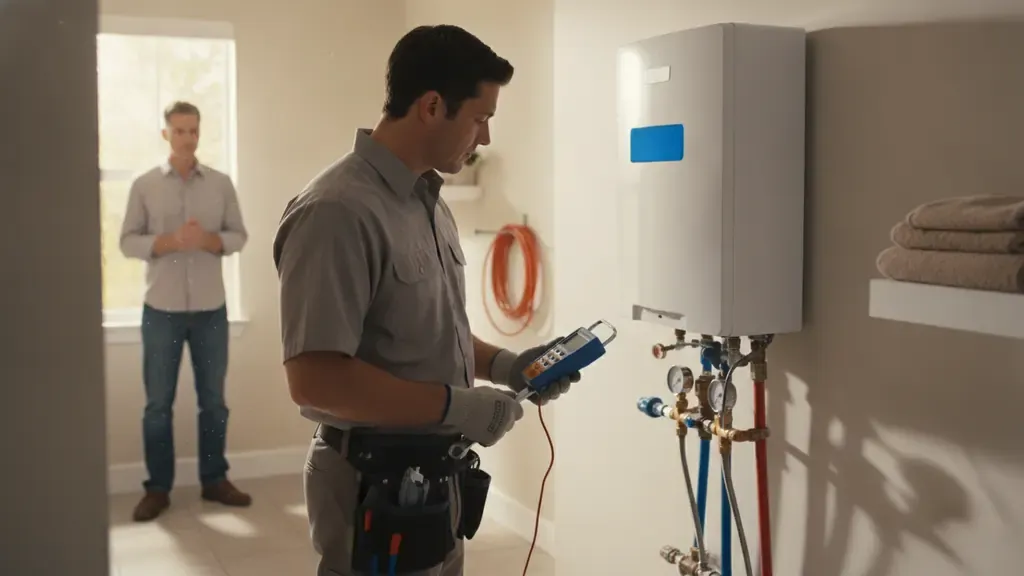
When a tankless unit delivers lukewarm water, shuts down, or shows an error code, the right tankless water heater repair starts with identifying the symptom without guessing at a part replacement. A few external checks may reveal a simple flow or power issue, but gas, electrical, combustion, and internal water-heater components require professional diagnosis. This guide explains the common problems Space Coast homeowners see and when to request service.
Schedule tankless water heater service with Space Coast Cooling & Plumbing.
What does tankless water heater repair include?
Tankless repair is the process of diagnosing and correcting a problem in an on-demand water-heating system. Unlike a storage tank, a tankless unit activates when water flows through it, then uses a gas burner or electric heating elements to raise the water temperature. That means a repair technician has to evaluate the interaction between water flow, temperature controls, power, fuel or heating elements, sensors, venting, and the heat exchanger.
A service visit may include reviewing the symptom, checking the unit's display, testing inlet and outlet temperatures, inspecting filters and connections, and looking for signs of mineral buildup or water damage. The exact repair depends on the unit type, installation, maintenance history, water conditions, and the manufacturer's instructions. A symptom alone is not enough to identify a failed component.
If you are still deciding whether a tankless system fits your home, see our tankless water heater guide. This repair article focuses on an existing system that is not performing as expected.
Why does the water temperature keep changing?
Temperature swings are one of the most noticeable tankless water-heater problems. You may get hot water for a short time, followed by lukewarm water, or the temperature may change when another faucet or shower starts. The cause can be related to flow, settings, water demand, mineral buildup, or a component that is not reading conditions correctly.
- Flow is below the activation threshold: A faucet that is only slightly open, a restricted showerhead, or a clogged inlet screen may not provide the flow the unit needs to stay activated.
- Demand exceeds the system's capacity: Running several hot-water fixtures at once can make an undersized or incorrectly adjusted system struggle to maintain the set temperature.
- Inlet water conditions changed: Seasonal water-temperature changes can affect how much heating is required, especially when the unit is already near its operating limit.
- Mineral buildup is affecting heat transfer: Scale inside the heat exchanger can reduce performance and create unstable outlet temperatures.
- A sensor or control issue is present: A temperature or flow sensor that is dirty, damaged, or out of range needs testing rather than a guess at replacement.
Start by noticing whether the problem occurs at one fixture or throughout the home. If only one shower is affected, the fixture may be restricted or mixing cold water unexpectedly. If every hot-water outlet is affected, the unit, supply, or system capacity is more likely involved. Do not remove the cabinet cover to investigate internal parts.
What do tankless water heater error codes mean?
An error code is a message from the unit's control system that a sensor, operating condition, or safety check is outside its expected range. The meaning varies by manufacturer and model. A code that means low flow on one unit may represent a different condition on another, so a generic online code list can send a homeowner in the wrong direction.
Write down the exact code, when it appeared, and what the unit was doing. Note whether there was a recent power interruption, plumbing work, change in water pressure, or unusual noise. A technician can use that history along with the model information to narrow the diagnosis.
Some codes relate to routine maintenance, while others indicate ignition, combustion, venting, electrical, overheating, or sensor concerns. If the unit repeatedly locks out, the code returns after a permitted reset, or you smell gas or see signs of overheating, stop using it and request professional service. Do not bypass a safety switch, bridge a sensor, adjust gas pressure, or open a combustion chamber to clear an error.
For general maintenance context, our water heater maintenance guide explains why scheduled care matters. The maintenance needs of a tankless system are not identical to those of a storage tank, so follow the unit manual and a qualified technician's recommendations.
Why has the hot-water flow dropped?
A tankless heater needs enough water flow to activate and operate correctly. Reduced flow may feel like a weak shower, a faucet that takes longer to heat, or hot water that stops when another fixture opens. The restriction may be at one fixture, at the unit's inlet, or in the home's plumbing.
First, compare several fixtures. If only one outlet has low flow, clean the fixture aerator or showerhead according to its instructions. If hot and cold flow are both weak throughout the home, the issue may be a plumbing restriction or supply problem rather than the heater. If cold flow is normal but hot flow is weak at multiple fixtures, a clogged inlet screen, service valve, filter, or heat exchanger may need inspection.
Do not remove an inlet screen or service fitting while the system is pressurized. Water can be hot even when the burner or element is off. A technician can isolate the unit, check pressure and flow, and determine whether cleaning, descaling, a plumbing repair, or a component repair is appropriate.
Why will a gas tankless water heater not ignite?
A gas-powered tankless unit may fail to ignite when it does not detect the required water flow, when fuel or electrical conditions are not correct, or when an ignition, flame-sensing, combustion-air, or venting issue is present. The unit may display a code, cycle without heating, or shut down shortly after starting.
Homeowners should not troubleshoot the burner, gas valve, ignition assembly, flame sensor, vent system, or combustion settings. These parts and systems have safety implications. A blocked vent or combustion-air problem can allow dangerous conditions, and an incorrect gas adjustment can damage the appliance or create a hazard.
You can safely observe whether the unit has power and whether other gas appliances are operating normally, as long as you do not smell gas. If you smell gas, leave the home without operating switches or creating a flame, then contact the gas utility or emergency services from a safe location. If there is no gas odor but the heater will not ignite, turn off hot-water demand and arrange a qualified inspection.
Can mineral scale cause tankless water-heater problems?
Yes. Dissolved minerals can collect on the heat exchanger and restrict water passages over time. Scale is more likely to create trouble when the system operates with hard water or when maintenance is skipped. The symptoms can include lower hot-water flow, longer heating time, temperature fluctuations, unusual sounds, higher energy use, or repeated error codes.
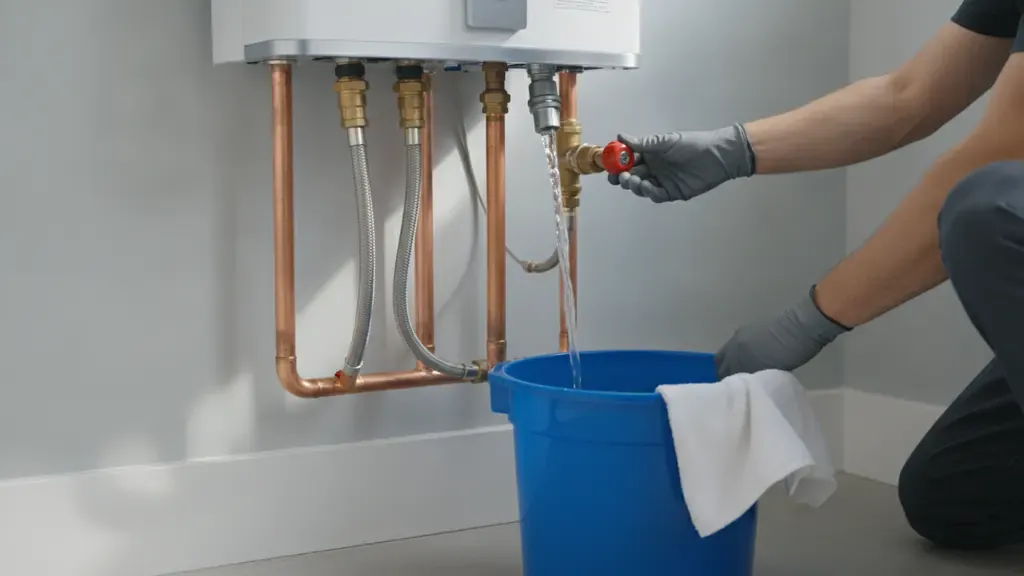
Descaling, sometimes called flushing, is not the same as casually running water through the unit. Proper service requires isolating the heater, using compatible equipment and solution, following the manufacturer's procedure, and returning the system to service safely. A technician should also look for the reason buildup has become a recurring issue, such as water quality or missed maintenance.
Do not pour household chemicals into the heater or open service valves without knowing the correct isolation procedure. If you have a service-valve kit installed and the manual gives homeowner maintenance instructions, follow those instructions exactly. When the manual is unavailable, the unit is overdue for service, or the system has a code or weak flow, professional maintenance is the safer choice.
What can homeowners safely check first?
A short external check can help you collect useful information without turning a service call into a larger repair. Stop immediately if you see leaking water near electrical components, smell gas, see scorch marks, hear unusual combustion sounds, or feel unsafe.
- Check the symptom at more than one fixture. Note whether the issue affects one faucet, one shower, or the entire home.
- Confirm the control setting. Make sure the temperature setting was not changed accidentally, and do not raise it to an unsafe level to compensate for a problem.
- Look at the display from the outside. Record any error code exactly, including letters, numbers, and punctuation. Do not open the cabinet.
- Check for obvious leaks. Look below and around the unit without touching hot pipes or disconnecting fittings. A shutoff may be appropriate for an active leak if you can operate it safely.
- Check the electrical supply visually. If the home's panel has a tripped breaker, do not repeatedly reset it. A recurring trip needs electrical diagnosis.
- Review recent changes. Write down recent plumbing work, a power outage, a water interruption, or a long period without use.
These checks are for observation and basic external verification. They do not replace testing. Do not disassemble the unit, remove the front cover, adjust gas or water pressure, clean a burner, alter wiring, or attempt to defeat a safety control.
Request a professional tankless water heater diagnosis for your Space Coast home.
When should you call for professional repair?
Call a qualified water-heater professional when the unit repeatedly fails, an error code returns, hot water is unavailable, or the symptom affects several fixtures. Professional diagnosis is especially important for problems involving gas, combustion air, venting, electrical power, internal sensors, heat exchangers, or water leaks.
Request prompt help for these service signs:
- You smell gas or suspect a combustion or venting problem.
- The unit shuts down, locks out, or shows the same error repeatedly.
- Hot water is scalding, unexpectedly cold, or changing temperature at several fixtures.
- Water is leaking from the heater, pipes, valves, or connections.
- Flow has dropped throughout the home or the unit no longer activates normally.
- You hear popping, banging, hissing, or other new sounds during operation.
- A breaker trips when the heater runs or the unit shows signs of electrical damage.
- The system needs descaling and you do not have the equipment, manual, or experience to perform it safely.
Space Coast Cooling & Plumbing provides water-heater service for homeowners across the Space Coast. The existing water heater repair service page explains how to request help for tankless and other water-heater systems. A technician can evaluate the actual unit and recommend a repair based on its condition rather than a generic online diagnosis.
How can you prevent repeat tankless water-heater problems?
Prevention begins with maintenance that matches the unit and the home's water conditions. Keep the owner's manual and model information available. Follow the manufacturer's schedule for descaling, filter cleaning, inspection, and other service. A professional can help determine an appropriate interval when mineral buildup, high demand, or past error codes have been an issue.
Keep the area around the heater accessible and free of stored items. Do not block required air openings or place chemicals near the appliance. Watch for small changes in hot-water flow, temperature stability, sounds, or display messages. Early attention can prevent a minor maintenance need from becoming a loss of hot water or a larger component problem.
When a tankless system is reaching the end of its useful service life or repairs are recurring, ask for a condition-based recommendation. Repair may be sensible, while replacement may be more practical in another situation. Installation, sizing, and replacement decisions are covered separately in our tankless water heater installation guide; this article's focus is diagnosing repair symptoms.
Frequently Asked Questions
Can a tankless water heater be repaired?
Yes. Many tankless water-heater problems can be repaired or corrected through cleaning, descaling, connection work, sensor testing, or component replacement. The correct solution depends on the unit's type, model, condition, and the cause of the symptom. Gas, electrical, combustion, and internal repairs should be handled by a qualified professional.
What is the most common problem with a tankless water heater?
Mineral scale, restricted flow, and maintenance-related performance problems are common, especially when hard-water conditions affect the heat exchanger. Temperature swings, error codes, ignition concerns, and low flow can also have several possible causes, so the symptom should be diagnosed instead of assuming one failed part.
How much does tankless water heater repair cost?
There is no reliable single repair price because the total depends on the diagnosis, unit type, parts, labor, access, water conditions, and whether the issue is maintenance or a larger component failure. A written, scope-specific estimate is the best way to understand the cost for your system.
How long do tankless water heaters last?
Service life varies with equipment quality, water conditions, usage, installation, and maintenance. Regular inspection and descaling can help protect performance, but age alone does not determine whether a unit should be repaired or replaced. A professional condition assessment can compare the system's current condition with the expected cost and reliability of continued service.
Should I reset my tankless water heater?
Follow the owner's manual if it describes a safe reset for your model, but do not keep resetting a unit that immediately shuts down or repeats an error. A recurring code, breaker trip, gas concern, leak, or unusual sound calls for diagnosis rather than repeated resets.
Need tankless water heater repair in the Space Coast area?
Contact Space Coast Cooling & Plumbing to schedule water-heater service.