
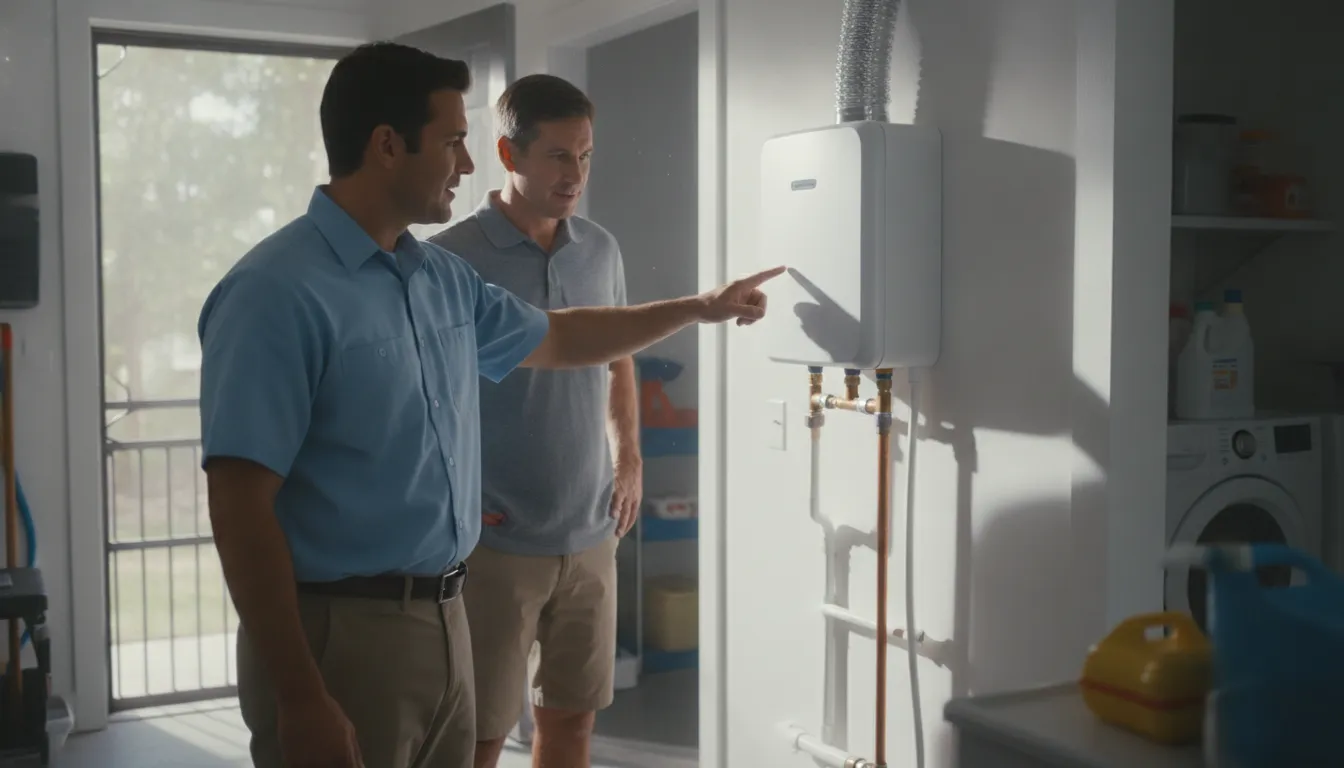
A tankless water heater does not store a set number of gallons. It heats water as it moves through the unit. That is why tankless water heater sizing starts with two numbers: how many gallons per minute your home may use at once, and how many degrees the heater must raise the incoming water. Get either number wrong and the shower can turn lukewarm when a second faucet opens.
Space Coast Cooling & Plumbing has installed traditional and tankless water heaters for Brevard County homes since 1994. Licensed plumbers size the unit to the house, then check the fuel supply, venting, and the drain before anyone orders equipment. When the size is set, tankless water heater installation is the next step. Project cost is a separate question. Our tankless installation cost guide covers price ranges after the size is clear.
Request tankless water heater sizing through our contact page.
What Tankless Water Heater Sizing Actually Measures
Storage tanks are sold by volume. A 40- or 50-gallon tank holds that much hot water and then needs time to recover. A tankless heater is sold by flow. The rating is gallons per minute, often shortened to GPM, at a stated temperature rise.
Temperature rise is the gap between cold water entering the heater and the hot water you want at the tap. A common planning setpoint is about 120 degrees Fahrenheit. If water enters at 70 degrees, the rise is 50 degrees. If it enters colder, the same heater delivers fewer gallons per minute.
Manufacturers print a chart for this. A unit that claims 7 GPM at a 35-degree rise may deliver closer to 4 or 5 GPM at a 70-degree rise. Comparing the headline GPM without the rise is how homes end up with a heater that looks large on paper and runs short in real use.
The U.S. Department of Energy's Building America program says to calculate the practical maximum flow the home needs at one time, then pick a gas tankless heater that can meet that flow at the required temperature rise. Its gas tankless guide also says the gas supply, vent clearances, and condensate drain have to be confirmed on site. Those checks come after the size, not instead of it.
How Tankless Water Heater Sizing Counts Peak Fixtures
Do not add every faucet in the house. Add the ones that can run together during a busy half hour. A four-person home with staggered showers may need less flow than a smaller home where two showers, the dishwasher, and a sink overlap.
ENERGY STAR lists average fixture flows you can use as a planning sheet, not as a finished design. Its whole-home tankless buying guide publishes the figures below.
- Shower or bathtub: 2.5 GPM.
- Clothes washer: 3.3 GPM.
- Kitchen or bathroom sink: 2.2 GPM.
- Dishwasher: 1.3 GPM.
Write down your real peak, not the worst day you can imagine and not a quiet Tuesday. Two showers plus a bathroom sink is 2.5 + 2.5 + 2.2, or about 7.2 GPM. One shower and a dishwasher is about 3.8 GPM. A kitchen sink alone is about 2.2 GPM.
Low-flow showerheads can drop a shower closer to 1.5 or 2.0 GPM. Older heads can sit above 2.5. If you already own the fixtures, the label on the showerhead is a better number than the national average. Our comparison of tank and tankless water heaters walks through the same fixture list when you are still deciding which type of heater fits.
| Busy moment in the home | Fixtures counted | Planning flow |
|---|---|---|
| One person getting ready. | One shower. | About 2.5 GPM. |
| Morning overlap. | Shower plus a bathroom sink. | About 4.7 GPM. |
| Two showers at once. | Two showers. | About 5.0 GPM. |
| Two showers and a sink. | Two showers plus a sink. | About 7.2 GPM. |
| Laundry during a shower. | Shower plus a clothes washer. | About 5.8 GPM. |
These rows use ENERGY STAR's average fixture flows. They are a starting sheet for the visit, not a promise of the model we will install. A plumber still checks fixture labels, pipe size, and how the family actually uses hot water.
Use Temperature Rise, Not the Headline GPM
Florida groundwater is milder than a northern winter, but it is not warm enough to ignore. Many manufacturer maps put central Florida inlet water in a broad band around the low 70s Fahrenheit for much of the year. Winter cold snaps and homes on a deep well can come in cooler. A shaded slab, a long buried line, or a well can all change the reading at the heater.
Here is the simple math. Subtract inlet temperature from the hot-water setpoint. A 120-degree setpoint with 72-degree inlet water is a 48-degree rise. The same setpoint with 60-degree inlet water is a 60-degree rise. The heater must be rated for your rise, not for a mild test condition printed in the largest type on the box.
Ask to see the manufacturer's chart at your rise, not only the maximum GPM. If two showers are your peak and the chart shows the unit dropping under that flow at a 60-degree rise, the heater is small for that house. Stepping up one model, or splitting demand, is usually cheaper than living with cold water and replacing the unit later.
Do not guess inlet temperature from the weather. A plumber can read it at a tap. That single number is what makes the size specific to your house instead of a national average.
Whole-Home or Point-of-Use
Whole-home sizing covers the fixtures that share one heater. That is the right plan for most Space Coast houses that want every bath and the kitchen on the same system. The heater has to carry the peak you counted above, at your temperature rise.
Point-of-use sizing is smaller on purpose. A compact heater at a garage sink, a guest suite, or a single bath only has to serve that spot. ENERGY STAR notes that a separate tankless heater can be matched to one need instead of the whole house. The flow target might be one shower, or one sink, rather than 7 GPM.
A point-of-use unit does not fix a short whole-home heater. If two showers already overlap, a tiny heater under the kitchen sink will not help the hall bath. Use point-of-use when one location is far from the main heater or has its own demand. Use whole-home when the family shares one peak.
Some larger homes do better with two whole-home units, each serving part of the house, than with one unit pushed past its chart. That is a layout decision. It depends on where the baths sit and where gas or electric capacity already exists. It is not a reason to buy the biggest single box in the catalog.
Match the Size to Gas, Electric, or Propane
A flow number is not installable until the fuel can support it. Gas and propane tankless heaters need enough fuel delivery for the burner at full fire. Electric tankless heaters need enough panel space and wire for a large, steady draw. The Department of Energy notes that electric tankless units can pull substantial current, so the panel has to be checked before the model is chosen.
On a visit, we look at four things after the GPM and rise are set:
- Fuel capacity. Is the existing gas line, propane supply, or electric panel large enough for this model without starving a range, dryer, or air handler?
- Vent path. Gas units need a code-compliant vent. Condensing models also need a condensate drain.
- Water lines. Pipe size, shutoff valves, and a safe place to mount the heater all change whether the rated flow can actually reach the fixtures.
- Location. A heater parked at one end of a long ranch house can still feel slow at the far bath, even when the GPM is right. A central spot shortens the wait.
If the panel or gas line cannot feed the size you need, the honest answer is an upgrade or a different layout. It is not a smaller heater with a hopeful rating. Our tankless water heater installation page explains how that on-site check works for Cocoa and the rest of the Space Coast.
Permits and inspection rules sit beside the size, not inside the sizing math. If you want to know when a water heater change needs a permit, read our Florida water heater permit guide and confirm the rule for your address before work starts.
Signs the Current Heater Is the Wrong Size
You do not need a flow meter to notice a mismatch. These patterns show up in daily use:
- The water stays hot for one shower, then drops as soon as a second shower or the washing machine starts.
- Winter mornings are weaker than summer mornings, even though nobody changed fixtures.
- The heater is loud, short-cycles, or shows a flow or scale code more often than it used to.
- Someone added a bathroom, a soaker tub, or a teen in the house after the unit was installed.
- Fixtures were swapped for higher-flow heads, or a new soaking tub was added to an older heater.
Temperature swings and error codes can also be repair issues, not a size problem. Scale, a failing sensor, or a weak gas supply can mimic a small heater. Our tankless water heater repair guide separates those faults from a unit that was undersized from the start.
If the heater is fine and you are only comparing it with a storage tank, gallon charts live on a different page. The 50-gallon water heater guide covers tank volume. It will not tell you the GPM a tankless model needs.
A yearly plumbing check is a good time to re-test this. The plumbing maintenance plan is $149 a year. The plan does not resize a heater by itself. It does give a licensed plumber a scheduled look at flow, scale, and the parts that make a correctly sized unit fall off its rating. Current plan details are on our maintenance plans page.
Request a quote for tankless water heater installation.
Frequently Asked Questions
How do I size a tankless water heater for my house?
Add the gallons per minute of the fixtures that run at the same time. Then check that flow on the manufacturer's chart at your temperature rise. Temperature rise is the hot setpoint minus the cold water entering the heater. A plumber should confirm both numbers at the house before you buy.
What GPM do I need for two showers?
Using ENERGY STAR's 2.5 GPM shower figure, two showers are about 5 GPM before any sink or washer is added. Two showers plus a bathroom sink land near 7 GPM. Your showerheads may be lower or higher than 2.5, so read the labels.
Does Florida's warm groundwater mean I can buy a smaller unit?
Mild inlet water helps, because the temperature rise is smaller than in a cold climate. It does not replace a flow count. A house with two overlapping showers still needs a heater rated for that flow at the rise measured on site. Guessing from the weather is how units come up short in January.
Can one point-of-use heater serve the whole house?
No. A point-of-use heater is sized for one sink, one bath, or a similar small load. Whole-home demand needs a heater, or a pair of heaters, rated for the peak you actually use. Putting a small unit under one sink will not keep a second shower hot.
Who should confirm the size before installation?
A licensed plumber should. Space Coast Cooling & Plumbing checks fixture flow, inlet temperature, gas or electric capacity, venting, and mounting location for homes across Cocoa, Merritt Island, Melbourne, Palm Bay, and nearby Brevard County. You see the plan before the equipment is ordered.
Get a Size That Matches the House
Bring a short list to the visit: which showers run together, any fixture you added, and whether the water already goes cool at peak times. We will measure the rise, read the model chart, and tell you if the gas line or panel has to change. That is tankless water heater sizing done for the house you live in, not for a national average.