
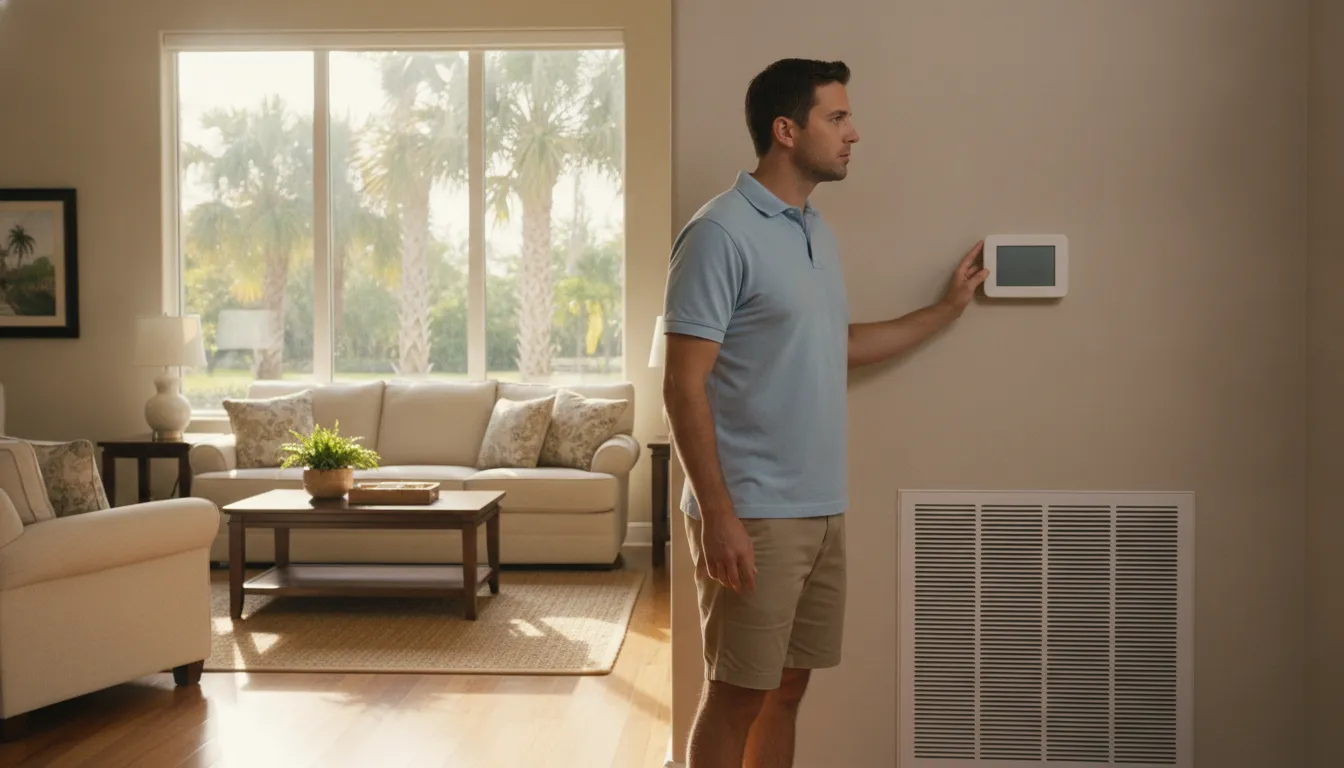
When the air conditioner stops working on a Space Coast afternoon, the house can feel warm within minutes. What to check when AC stops working comes down to four things you can see. Check the thermostat, the filter, the breaker once, and any ice or water. Do that before you call. Those checks show whether a wrong setting or a blocked filter explains the warm house, or whether a technician needs to take over. They do not tell you which part failed, and they are not a repair.
Space Coast Cooling & Plumbing has handled air conditioning repair across Brevard County since 1994, from a shop at 760 West Avenue in Cocoa. A real person answers the phone day and night. If the house is already too warm, or any check below looks unsafe, skip the list and request AC repair service.
Start with what you can see
Write down three facts before you touch anything. Is the system off, running, or clicking and quitting? Are the vents blowing warm air, weak air, or nothing? Is there water on the floor, ice on the indoor unit, or a smell like hot dust or burning plastic?
- Set the thermostat to Cool and the fan to Auto.
- Look at the filter and replace it if you cannot see light through it.
- Reset a tripped breaker one time only.
- Turn the system off if you see ice, standing water, or smell burning.
Those three answers are what a technician needs on the call. They also keep you from resetting the same breaker over and over, which hides the clue and can damage the equipment. If you smell burning, see smoke, or hear grinding or banging, turn the system off at the thermostat and call. Do not open the outdoor unit or the air handler cabinet. Those panels cover live electrical parts and the blower.
This list is for a central air conditioner or heat pump in a house. It is not a parts guide. If you want the longer map of Florida cooling problems, the AC repair guide for Florida homeowners sits beside this checklist. Use this page for the first few minutes, and that guide when you want the wider picture.
What to check when AC stops working
A thermostat set to Heat, Fan, or Off will not cool the house, and it is the most common false alarm we hear. Set the mode to Cool and the fan to Auto. Set the temperature at least three degrees below the room temperature, then wait five minutes. The outdoor unit should start. If the fan runs and the outdoor unit stays silent, you have a real no-cool call, not a setting.
Look at the display. A blank screen often means dead batteries or a tripped breaker, not a failed air conditioner. Replace the batteries if the thermostat takes them, then recheck Cool and Auto. Do not pull the thermostat off the wall. The wires behind it are low voltage, and a loose wire creates a second problem.
If the thermostat looks correct and nothing starts, stop there. Our guide to an AC that stopped working covers the causes that come after a good thermostat, including power and control problems a homeowner should not chase. If the system runs and the air is warm, jump to the filter and airflow checks below, then read why an AC is not cooling in Florida if the simple checks do not change anything.
Heat pumps have one extra trap. If the thermostat says Emergency Heat or Auxiliary Heat and the air feels warm, you may be running the heat strips, not the cooling cycle. Switch back to Cool. If it will not stay in Cool, leave it and call. Do not keep toggling modes.
Look at the filter and the airflow
A filter packed with dust is the one homeowner fix that often matters on a hot day. Pull the filter at the return grille or at the slot on the air handler. If you cannot see light through it, replace it with the same size. Hold the old filter up to a window. If it looks gray and felted, it is done. ENERGY STAR's maintenance checklist tells homeowners to inspect, clean, or change air filters once a month, because a dirty filter raises energy use and can damage the equipment.
Match the size printed on the frame. A filter that does not fit leaks air around the edges and does nothing. Do not upgrade to a much thicker or higher-MERV filter on the spot. A filter the system was not sized for can choke airflow the same way a dirty one does. The EPA guide to air cleaners in the home is clear that no filter removes every pollutant, and that the filter has to fit the system you already have.
While the system is off, walk the returns and supplies. Move furniture, rugs, and closed doors that block them. In many Brevard houses the return is in a hallway, and a closed bedroom door is enough to starve it. Give the system 15 minutes after a new filter. If the air is still warm or weak, the filter was not the cause.
Do not hose the outdoor coil while the unit is running, and do not pressure-wash the fins. A garden hose on a coil that is truly matted with grass clippings is fine only with the disconnect off, and only if you already know how to shut that disconnect. If you are not sure, leave the coil alone. Bent fins and water in the electrical compartment are worse than a dirty coil.
Check the breaker once, then stop
Go to the electrical panel and find the breaker labeled for the air conditioner or air handler. A tripped breaker sits in the middle, not fully On or Off. Switch it fully Off, then On, one time. If it trips again right away, leave it off and call. Resetting it again will not cool the house, and it can overheat the wire.
Some homes also have a small disconnect box on the wall within sight of the outdoor unit. The pull-out or switch should be seated and On. If it is already On, do not pull it out to "test" it. If the outdoor unit is buzzing and the fan is not spinning, turn the system off at the thermostat and stop. That sound is a reason to call, not a reason to push the fan blade with a stick.
After a storm, a breaker that will not hold is a different problem from an air conditioner that simply will not start. Our note on an AC that will not start after a power outage is the page for that case. For burning smells, scorched breakers, or any panel that feels hot, leave the panel closed and call an electrician as well as an AC company. Our AC electrical repair guide explains which of those symptoms belong to the air conditioner and which do not.
One reset is the limit. A second trip means something is pulling too much power. Guessing at a capacitor or a contactor is not a safe check. Those parts hold a charge, and they are not a homeowner job.
Ice or water means turn it off
Ice on the copper lines, the indoor coil door, or the outdoor unit is a stop sign. Turn the system to Off. Leave the fan on Auto, not On, unless a technician has already told you to run the fan to thaw a coil. Set a towel under the indoor unit if water is dripping while the ice melts. Do not chip the ice, and do not pour hot water on it.
A dirty filter is one reason a coil freezes. Low airflow from closed vents is another. Refrigerant problems are a third, and you cannot see those from the hallway. If the ice comes back after a new filter and open vents, the next step is a diagnostic visit, not another afternoon of thawing. The page on why an AC freezes up walks through that pattern in more detail.
Water around the indoor unit with no ice is its own clue. A clogged condensate drain is common in humid Florida houses, and it can shut the system off on a safety switch. Do not pour bleach or vinegar into a drain you have not been shown, and do not open the air handler to shop-vac a line. Note how much water you see, turn the system off if the pan is overflowing, and tell the technician. Our guide to water leaking inside from the AC covers what that puddle usually means.
Grinding, squealing, or a burning smell is the same rule as ice: off, then a call. A loud system that is still cooling can sometimes wait until morning. A loud system that is also warm, wet, or smoky should not. The loud-noise guide is there if you want to name the sound before you call. You do not have to name it for us to come out.
What each check means
Use this table after you have done the checks, not instead of them. The right column is the decision, not a diagnosis.
| What you checked | What you found | What to do next |
|---|---|---|
| Thermostat | It was on Heat, Fan, or Off, and Cool plus Auto started the outdoor unit | Give it 15 minutes. If the house cools, you are done. |
| Thermostat | Cool and Auto are set, the screen is lit, and nothing starts | Check the breaker once. If it is already On, call. |
| Filter | You could not see light through it, and you replaced it with the same size | Wait 15 minutes. Call if airflow or cooling does not improve. |
| Breaker | It was mid-trip, you reset it once, and it tripped again | Leave it off and call. Do not reset it a second time. |
| Indoor unit | Ice on the lines or cabinet, or water on the floor | Turn the system off and call. Do not chip ice or open the cabinet. |
| Smell or sound | Burning smell, smoke, grinding, or banging | Turn it off now and call. Skip the rest of the list. |
If two rows point to a call, you do not need a third check. Tell us which row you landed on. That is more useful than a guess about the part.
Keep the house safer while you wait
Florida heat is the other half of this problem. The CDC heat-wave guidance says to stay indoors, use air conditioning when you have it, and go to a cool public place if you do not. If the repair will take hours, do not wait in a closed house with a baby, an older adult, or anyone already ill. A library, a mall, or a neighbor's cooled room is the better plan. Drink water. Skip alcohol. Never leave a child or a pet in a parked car while you deal with the thermostat.
Close blinds on the sun side. Use ceiling fans only while people are in the room. A fan does not cool an empty room, and it does not replace air conditioning. Do not run the oven. Move the afternoon to the coolest room, often the one that stayed shaded.
When you call, have the three facts from the first section ready, plus the filter size if you changed it and whether the breaker held. We dispatch from Cocoa to Titusville, Merritt Island, Melbourne, Palm Bay, and the beachside towns. You get a written price before any repair, and the trucks carry common parts so a lot of jobs finish on the first visit. We do not quote a price or an arrival time before we hear what the system is doing.
If this is the second or third time this summer the system has quit, a one-time repair may not be the only conversation. The HVAC maintenance plan is $250 per system per year and includes two maintenance visits, 10 percent off services, and priority booking. It will not revive a system that is off right now. It is how you stop living from breakdown to breakdown. The article on whether an HVAC maintenance plan is worth it in Florida goes further into that choice.
What not to do before a technician arrives
A few moves make the visit harder and the repair more expensive. Skip them.
- Do not add refrigerant, stop-leak, or any product sold as AC gas. Handling refrigerant takes a license, and the wrong amount makes the system worse.
- Do not open the outdoor electrical compartment or the air handler blower door.
- Do not reset a tripped breaker more than once.
- Do not chip ice off the lines or the coil.
- Do not run the system "just to test it" after you smell burning or see smoke.
- Do not close every supply vent to push air into one room. That raises pressure in the ducts and can freeze the coil.
If you already did one of these, say so when you call. It changes what the technician looks at first. Hiding it does not.
FAQs
What should I check first when the AC stops working?
Set the thermostat to Cool and the fan to Auto, then confirm the set temperature is below the room temperature. If the outdoor unit still does not start, look at the filter and reset a tripped breaker one time. Stop if the breaker trips again or you see ice, water, or smell burning.
Can a dirty filter make the AC stop cooling?
Yes. A filter you cannot see through blocks airflow, and the system can freeze or run without cooling the house. Replace it with the same size and wait about 15 minutes. If cooling does not come back, the filter was not the only problem.
Should I keep resetting the AC breaker?
No. One reset is enough. A breaker that trips again is telling you something is wrong electrically. Leave it off and call. Repeated resets can damage the equipment and the wiring.
Is it safe to leave a frozen AC running?
No. Turn the cooling off so the ice can melt, and do not chip it. A frozen coil can mean a blocked filter, closed vents, or a refrigerant problem. The last of those needs a technician.
Do I have to know the failed part before I call?
No. Tell us whether it is off, running warm, iced up, or tripping the breaker, and what you already checked. We diagnose on site and explain the options with a price before any work starts. Call (321) 631-5755 or use the contact form.
If the checks on this page did not bring the cooling back, the next step is a person, not another search. Call (321) 631-5755 or send the symptoms through our contact page. We will tell you what we can do and when we can be there.